
White Hat SEO in 2026: What Actually Ranks in Google and AI Search
If your traffic moved after the December 2025 Core Update, the January 2026 recalibration, or the February 2026 Discover Core Update, you are not imagining it. Rankings shifted in waves. Pages that recovered in one week slipped the next. And through all of it, one direction held steady: Google keeps rewarding pages that genuinely help a specific person, and keeps filtering out pages built mainly to rank.
This is not a list of tips. It is what we have learned running SEO and paid search across B2B and B2C accounts, written for the search environment as it actually behaves right now. If you are new to this, it will help you start on the right foundation. If you are already spending money and time, it will help you stop leaking both.
What White Hat SEO Means Now
White hat SEO is optimisation that works with how search engines evaluate quality rather than trying to trick them. The definition has not changed. What changed is that the safe, slower approach is now the only approach that survives a core update.
In practice, the work that holds up looks like this:
- Topic clusters built around real expertise, not isolated articles
- Fast, crawlable, technically clean pages
- Clear structure with proper headings, schema, and internal links
- Original research, first hand experience, and specific claims
- Links and brand mentions earned because the work deserves them
The work that gets you demoted looks like this: thin pages published at volume to chase keywords, bought or farmed links, misleading headlines, and duplicate location or service pages with no real local context. These once produced short term gains. Recent updates target them directly.
At The Subtext, our SEO services are built around the first list. The focus is durable visibility across both traditional search and AI powered results, not quick wins that reverse at the next update.
Google Evaluates Clusters, Not Single Pages
The most useful finding from the December 2025 update came out of independent post mortems: pages moved up and down as a group, not one by one. Google assigns authority to your whole cluster on a topic, then distributes it to the individual pages inside it.
The practical consequence is direct. You can no longer prop up one strong pillar page with a dozen weak supporting posts. One thin page can suppress the entire cluster around it.
This is why fewer, deeper pages now beat large, scattered blogs. After auditing dozens of sites, the pattern is consistent. Sites with clear topic clusters, fewer but more complete pages, and internal links that follow topic logic outperform sites with sprawling content libraries and no structure. Before publishing anything new, audit what you already have. Merging or removing weak pages often does more for rankings than adding fresh ones.
One Page, One Intent
January 2026 showed stricter intent enforcement. Queries that used to return mixed results started separating cleanly. Informational searches favoured informational pages. Commercial searches favoured pages closer to a decision. Some pages that had ranked for years lost visibility, not because Google decided they were bad, but because it decided they were no longer the best match for the dominant intent behind the query.
So a single page can no longer serve awareness, comparison, and conversion at once. When a page tries to educate, sell, and rank all in one place, it usually fails quietly at all three. Give each page one job. If it targets more than one intent, split it. If it half answers a query, deepen it until it fully does.

Experience and Trust Signals Decide Who Google Believes
Everyone repeats the advice to add experience. Few explain how Google reads it. It reads it through two kinds of signal.
Content signals are the marks of first hand involvement: specific observations that are hard to copy, real examples, and depth beyond a summary of what already ranks. Behavioural signals are what users do: whether they engage with the page, whether they bounce straight back to the results, whether they immediately search again. When both line up, Google gains confidence that the page satisfies the searcher.
Two things matter here that most teams underuse. First, E-E-A-T is now assessed at the domain and author level, so structured author pages, real brand mentions, and citations to strong sources all count. Second, brand mentions correlate more strongly with AI Overview appearances than traditional backlinks do, by roughly three times in one 2026 analysis by Position Digital. Being talked about is starting to matter as much as being linked to.
The pages that struggle most are the ones that summarise the existing first page of results. They look correct and read as interchangeable. Pages built on lived experience and practical detail hold their positions far more consistently through updates.
Winning Inside AI Overviews
This is where 2026 SEO gets genuinely different. Google AI Overviews now appear in roughly 44 percent of queries, up from 26.6 percent in mid 2024, per BrightEdge. When an Overview appears, organic click through rate drops sharply, from about 1.76 percent to 0.61 percent.
That sounds like a reason to panic. It is the opposite, if you understand the trade. Pages cited inside an AI Overview earn about 35 percent more organic clicks and 91 percent more paid clicks. Citation is not a consolation prize. It is the main prize now.
What earns a citation is specific:
- Semantic completeness. In an analysis of 15,847 Overview results by Wellows (February 2026), content scoring high on semantic completeness was 4.2 times more likely to be cited. Google favours self contained passages, usually 134 to 167 words, that answer a question without sending the reader elsewhere.
- Answers placed early. Research from Growth Memo found 44.2 percent of LLM citations come from the first 30 percent of an article. Bury your answer in paragraph nine and it will not get pulled.
- Facts over filler. Surfer SEO’s late 2025 analysis showed cited articles carry 62 percent more concrete facts than non cited ones. Statistics, named sources, and specific claims win.
- Multimodal content. Pages combining text, images, video, and structured data see 156 percent higher selection rates for citations, per Wellows. By early 2026, 78 percent of frequently cited sources included multimodal elements.
It helps to know the difference between an AI Overview and a featured snippet. A snippet rewards precision and pulls one tight answer. An Overview rewards coverage and structure and synthesises several sources. Long form, well organised content often performs better in Overviews than short optimised snippets do.
One number keeps the whole thing grounded: 76.1 percent of URLs cited in AI Overviews also rank in the top 10 organic results (Ahrefs, 2025). Strong traditional SEO is still the foundation. Lily Ray put it plainly at Affiliate Summit West 2026: if you rank well in Google, you raise your odds of being cited by AI. Your job has not changed direction. It has expanded. You still need technical quality, real authority, fast pages, and useful content. You now add structure that makes that content easy for AI systems to extract.

Keyword Strategy That Fits AI Search
Keyword research is not broken. Most people just run it the way they did in 2021.
Two moves matter most right now. First, mine the low difficulty window. Almost 80 percent of keywords that trigger AI Overviews fall in the 0 to 40 keyword difficulty range. Most strategies treat low competition terms as low value. In the AI era, they are where the citation opportunities concentrate. Filter your list for informational intent and difficulty under about 35.
Second, use Reddit as an intelligence layer. Reddit now surfaces heavily in Google results, and more importantly it shows the raw language real people use around your topic: their questions, their confusion, their complaints. Those phrases rarely appear in keyword tools. Pair that with a normal competitor analysis in Ahrefs or Semrush, filtered to competitor rankings in positions 4 to 15. Those are your easiest legitimate openings.
Technical Foundations Still Decide Rankings
Google organic SEO did not get less technical. It got more precisely technical.
Core Web Vitals still matter, and most sites still fail them. Only 47 to 54 percent of sites meet all three thresholds, and sites that moved from Poor to Good reported around 25 percent conversion rate gains. Pay particular attention to Interaction to Next Paint. Most owners do not know their INP score. Check it in Google Search Console and PageSpeed Insights.
Structured data is the citation accelerator almost nobody uses fully. FAQ, HowTo, and Article schema help AI systems parse your content. Speakable schema is the most underused of all. It marks passages as authoritative answers, which makes them easier for AI systems to extract. On architecture, keep the hierarchy clean, the internal links logical, and the crawl path short.
Local SEO Is Now an AI Signal
Treat your Google Business Profile as a content asset, not a listing you set once. Publish updates that answer local questions, seed the Q&A with real customer queries, and respond with substance. These answers increasingly show up inside AI Overviews for local searches.
This tightened noticeably in India during January 2026. City based service searches became more sensitive to proximity, consistency, and genuine local context. Businesses relying on vague location targeting or duplicated city pages saw more volatility. Pages that demonstrated real regional understanding held up. For service businesses, clear service plus city pages, an accurate profile, and localised FAQ content are among the fastest wins available. As an SEO agency in Surat, this is consistently where we see return arrive first.
Where Paid Search Earns Its Place
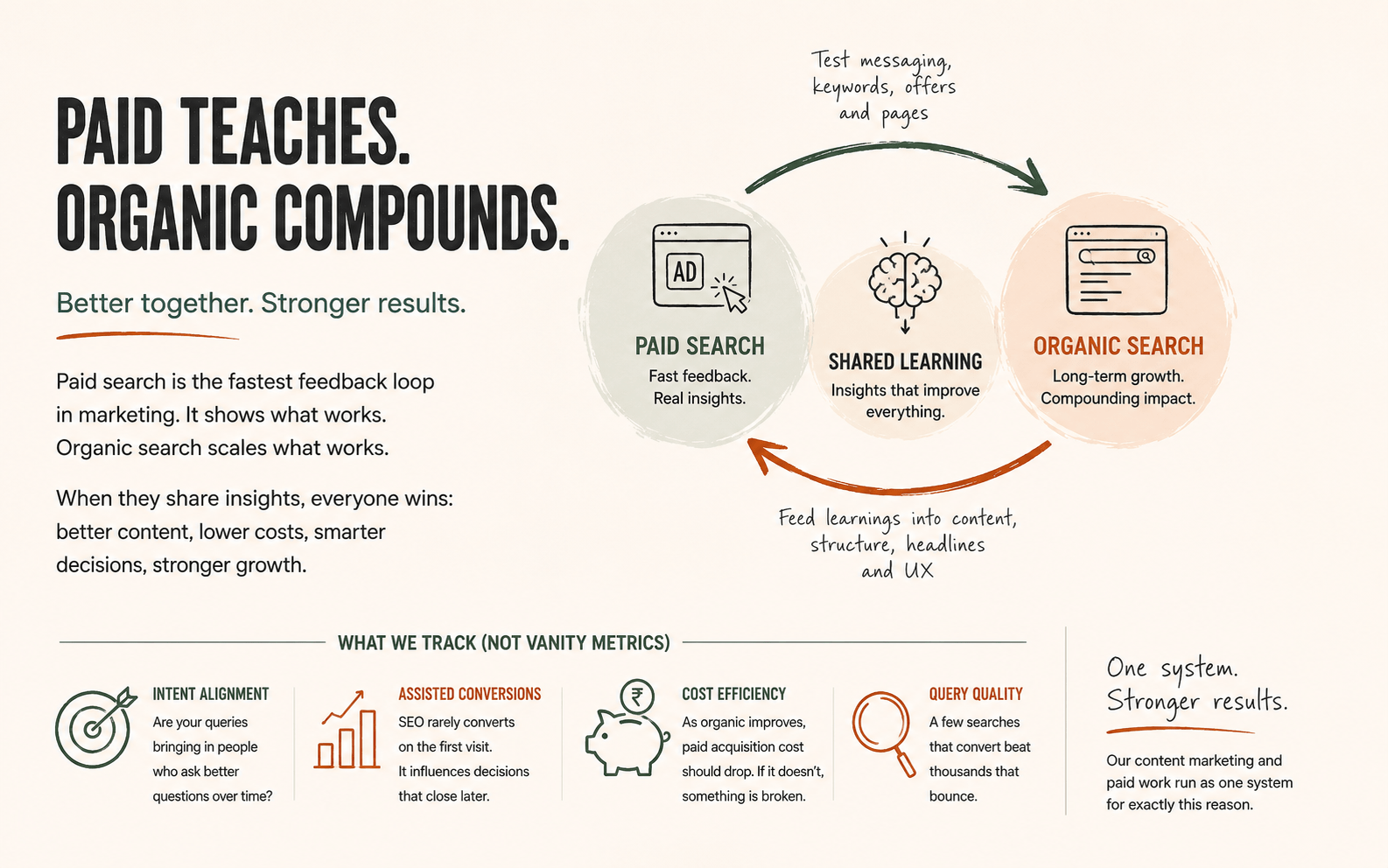
The teams that win are not choosing between organic and paid. They let one correct the other.
Paid search is the fastest feedback loop in marketing, and its best use is learning, not just leads. A campaign tells you which messaging converts, which keywords attract serious buyers, and where people hesitate before they act. Feed that back into your page structure, your headlines, and your decisions about content depth. When paid and organic share what they learn, quality scores rise, acquisition costs fall, and content iterates faster.
This also fixes how you measure. Traffic is not success. Clicks are not success. Even leads are not always success. What we track instead:
- Intent alignment. Are your queries bringing in people who ask better questions over time?
- Assisted conversions. SEO rarely converts on the first visit. It influences decisions that close later.
- Cost efficiency. As organic improves, paid acquisition cost should drop. If it does not, something is broken.
- Query quality. A few searches that convert beat thousands that bounce.
Our content marketing and paid work run as one system for exactly this reason.
What Stopped Working
Every core update reveals what Google quietly stopped rewarding. January made several old tactics noticeably weaker:
- Content written to mirror competitors rather than to answer a person directly
- Internal links stuffed with exact match anchors to push keywords instead of guiding readers
- FAQ sections bolted on for length, repeating the question without adding an answer
- Publish date changes with no real content change
- Templated service or city pages produced at scale with no unique local context
If any of these describe your current site, that is where to start, before you write anything new.
Maintenance Beats Publishing
Old content does not die. It decays, quietly, as Google reassesses intent relevance and competitive depth. After managing sites with hundreds of pages, this is the habit that produced the fastest gains for us: refresh your top performing pages on a schedule, update examples and context as they age, and realign headings to how people actually search now. Cosmetic edits do not count. Google is now good at telling a real improvement from a changed date.
Measure this the way Google now evaluates it, over time rather than day to day. The recent Search Console reporting changes make weekly and monthly comparison easier for a reason. Watch patterns, not daily ranking twitches, and track where your brand is being cited across AI answers alongside your traditional positions.

The Short Version
Search still works. It asks for more thought than it used to. Build fewer, deeper pages. Give each one a single job. Prove real experience. Structure your best answers so both Google and AI systems can lift them cleanly. Keep the technical base fast and clean. Then let paid search tell you quickly where you are wrong so organic can compound the parts you get right.
If your rankings have stalled since the recent updates, the cause is usually structural: a cluster problem, a technical gap, or a page trying to do too much. That is the conversation to have. Book an SEO review with The Subtext and we will show you where your visibility is leaking.
FAQs About White Hat SEO Strategies
What are white hat SEO strategies?
White hat SEO strategies are search engine optimization methods that follow search engine guidelines and focus on improving user experience. These strategies include creating high quality content, improving technical SEO, building topical authority, and earning backlinks naturally rather than manipulating rankings.
What is the difference between white hat SEO and black hat SEO?
White hat SEO focuses on sustainable long term growth by following search engine guidelines. Black hat SEO relies on manipulative tactics such as keyword stuffing, link schemes, and automated content generation. While black hat techniques may produce short term results, they often lead to penalties or ranking losses after algorithm updates.
Do white hat SEO strategies still work in 2026?
Yes. In fact, white hat SEO strategies are more effective than ever because modern search algorithms prioritise expertise, authority, and helpful content. Recent Google updates increasingly penalise manipulative tactics while rewarding websites that demonstrate genuine topical expertise.
How long does white hat SEO take to work?
White hat SEO strategies usually take three to six months to show significant improvements, depending on competition and website authority. However the results are typically more stable because they rely on sustainable signals such as content quality and topical authority.
What is the best small business SEO strategy?
The most effective small business SEO strategy is building authority around a very specific niche or audience. Instead of targeting broad keywords, businesses should focus on specialised queries that match their expertise and geographic location.
How do AI Overviews affect SEO?
AI Overviews summarise answers directly in search results, which can reduce organic click through rates. However pages that are cited inside AI Overviews often receive more traffic and higher authority signals, making citation optimisation an important part of modern SEO strategies