Local Business Search Engine Marketing: Why Surat Businesses Are Invisible on Google (And What to Do About It)
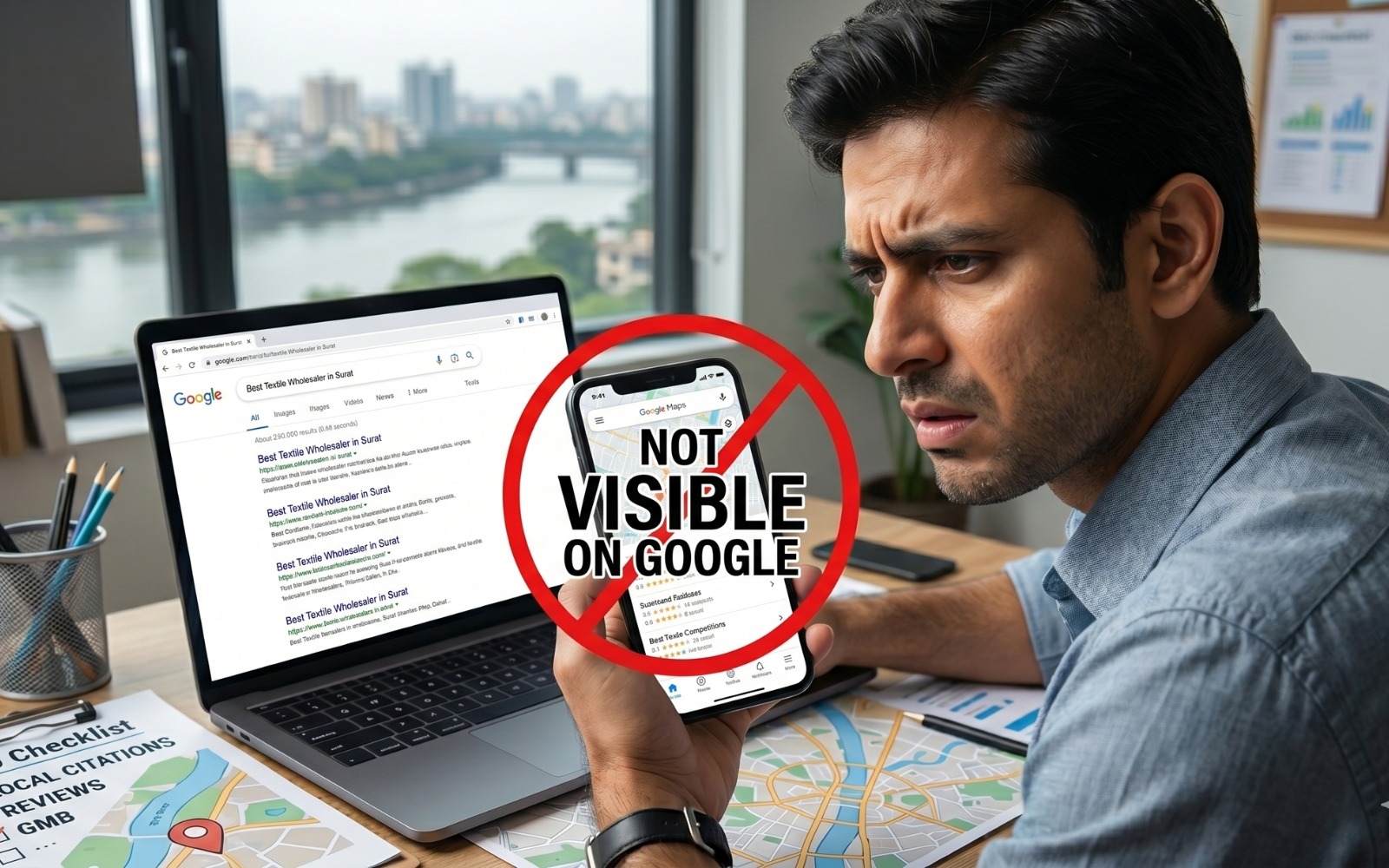
You run a solid business. Customers who find you are happy. You have been at it for years. But open Google right now and search for what you sell followed by ‘Surat.’ Chances are you are nowhere on that first page. Someone else is there. Maybe a competitor you know is smaller than you. Maybe a business that opened two years ago. Maybe a listing you have never even heard of.
That is a real problem. Because the person searching made their decision before they ever called anyone. Google decided who they saw and who they skipped.
The good news is that this is fixable. (At least, with The Subtext) Local business search engine marketing is specific work with a clear playbook. It is also work that most Surat businesses are either ignoring entirely or doing halfway. Which means the gap between where you are and where you could be on Google is smaller than you think.
What follows covers the Surat search landscape honestly, what Google actually needs to rank a local business, what businesses are consistently missing, and what the full picture of getting found online looks like today.
Surat’s Business Landscape and Why Google Treats It Differently
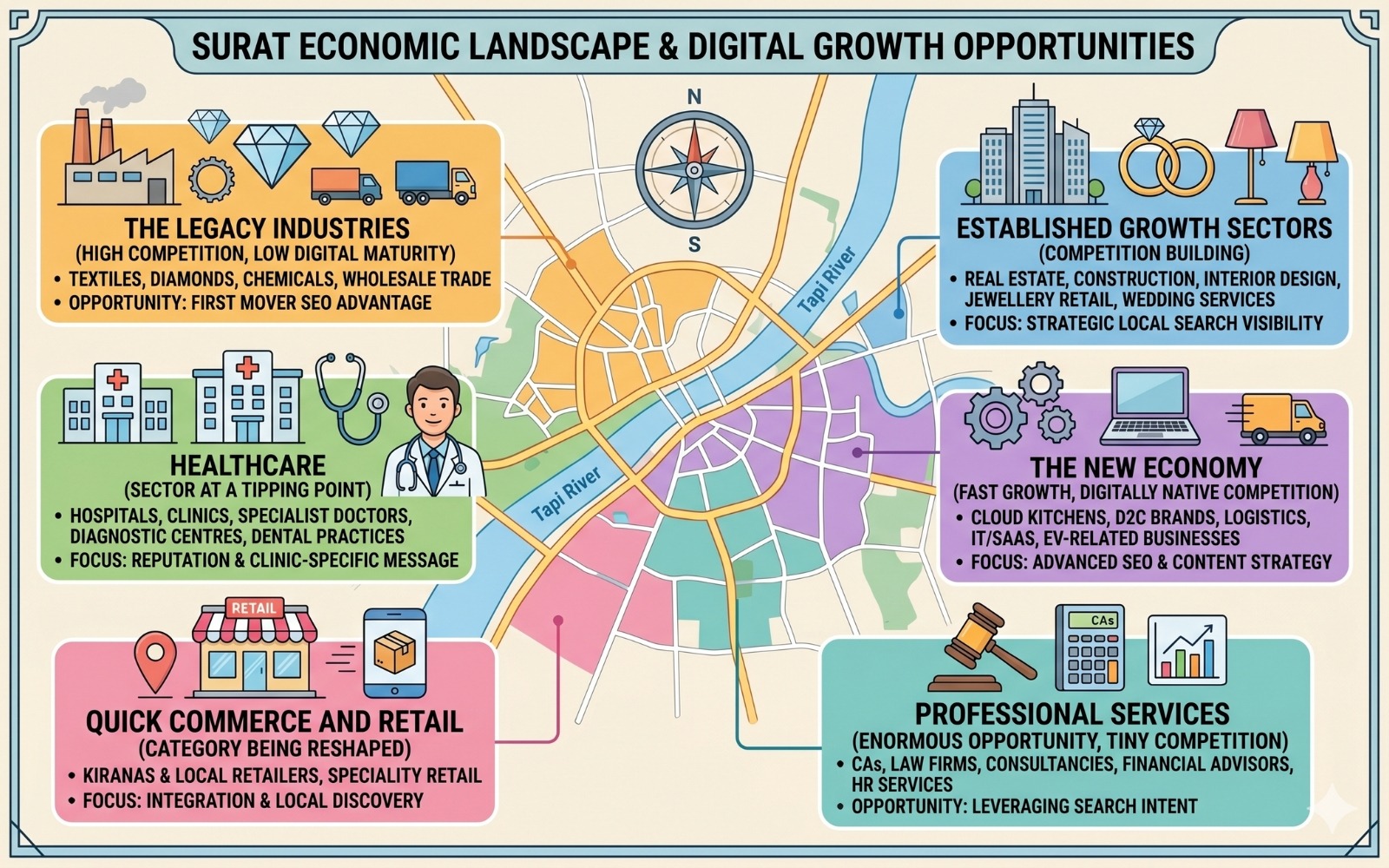
Surat is one of the most commercially active cities in India. The business ecosystem here spans industries that have been running for generations alongside sectors that barely existed five years ago. Google’s local search algorithm treats this density and variety in specific ways that most businesses in the city have never thought about.
Understanding which category your business falls into tells you a great deal about where the opportunity and the competition actually sits.
The Legacy Industries: High Competition, Low Digital Maturity
Textiles, diamonds, chemicals, and wholesale trade are the backbone of Surat’s economy and have been for decades. These industries are globally significant in terms of volume but almost entirely relationship-driven. Deals happen through personal networks, trade fairs, and longstanding associations.
What this creates on Google is an unusual situation. The search volume for these categories exists, buyers do search, but the businesses themselves have largely ignored digital marketing. Most textile or chemical wholesalers in Surat have either no website or a website that was built in 2015 and has been untouched since. Their Google Business Profiles, if claimed at all, have two photos and no reviews.
The opportunity here is disproportionate. A business in these verticals that invests properly in local SEO right now is competing against almost nobody. The first mover advantage in legacy industries is real and it is still available.
The Established Growth Sectors: Competition Is Building
Real estate, construction, interior design, jewellery retail, and wedding services have been growing steadily in Surat for years. These categories have more digital-savvy operators than the legacy industries, and competition on Google is noticeably higher.
Real estate in particular has become a genuinely contested space on local search. Builders and brokers in areas like Vesu, Pal, Adajan, and Dumas now actively compete for search visibility. If you are in this category and you have been telling yourself you will deal with SEO later, later has already arrived for your competitors.
Interior design and jewellery are similar. The businesses at the top of local search results in these categories have usually been working at it for two to three years. Getting in front of them requires a proper programme, but it is achievable within six to twelve months with the right approach.
The Professional Services Segment: Enormous Opportunity, Tiny Competition
Chartered accountants, law firms, consultancies, HR services, staffing agencies, and financial advisory firms in Surat are leaving enormous amounts of Google visibility on the table. The search intent exists. Business owners search for CA firms in Surat, compliance consultants, legal advice for businesses, and similar terms regularly. The supply of well-optimised businesses in these categories is thin.
Professional services firms tend to rely on referrals and resist online visibility for a mix of reasons, discretion about client work, uncertainty about what to publish, and unfamiliarity with how digital marketing works for their category. This hesitation is understandable but costly. The firms that are starting to invest in search visibility in this segment are building a significant lead over peers who are still waiting. A structured digital marketing strategy is often what separates the ones gaining ground from the ones watching it slip.
Healthcare: A Sector at a Tipping Point
Hospitals, clinics, specialist doctors, diagnostic centres, and dental practices in Surat are now actively searching for better online visibility. Patient behaviour shifted materially over the past four years. People search for doctors, read reviews, and check a clinic’s Google Business Profile before booking an appointment. A hospital with weak online presence loses patients to competitors before a single call is made. And that is why digital marketing for hospitals is rapidly gaining momentum.
The healthcare vertical in Surat requires a specific approach. Messaging needs to be visibility-focused rather than conversion-focused. Overpromising outcomes or using aggressive lead-generation language is both ethically problematic and a trust signal problem for educated patients. What works here is demonstrating genuine expertise, clear service information, and strong review management.
The New Economy: Fast Growth, Digitally Native Competition
Cloud kitchens, D2C brands, logistics startups, SaaS companies serving local businesses, IT services, digital agencies, EV-related businesses, and co-working spaces represent Surat’s new economy. These businesses understand digital better than legacy industries, which means competition on Google is sharper and the quality of SEO work required is higher.
For businesses in this category, local SEO is just the starting layer. Content strategy, topical authority, and brand search volume all matter alongside the standard local signals. A cloud kitchen that only optimises its Google Business Profile is playing a short game in a long game environment.
Quick Commerce and Retail: A Category Being Reshaped
Retail in Surat is navigating a complicated moment. Kiranas and local retailers are facing pressure from quick commerce platforms. At the same time, speciality retail in categories like home decor, apparel, and gourmet food is finding an audience that wants local and distinct. For these businesses, Google visibility, through quick commerce registration and such, is often the difference between a customer discovering them versus ordering from a platform instead.
Why Your Business Is Invisible on Google Right Now
Most businesses that are invisible on local search are missing several things simultaneously. Google ranks on the cumulative weight of signals, and a business that scores poorly across multiple factors sits at the bottom regardless of how good the product or service is.
No Claimed or Properly Optimised Google Business Profile
The Google Business Profile is the single most important asset for local search visibility. It powers the map pack results, the knowledge panel that appears when someone searches your business name, and local organic results. An unclaimed profile, an incomplete profile, or a profile with outdated information is as good as invisible.
Proper optimisation means every field completed, a description that uses natural language around your actual services and location, the correct primary and secondary categories, real photos of your premises and team, service listings with descriptions, and a consistent posting cadence. Most businesses in Surat have done one or two of these things, never all of them.
A Website Google Cannot Read Properly
If your website loads slowly on mobile, has pages that are thin on content, uses generic title tags, carries no local keywords in meaningful places, and has no schema markup telling Google what kind of business you are, Google has very little to work with. It cannot confidently rank you for searches because your site gives it minimal signal about what you do, where you do it, and who you serve.
Page speed is particularly important in India. Mobile data speeds vary significantly and Google indexes the mobile version of your site first. A website that takes six seconds to load on a 4G connection loses rankings and loses the visitor at the same time. If your site is on WordPress, there is a specific checklist of fixes that address exactly this, covered in detail in our guide on how to optimize a WordPress website for mobile.
No Reviews or a Stalled Review Profile
Review count, review recency, and how consistently a business responds to reviews are all ranking factors in local search. A business with eight reviews from 2022 and no responses is outranked by a competitor with forty recent reviews and an owner who replies to every one. Google treats an active review profile as a signal that the business is alive, relevant, and engaged with its customers.
Most Surat business owners do not have a system for generating reviews. They get a few organically and then forget about it. Meanwhile, more review-aware competitors accumulate steadily and the gap compounds over months.
Weak or No Backlink Profile
Backlinks are other websites linking to yours. They tell Google your site has credibility and authority. For local businesses, backlinks from Surat-specific directories, local news coverage, industry associations, trade portals like Indiamart or TradeIndia, and complementary local businesses all carry weight. Most Surat SMEs have almost no backlinks at all, which means Google has no external validation of their relevance or credibility.
Content That Does Not Exist
If your website has a home page and a contact page and nothing else, you are giving Google almost no surface area to rank. Every page on your website is a potential entry point from search. Service pages, location-specific pages, and informational content about topics your customers search for all expand how many searches can lead to your business.
The businesses sitting at the top of local search in most Surat categories have websites with multiple service pages, a regularly updated blog or article section, and location-specific content. They are producing content that answers the questions their customers are actually searching for. The businesses at the bottom have five pages that have not changed since 2019.
What Businesses Miss and What It Costs Them
These are the specific gaps we see most frequently when we look at Surat businesses. Each one has a real cost that is easy to underestimate because the lost revenue is invisible by definition.
Leaving the Map Pack to Competitors
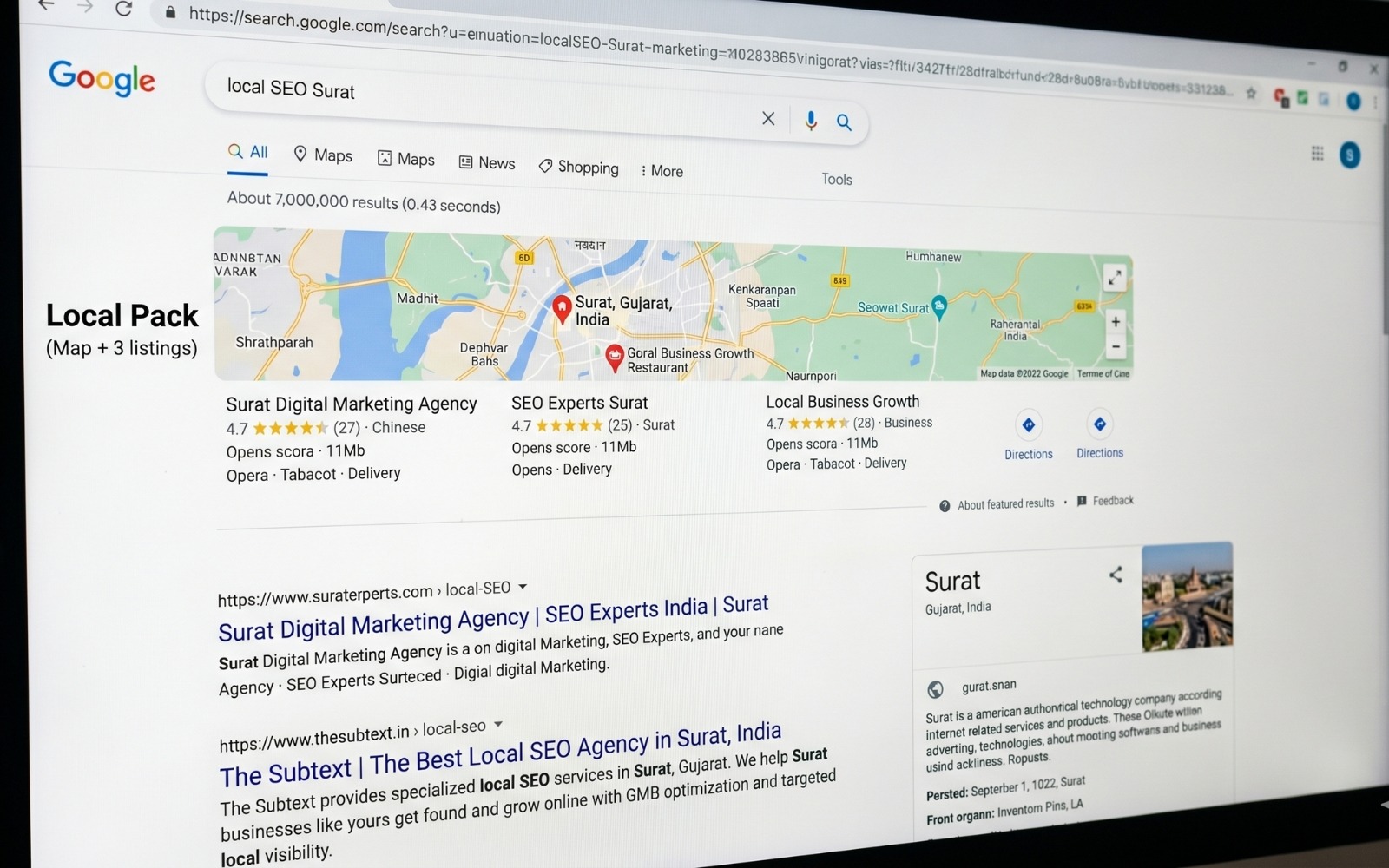
The three businesses that appear in Google’s local map pack for any given search term collect a disproportionate share of clicks and calls compared to everyone below them. Research from BrightLocal consistently shows that map pack results receive more clicks than any other section of the search results page for local queries.
Most businesses in Surat have never thought about what it would take to appear in that map pack for their primary service terms. That space is finite. There are only three positions. The businesses that are in it are there because they have done specific work to get there. The businesses that are out are funding their competitors’ growth without realising it.
Ignoring Voice Search and Conversational Queries
Search behaviour has shifted. A significant and growing proportion of searches are conversational, either typed as questions or spoken to Google Assistant. Queries like ‘best dermatologist near me,’ ‘CA who handles textile GST in Surat,’ or ‘affordable wedding caterer Vesu’ are common patterns. Businesses that have no content structured around how customers actually ask questions miss this traffic entirely.
Optimising for these query patterns does not require a separate strategy. It requires writing content in plain, direct language that answers the questions your customers ask, and structuring pages in a way that Google can easily read and surface in featured snippets and voice results.
Missing the Long-Tail Searches Where Buying Intent Is Highest
The most competitive keyword in your category, say ‘real estate agent Surat,’ is harder to rank for and is often searched by people at an early stage of their journey. The search ‘flat for sale in Vesu under 70 lakhs’ is searched by someone who is much closer to a decision. These longer, more specific queries are called long-tail keywords and they consistently convert at higher rates than broad terms.
Businesses that focus only on short, high-competition keywords miss the long-tail entirely. A proper keyword strategy identifies all the specific questions and search patterns your target customers use and builds content that answers each one. This is how smaller businesses rank and convert against larger competitors who are only fighting over the broad terms.
Zero Presence in AI-Powered Search Results
Google’s search results now regularly include AI-generated summaries at the top of the page. These summaries pull from websites that Google considers authoritative, well-structured, and clear in their expertise. If your business has thin content and weak authority signals, you are absent from this increasingly visible real estate on the search page.
Building presence in AI search results, sometimes called AEO or answer engine optimisation, requires the same foundational work as regular SEO but with additional attention to how content is structured, whether it directly answers specific questions, and whether your website signals genuine expertise on a given topic. Businesses that wait on this are handing the initiative to competitors who are already building it. For a fuller picture of how white hat SEO strategies are shifting to accommodate AI search, the detail is covered in that piece specifically.
No System for Converting Google Traffic Into Leads
Some businesses invest in SEO and get more website traffic but see no increase in enquiries. This is a conversion problem, and it is more common than it should be. A visitor who finds your website from a local search has high intent. They searched for your category in your city. If your website makes it hard to find your phone number, has no WhatsApp link, asks them to fill out a lengthy form, or gives them no reason to choose you over the next result, they leave and try someone else.
In Surat specifically, WhatsApp is how business communication happens. A clearly placed WhatsApp contact option on a mobile website converts local visitors at a significantly higher rate than any other contact method. This is a free optimisation that most businesses are still skipping.
What a Business Actually Needs to Do to Rank on Google
Ranking on Google for local searches is a multi-layer effort. Every layer matters and they work together. Doing three out of ten of these things produces marginal results. Doing all of them consistently produces compounding results over twelve to eighteen months.
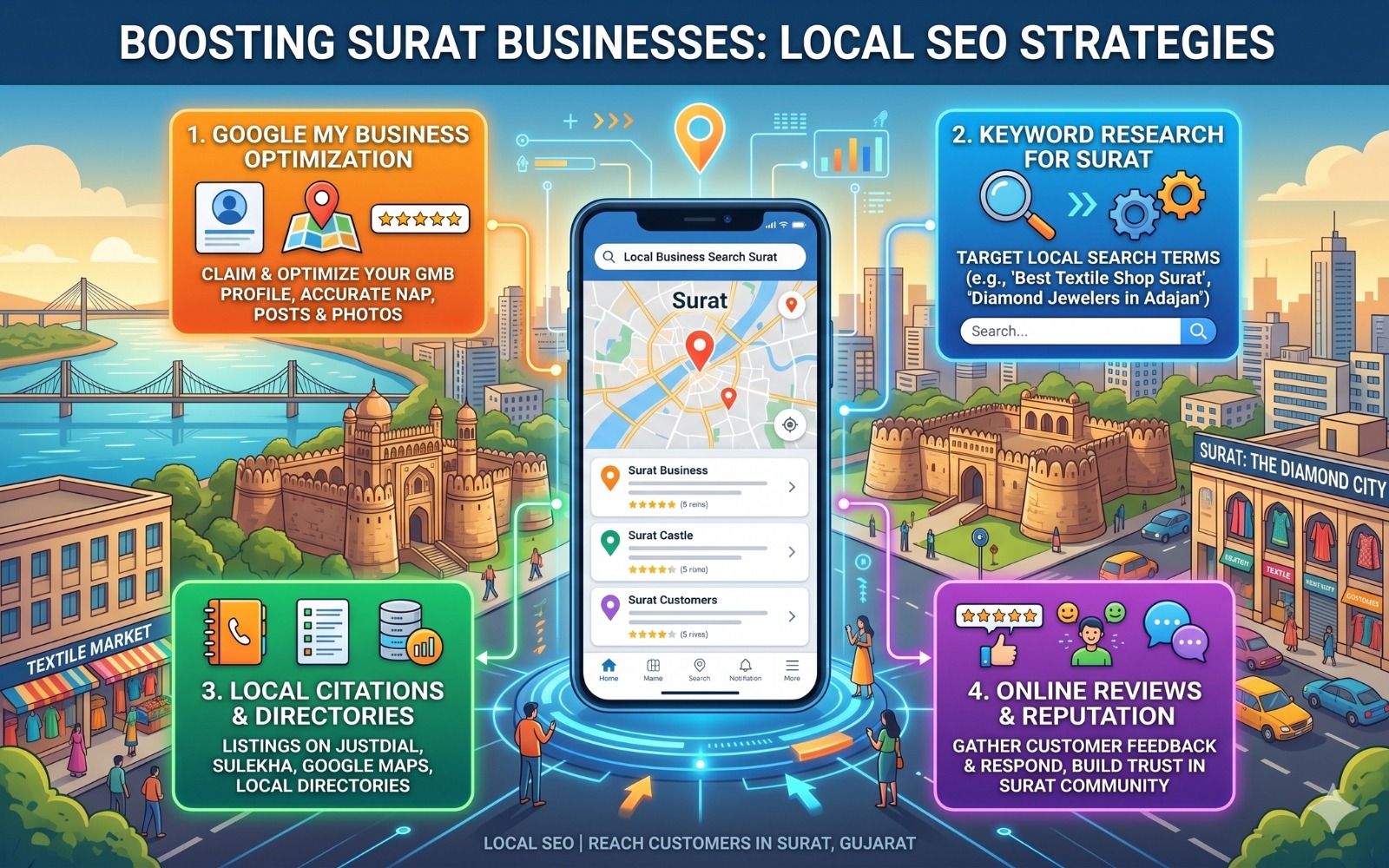
Layer 1: Google Business Profile (Non-Negotiable Foundation)
- Claim and verify your listing if you have not already done so
- Complete every field including business description, opening hours, and service areas
- Select the most specific and accurate primary category available
- Add secondary categories that reflect additional services
- Upload a minimum of ten real photos: exterior, interior, team, products or services in action
- List all services with descriptions and pricing where applicable
- Post an update, offer, or piece of useful information at least once a fortnight
- Answer every review, positive or negative, within 48 hours
- Monitor and manage the Q and A section so no incorrect information sits unanswered
Layer 2: Website Technical Health
- Ensure your site loads in under three seconds on mobile, test this using Google PageSpeed Insights
- Fix any pages returning errors or blocked from crawling
- Submit a sitemap to Google Search Console and verify there are no indexing issues
- Ensure your site is HTTPS
- Check that your business name, address, and phone number appear consistently in the footer of every page
- Implement LocalBusiness schema markup in JSON-LD format so Google can read your business data in structured form
Layer 3: On-Page SEO for Each Service Page
- Write a unique title tag for every page that includes your primary keyword and location
- Write a meta description that opens with what the page delivers and closes with a clear reason to click
- Use one clear H1 per page that matches what a local customer would search for
- Build body content that answers the specific questions your customers ask about that service
- Include your city and area naturally within the page content
- Add internal links from each page to related service pages and from blog content back to service pages
Layer 4: Citation Consistency Across Platforms
- List your business on Justdial, Sulekha, Indiamart, TradeIndia, and other relevant directories
- Ensure the exact same business name, address, and phone number appears across every listing
- Correct any outdated or inconsistent citations from previous addresses or phone numbers
- List on any industry-specific directories relevant to your category in India
Layer 5: Review Generation as an Ongoing System
- Set up a repeatable process to ask every satisfied customer for a review, WhatsApp message, QR code at billing, or a direct link
- Make it as easy as possible, a short link directly to your Google review form
- Aim for a minimum of two to four new reviews per month at the start
- Respond to every review in writing, even a simple acknowledgment adds signal
Layer 6: Content Strategy and Publication
- Identify the ten to fifteen most common questions your customers ask before buying
- Build a content plan that answers each question with a standalone page or article
- Write from direct experience, what you have seen in your own work, specific to your category and city
- Publish consistently, even one well-written piece per month compounds significantly over a year
- Update older content when circumstances change rather than letting it go stale
Layer 7: Local Link Building
- Submit to local Surat business directories and associations
- Seek mentions or features in local news sources like Divya Bhaskar online or Surat Mirror
- Partner with complementary local businesses for cross-referral mentions online
- If you are a member of trade bodies like the Southern Gujarat Chamber of Commerce, request a listing on their directory
- Document client work as case studies, these attract organic links over time
Layer 8: Measurement and Iteration
- Set up Google Search Console and review it monthly for ranking trends and indexing issues
- Set up Google Analytics or equivalent and track which pages drive contact actions
- Monitor your Google Business Profile insights for call volume and direction requests
- Review your local keyword rankings quarterly and adjust content focus based on what is moving
- Track competitor profile changes and content updates so you know when others are accelerating
Understanding how SEO and paid search work together as you build this up is important context. Our breakdown of SEO SEM best practices covers exactly how to sequence both so they reinforce each other rather than pulling in different directions.
EXPERT PERSPECTIVE
“Expertise is the currency of modern search. Google’s systems are increasingly built to surface content from people who have genuinely done the thing they are writing about, not people who have read about it.” — Lily Ray, VP of SEO Strategy and Research at Amsive — Search Engine Journal, 2024
This is exactly the standard we hold content to when working with clients. Every article, every service page, every piece of copy should sound like it was written by someone who does this work every day. Because in our case, it is.
How Long Does It Actually Take to Rank on Google?
A realistic answer depends on where you are starting, how competitive your category is in Surat, and how consistently the work is done. But here is an honest general picture:
Months One and Two: Building the Foundation
Google Business Profile claimed and fully optimised. Website technical issues identified and resolved. Citation audit completed with inconsistencies fixed. Schema markup implemented. Core service pages rewritten with proper SEO services. Review generation system set up and running. At the end of this phase, Google has significantly more signal to work with than it did before.
Months Three to Five: Building Authority and Content
First pieces of local content published. Backlinks acquired from directories and relevant sources. GBP posting cadence maintained consistently. Reviews accumulating steadily. Search Console data starting to show early movement on longer-tail keyword phrases. This is the phase where most businesses lose patience. Nothing dramatic is visible yet. The work is compounding below the surface.
Month Six and Beyond: Visible Results
Rankings for primary terms stabilise. The map pack starts appearing for a growing number of relevant searches. Inbound calls and direction requests from Google begin to increase. Search Console shows pages ranking in positions eleven to twenty shifting into the top ten. New keyword opportunities emerge from the data. This is when the investment becomes obvious in the numbers.
For highly competitive categories in Surat, real estate, healthcare, legal, the timeline extends and the required investment is deeper. For legacy industries and professional services where competition is sparse, results can come faster.
A Note on Surat’s B2B Economy
A substantial portion of Surat’s commercial activity is business-to-business. Textile suppliers selling to manufacturers, chemical companies selling to processors, logistics firms serving exporters, and IT services companies working with SMEs. B2B search behaviour is different from consumer search and requires a different strategy.
B2B buyers search more specifically, use industry terminology, and take longer to convert. The content required to rank and build trust in B2B categories is more technical and more detailed than what works for consumer-facing businesses. A generic service page is enough. Case studies, process documentation, industry-specific content, and a clear demonstration of working experience in the buyer’s industry all matter.
We work with B2B companies across Surat and Gujarat specifically on this type of programme. You can read more about how we approach B2B SEO and what a structured search visibility programme looks like for businesses that sell to other businesses.
How The Subtext Works With Surat Businesses
We are a boutique digital marketing agency in Surat, based in Vesu. We work with a deliberately selective group of clients, B2B companies, local businesses, D2C brands, and healthcare practices. We are specific about who we take on because we want to be able to move the needle, and that requires genuine focus.
When we start working with a local business, the first step is always an audit. Your Google Business Profile, your website’s technical health, your existing keyword positions, your citation landscape, and what competitors ranking above you have done that you have not. From there we build a programme that is specific to your category and your geography within Surat.
We are direct about timelines and honest about what is achievable in what period. We do not promise first-page rankings in thirty days. We also do not let clients sit in vague month-to-month retainers with no accountability. Every engagement has clear milestones and measurable targets.
If you want to understand what this kind of work costs before speaking to anyone, we have written a transparent breakdown of SEO pricing in India across different budget levels and service scopes.
You can see our full range of digital marketing services in Surat or go straight to our digital marketing agency page to understand how we work and what we focus on.
If any of what you have read here maps onto a problem you recognise in your own business, we are worth a conversation. Reach us at hello@thesubtext.in or call +91 95125 35512.

Five Things You Can Do Right Now Without Spending Anything
Before you engage anyone, run these checks yourself. They cost only time and will tell you more about your actual Google position than any generic audit report.
- Search for yourself: Open Google and search your primary service followed by ‘Surat.’ Scroll through the first page. Note who appears in the map pack and who appears in organic results. This is your competitive baseline.
- Check your Google Business Profile: Go to business.google.com. Is your listing claimed? Is every field complete? When was the last time you posted an update or received a review?
- Open your website on your phone: Does it load in under three seconds? Can you find your phone number and WhatsApp link within two seconds of landing? If the answer to either is no, you have a conversion problem waiting to happen.
- Count your reviews and when they arrived: Look at your Google reviews. How many do you have? How recent is the last one? Have you responded to all of them? A stalled review profile is actively hurting your local ranking.
- Check one competitor ranking above you: Click on a business appearing above you in local results. How many reviews do they have? How does their GBP look? How many pages does their website have? The answers tell you exactly what work they have done that you have not yet done.
These five checks give you a clear picture of the gap. Most business owners who do them come away ready to act. The businesses that act earliest hold an advantage that takes years for others to close.
One Last Thing
Google visibility is infrastructure for a modern business. In the same way a physical shopfront needs a signboard, a business in 2025 needs to be findable online. In Surat’s dense commercial environment, the businesses that figure this out first hold an advantage that is genuinely hard to overcome.
The majority of your local competitors have not figured it out yet. That gap is real. And it is still yours to close. And we can help. Reach out.
Frequently Asked Questions About Local Business Search Engine Marketing
How long does local SEO take to show results for a small business in India?
Local SEO typically takes three to six months to show meaningful results for a small business in India. The first two months focus on foundational work: Google Business Profile optimisation, technical fixes, and citation cleanup. Visible ranking improvements usually begin in months three to five, with consistent map pack presence and increased inbound calls appearing by month six.
What is local business search engine marketing and how is it different from regular SEO?
Local business search engine marketing is the process of optimising a business to appear in location-based Google searches, the local map pack, and Google Maps. It differs from regular SEO because it targets customers in a specific geographic area rather than national or global audiences. It relies on Google Business Profile signals, local citations, reviews, and location-specific content rather than domain authority alone.
How do I get my business on the first page of Google in Surat?
To get your business on the first page of Google in Surat, you need to claim and fully optimise your Google Business Profile, build consistent citations across directories like Justdial and Indiamart, generate regular customer reviews, ensure your website loads fast on mobile, and publish content that specifically answers the questions Surat customers search for. All eight layers need to work together.
Why is my business not showing up on Google Maps?
Your business may not be showing on Google Maps because your Google Business Profile is unclaimed, unverified, or incomplete. Other common reasons include inconsistent NAP information across directories, no recent reviews, a website with no local keywords or schema markup, and weak authority signals from missing backlinks. Each of these individually reduces your local visibility. Together they can make your listing invisible.
What is a Google Business Profile and why does it matter for local SEO?
A Google Business Profile is a free listing that controls how your business appears in Google Search, Google Maps, and the local map pack. It is the single most important asset for local SEO because it directly determines whether your business appears when someone nearby searches for what you sell. An incomplete or unmanaged profile means Google cannot confidently rank your business for local searches.
How many Google reviews does a business need to rank locally?
There is no fixed number of Google reviews required to rank locally, but review volume, recency, and owner response rate all influence your position. A business with 40 recent reviews that receives consistent new ones and responds to each will outrank a business with 100 old reviews and no responses. The pattern of activity matters more than the total count.
What does local SEO cost for a small business in Surat?
Local SEO for a small business in Surat typically ranges from Rs. 8,000 to Rs. 35,000 per month depending on how competitive your category is, how much work the website needs, and whether content creation is included. One-time setup work for a straightforward business can cost less. We have published a detailed breakdown of SEO pricing in India that covers different budget levels and what each includes.
What is the difference between local SEO and Google Ads for a local business?
Local SEO builds organic visibility over time and continues producing results without ongoing ad spend. Google Ads produce immediate visibility but stop the moment you stop paying. For most local businesses in Surat, the best approach is to use Google Ads to generate early traffic while SEO builds in the background, then reduce ad spend on terms where organic rankings are established.
How does Google decide which businesses appear in the local map pack?
Google determines map pack rankings based on three factors: relevance (how well your business matches what the person searched for), distance (how close your business is to the searcher), and prominence (how well-known and authoritative your business appears across the web). Prominence is influenced by reviews, backlinks, citation consistency, Google Business Profile completeness, and website quality.
Can a small business in Surat compete with larger companies on Google?
Yes. A small business in Surat can outrank larger companies in local search because local SEO rewards proximity, relevance, and profile activity rather than budget or company size. A smaller business with a fully optimised Google Business Profile, consistent reviews, strong local citations, and relevant content will consistently outrank a larger competitor that has ignored these signals.