Brand Identity Design Company for B2B and D2C Brands Across India
Somewhere between year one and wherever you are now, the brand got patchy. A logo version nobody can explain. Colours that shifted slightly depending on who made the asset. A pitch deck that looks like it belongs to a different company than the website. None of it is catastrophic on its own. Together, it tells a story you did not mean to tell. We build brand identity systems that fix that and hold up after we hand them over, which is the part most brand identity work gets wrong.
The Subtext is a boutique digital marketing agency in Surat that has worked on brand identity design across B2B services companies, D2C product brands, and businesses rebuilding an identity that grew without a plan. Strategy first. Design with intention. A system your team can use without calling us every time a new asset needs to be made.
Our team has worked across more than 40 branding and visual identity projects, with clients spanning manufacturing, professional services, ecommerce, and consumer goods. The patterns we describe on this page are things we have seen directly, not read about.
The Impression Lands Before Anyone Has Read a Word
There is a specific kind of brand problem that builds quietly. Nobody flags it internally because everyone has just got used to it. The visiting card has one version of the logo. The website has another. The Instagram bio has a hex colour that is close to the brand colour but not quite. The person who made the pitch deck last quarter used a font that felt right to them. Add it up and the brand reads as a company that has been too busy growing to think about how it looks. Which may be true. The expensive part is that prospects notice it before they say anything about it.
This is a conversion problem as much as an aesthetic one. In the B2B digital marketing work we do, a fragmented visual identity creates doubt at exactly the moment a prospect is deciding whether to go further. It does not kill the deal loudly. It just makes the other option feel safer.
What a Brand Identity Design Package from The Subtext Includes
Every project is scoped to what the brand actually needs. No fixed packages that include things you will never use and leave out the things you will ask about in month two. The core of every identity system we build covers:
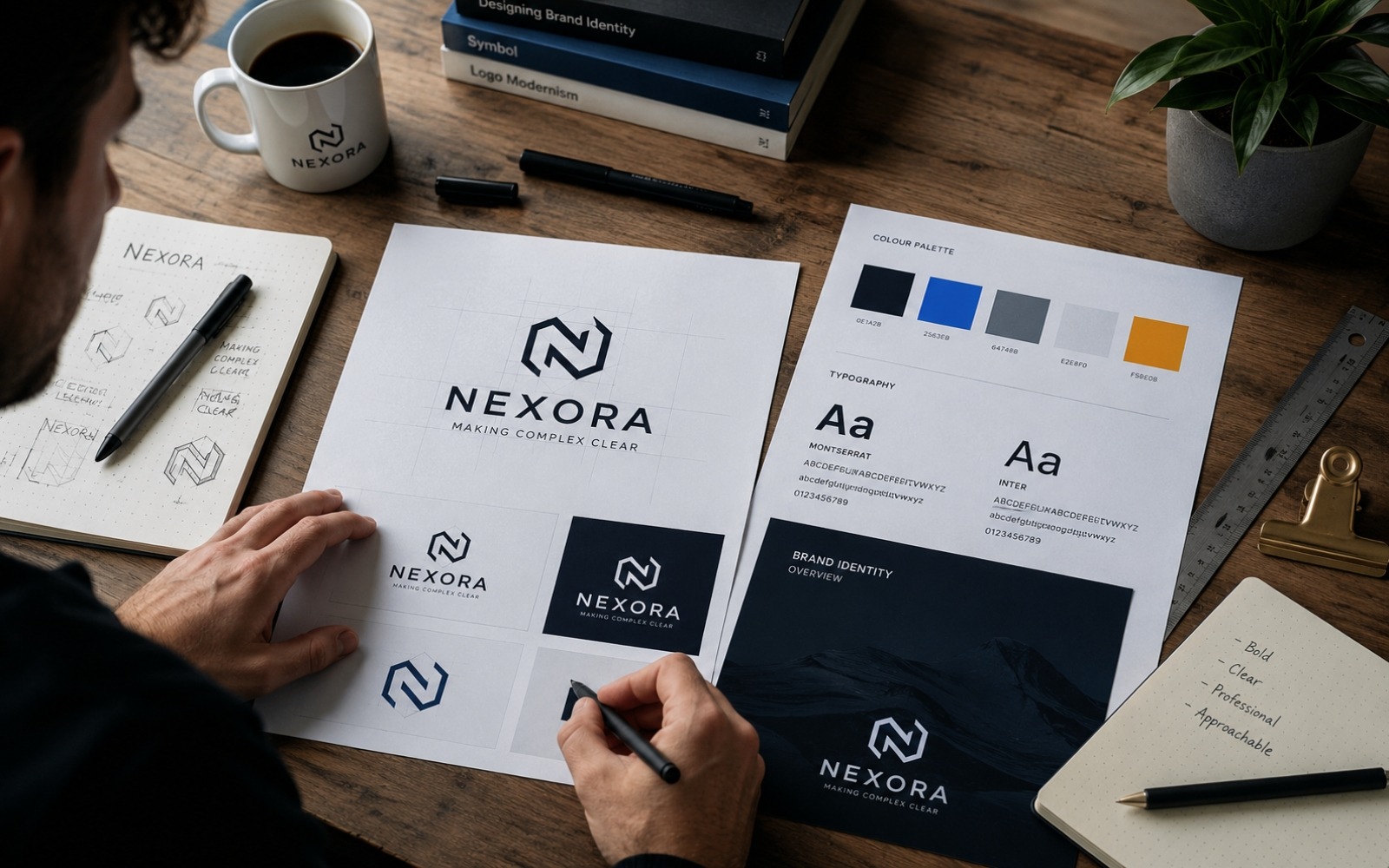
- Logo system — primary mark, alternate orientations, icon-only version, monochrome variants. Tested at every size and on every background type. What makes a logo hold up over time is a different question from what makes it look good in a presentation mockup, and we treat them separately.
- Colour palette — primary and secondary colours, with documented usage rules. Not just hex codes sitting in a PDF. Which colour is for CTAs, which is for backgrounds, which is reserved for emphasis, and why each decision was made so the next person can follow the logic.
- Typography system — brand fonts for headings, body, captions, and supporting text. Pairing rationale included. Typography is the most underestimated signal in brand identity. It tells people whether you are a premium business or a budget one before they have processed a single word.
- Visual language — iconography direction, photography or illustration style, layout principles. The parts most brand identity packages leave entirely undocumented. Also the first things your next designer or vendor will ask about.
- Brand guidelines — practical and usable. Do-and-do-not comparisons built from real examples in your brand. Written for the marketing manager making a social post on a Tuesday, not just the designer who onboards once a year.
Who We Build Brand Identities For
B2B Companies
A prospect has already looked at your website, your LinkedIn, maybe your credentials deck before they agree to a call. If those touchpoints look inconsistent or underdeveloped, the doubt is quiet but it is there. And in B2B, where sales cycles are longer and every touchpoint counts for more, quiet doubt is expensive. Corporate identity design — proposals, pitch decks, email signatures — does active selling in B2B contexts. We design brand identity systems with those formal applications in mind from day one, because a brand that looks sharp on a homepage but falls apart on a printed proposal has only done half the job.
D2C and Product Brands
Two products that are functionally similar can have completely different conversion rates based almost entirely on how the brand presents. Packaging, product photography, social templates. When those elements feel like they belong to three slightly different brands, customers sense it even when they cannot name why. The way branding and social media work together in D2C means visual consistency is not a nice-to-have at any serious scale. It is the thing separating a product from a brand.
Businesses Launching or Rebranding
Whether starting from scratch or fixing a brand that has grown without a plan, the end goal is the same. Something that holds up across channels, reads as one company, and gives the team a clear reference instead of a decision to make from scratch every time a new asset is needed. If you are thinking through the broader shape of what a brand strategy involves before getting into identity design specifically, that is a useful starting point. We’ve worked on both ends, and the rebrands are usually more interesting because there’s an actual problem to solve.
Two Situations We Have Worked Through
The B2B Rebrand That a Pitch Exposed
Four years into operating, a B2B services company had a solid client base and a steady referral pipeline. They started pitching a larger tier of client and were asked, midway through an evaluation, for a company credentials document. When the team sat down to put it together, they found three different versions of the logo in circulation across various folders and email chains. No documented colour palette anywhere. Presentation templates that shared no visual language with the website.
The prospect did not mention any of it. They went with a different firm. The company is not certain that was the reason. But it was the moment they decided to stop putting the brand work off.
We built a complete brand identity system and corporate identity set: logo system, colour and typography documentation, pitch deck template, email signature standards, and a brand guidelines document clear enough to hand to an external vendor without a briefing call. The credentials deck they built using the new system was the first time everything across their business looked like it came from the same place. More practically, they stopped losing time on every new asset because the decisions had already been made.
Outcome Consistent brand across all sales touchpoints. Pitch decks that matched the website for the first time. Reduced back-and-forth with vendors and freelancers on every new asset.
The D2C Brand That Had Outgrown Its Logo
Two years in, a D2C product brand had grown faster than expected. The original logo was done early, quickly, by a freelancer who did a competent job for a brand that did not yet know what it was. By the time they came to us, they had good product photography, a decent Instagram following, and packaging that looked like it belonged to a completely different company than the website, which looked different again from the social templates the in-house team was building in Canva every week.
Before any design work started, we ran a category audit. What it showed was that the visual language the brand had drifted into over two years was nearly identical to three of their direct competitors. Same earthy tones, same sans-serif minimalism, same general mood. Nothing was wrong with it exactly. It just made the brand invisible in a feed scan.
The brand identity we built was deliberately distinct from that convention. Logo, colour, typography, photography direction, social media templates — every element designed to work together and to stand out in the specific context where the brand needed to perform. The in-house team had templates they could use without going off-brand, which sounds minor until you have watched what happens to a brand when the team does not have them.
Outcome Unified visual identity across packaging, website, and social. A distinct visual language in a crowded category. Templates the in-house team could use without producing off-brand assets.
How We Work
Strategy before design
The first question is never what do you want it to look like. It is what does everyone else in your category look like, and where is the space. Most industries have a visual convention that nearly every brand in the space follows without examining it. Following it makes you legible to the category. Breaking it deliberately, after actually understanding it, is what makes you distinct. That audit happens before we open a single design file.
Built for real contexts and not presentation mockups
A logo that looks confident on a white background in a Behance case study can fall apart completely at 48 pixels in a WhatsApp message, or on a printed banner with a dark background. We test across the contexts your brand will actually appear in: website, pitch deck, social templates, printed collateral, email signature. And if marketing writing or paid campaigns are in the plan, the identity is built to hold up there too.
Guidelines your non-designers will actually follow
Most brand guidelines documents are thorough on logo clearspace and useless on the decisions that actually come up day to day. The colour usage rules. How the typography sits on a dark background. What the brand voice sounds like in a caption. We build for the person in your team who is making a social post on short notice, not just the designer who touches the brand files twice a year.
Brand Identity Design Package: What to Expect at Each Level
Brand identity design pricing in India varies widely depending on the scope of work, the seniority of who is doing it, and whether you are getting a logo or a full system. Understanding what sits at each level helps you figure out what your business actually needs before you talk to anyone.
Starter Logo and Basic Identity
Industry range: Rs. 15,000 to Rs. 40,000
What you typically get: a primary logo, one or two colour options, basic font guidance, and files for digital use. Suitable for very early stage businesses or sole proprietors who need something presentable quickly. The tradeoff is that it is usually a logo, not a system. Most businesses in this range find themselves redoing the work within two years as the brand grows.
Mid-Tier Brand Identity Package
Industry range: Rs. 50,000 to Rs. 1,50,000
What you typically get: a complete logo system, colour palette with usage rules, typography system, basic brand guidelines, and a set of brand assets for digital use. This is where most growth-stage B2B companies and D2C brands start. The quality varies considerably in this range, specifically on whether the guidelines are genuinely usable or just a formatted PDF that nobody references.
Full Brand Identity System
Industry range: Rs. 1,50,000 to Rs. 4,00,000+
What you typically get: everything in the mid-tier package plus corporate identity applications (letterheads, business cards, email signatures, pitch deck template), extended visual language documentation, social media templates, and a brand guidelines document built for real-world use across multiple teams. This is the scope for businesses pitching at a senior level, rebranding an established company, or launching a D2C brand that needs to compete visually from day one.
Where The Subtext sits in this: we work with growth-stage businesses and established companies, typically at the mid-tier to full system scope. The project brief we put together tells you exactly what is included before any work starts.
Build a Brand That Looks Like One Company, Everywhere It Appears
Launching, repositioning, or fixing a brand that has drifted. The starting point is the same: a conversation where we look at where the brand actually is and what it needs. We work with a select number of clients at a time. Get in touch and we’ll tell you honestly whether brand identity work is the right next step or whether something else should come first.
Questions Clients Ask Us Before Starting
What does a brand identity design package include?
Logo system, colour palette, typography, and brand guidelines at minimum. Depending on scope: iconography, photography direction, social media templates, pitch deck template, corporate identity set. We scope based on where your brand actually needs to perform, not a fixed package that looks comprehensive on paper.
How is a brand identity design company different from a freelance designer?
A freelancer can produce a good logo. That’s genuinely useful. What they don’t usually deliver is the system around it: the usage documentation, the real-context testing, the guidelines that let your team make consistent decisions without asking anyone. That’s the part that determines whether the brand still looks like itself in eighteen months.
We already have a logo. Do we need the full system?
Depends entirely on what exists around it. If you have documented palettes, typography rules, and usage guidelines your team actually references, maybe not. If brand decisions are being made from memory or inconsistently across channels, the logo alone is not solving the problem.
How long does a brand identity project take?
Four to eight weeks for most projects. The strategy and discovery phase takes the longest and is the part that determines whether the brand holds up later. Compressing it to save time usually shows up as a problem around the six-month mark.
Do you only work with businesses in Surat?
We work with B2B companies and D2C brands across India. Surat is our base. The work is entirely remote-compatible.
Can we add marketing or content work after the brand identity is built?
Yes, and it’s a natural sequence. Several clients move into social media marketing, content and marketing writing, or broader digital marketing once the identity is in place. The brand gives everything downstream something to build on. Without it, you’re producing content for a brand that hasn’t decided what it is yet.
What is the difference between brand identity and corporate identity?
Brand identity is the full system: how the business looks, feels, and communicates across every channel. Corporate identity is a specific layer within it: letterheads, business cards, proposals, email signatures, official documents. For B2B companies pitching larger clients, that layer matters enormously. We design both within the same project scope because separating them creates exactly the kind of inconsistency the whole exercise is meant to fix.
How much does brand identity design cost in India?
At the starter end, logo-only work from freelancers runs from Rs. 15,000 to Rs. 40,000. A proper mid-tier brand identity package from a specialist agency sits between Rs. 50,000 and Rs. 1,50,000. A full brand identity system including corporate identity applications, templates, and comprehensive guidelines typically ranges from Rs. 1,50,000 to Rs. 4,00,000 or more depending on the scope and the number of applications. The pricing section above breaks this down in more detail.
Brands That Just Look Better.