Content Writing Tips That Work Right Now (The Rules Just Changed)
Why your blog that worked in January might be invisible today and what to do about it
Here’s what nobody tells you about writing content right now: the rules didn’t just shift. They inverted.
Charlie Munger famously said, “Invert, always invert.” He meant: if you want to solve a problem, first figure out what would make it worse… then don’t do that. Apply that to content writing today and you get an uncomfortable answer. Most content being published right now is precisely what makes ranking worse.
For years, good SEO writing meant covering a topic comprehensively, hitting your keywords, staying consistent, building internal links. That playbook worked. A lot of us built real traffic on it.
Then came AI tools. Accessible, fast, and genuinely impressive and the internet promptly used them to flood Google with content that, in many cases, the writer hadn’t even fully read before hitting publish. Not exaggerating. Entire content operations spun up around generating, formatting, and uploading with “editing” meaning a quick skim and a title tweak.
The result? Google’s index started filling with pages that were technically correct but had nothing to say. Thousands of articles covering the same ground, in the same order, with the same subheadings, just slightly reworded.
Google’s first major core update of 2026 was, in many ways, the bill coming due for that.

First, Understand What Actually Changed
Before any content writing tip makes sense, you need to understand one thing: Google now evaluates Information Gain as a primary ranking signal.
Information Gain isn’t about length, structure, or keyword density. It’s about whether your page adds something genuinely new compared to everything that already ranks for the same query. Google essentially asks: “Does this page say something the other 10 results don’t?”
If the answer is no, if you’re rephrasing, summarising, or recombining what’s already out there, you’re losing ground. And given how much AI-generated content looks exactly like that, a lot of sites are losing ground right now.
Here’s what else the March 2026 core update changed, quickly:
- AI content isn’t penalised. Hollow content is. Sites using AI as a drafting tool with real human input and original examples held or gained rankings. Sites using AI to mass-produce generic coverage dropped hard.
- E-E-A-T signals carry measurably more weight. Pages with verifiable author credentials rose from ~58% to ~72% of top-ranking results in the weeks following the update.
- Google now satisfies the “next question” too. Matching search intent means covering what a user would logically ask after their initial query and not just the query they typed.
- AI Overviews are now as important as rank position. Being cited in Google’s AI-generated response matters as much as sitting at position 1. Original, authoritative content gets cited. Thin summaries get excluded.
Now these content writing tips will actually make sense.
Content Writing Tips That Actually Work Now
- Add something that doesn’t exist anywhere else.
This is the most important content writing tip right now and also the hardest. Before you write, ask: what can I say that the top 10 results can’t? That could be:
- Your actual client data or real numbers from work you’ve done
- A case study built from your own experience
- A counterintuitive finding you’ve tested and verified
- A perspective forged from working deep inside one industry
If you can’t answer this question, you’re not ready to write the piece yet. Close the doc. Go get the experience first.
(This blog is written from a practitioner’s perspective and is definitely not a recombination of advice already ranking. That’s intentional. It’s practicing tip #1.)
- Answer the next question before they ask it.
Google’s intent matching is now sophisticated enough to know that someone searching “content writing tips” is also probably wondering whether their old content needs updating, whether AI can write for them, and whether length still matters.
Cover those angles inside your piece. Don’t save them for a separate post. This is what Google means by “fully satisfying” a query and it’s what keeps people on the page long enough to matter.
- Make your authorship real and visible.
Verifiable author credentials are now a measurable ranking signal. Not a byline that says “by Admin.” A bio that tells the reader (and Google) who is speaking and why they would know.
If you’re writing for a brand, this means attaching a real person’s name, role, and relevant experience to the content. Even a single line moves the needle: “Written by [Name], who has managed content strategy for [industry] clients since [year].”
- Write modularly. Meaning: every H2 should stand alone.
AI Overviews pull excerpts, not full pages. If your H2 sections can’t be understood without the surrounding paragraphs for context, they won’t get cited. Write each section as if it could be read independently and still be useful.
Short intro. Clear point. Evidence or example. Done.
(You’ve been reading this blog that way the whole time.)
- Cut the recap. Add the experience.
The average blog in 2025 spent its first 200 words establishing why the topic matters. Start with the insight. Trust your reader to have come because they already care.
The experience part matters more than the explanation. A sentence like “running campaigns for B2B textile brands, we found that intent shifts dramatically by quarter” is more valuable and more rankable than a paragraph defining what buyer intent is.
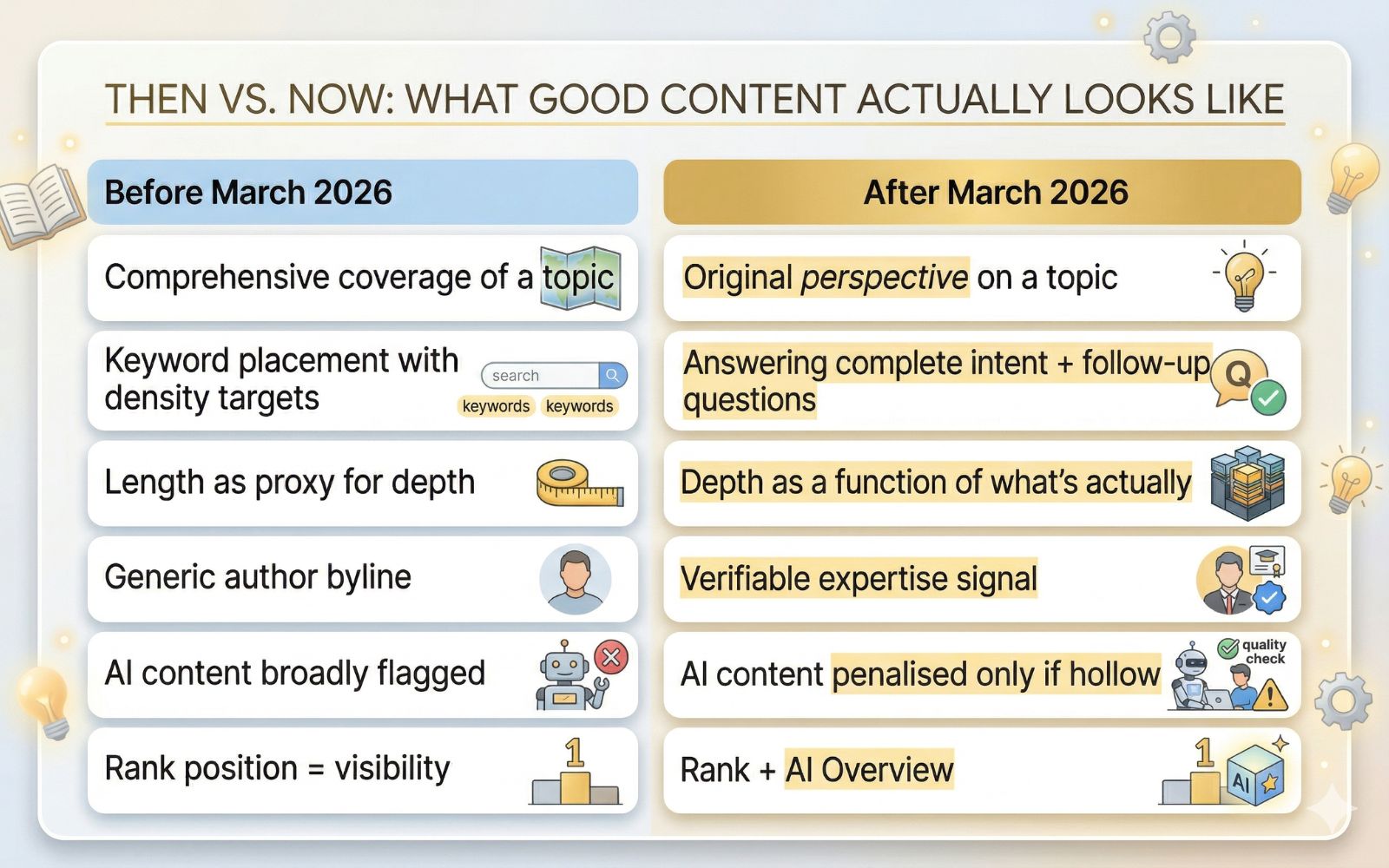
Then vs. Now: What Good Content Actually Looks Like
Before March 2026 | After March 2026 |
Comprehensive coverage of a topic | Original perspective on a topic |
Keyword placement with density targets | Answering complete intent + follow-up questions |
Length as a proxy for depth | Depth as a function of what’s actually added |
Generic author byline | Verifiable expertise signal |
AI content flagged broadly | AI-assisted content penalised only if hollow |
Rank position = visibility | Rank + AI Overview citation = real visibility |
You’re Probably Asking These Too
How has content writing strategy changed after the March 2026 core update?
Content writing strategy has shifted from comprehensive topic coverage to original perspective and information gain. Google now rewards pages that add something new, such as real data, first-hand experience, or a distinct point of view, over pages that rephrase what already ranks.
What are the core principles for content writing after the next major search engine update?
The core principles are: demonstrate real experience, add information that doesn’t already exist in search results, answer the user’s next question before they ask it, and write for a specific competent reader rather than a generic beginner audience.
Which content management tools are best for adapting to post-March 2026 SEO changes?
Tools that help with topical authority mapping (like Semrush or Ahrefs), content pruning (Screaming Frog, Google Search Console), and on-page depth analysis (Surfer SEO, NeuronWriter) are most relevant right now. The tool matters less than knowing what signal you’re optimising for.
How will content quality be measured by search engines in the near future?
Search engines are moving toward measuring information gain, authorship credibility, and full intent satisfaction (not just keyword match or word count). Expect E-E-A-T signals, structured authorship, and original insights to carry increasing weight with each future update.
Are AI writing assistants still useful for content after the March 2026 core update?
Yes, but as drafting and research tools, not as finished-content generators. AI-assisted content that includes original human insight, verified facts, and a clear author perspective still ranks well. AI content published without review or added value is what’s getting penalised.
Best practices for creating helpful content that ranks well post-algorithm change?
Start with a genuinely original angle, write modularly so each section stands alone, add verifiable author credentials, answer follow-up questions inside the same piece, and prioritise satisfaction over length. Content that leaves a reader with nothing left to wonder performs best.
Where can I find expert agencies specialising in content writing after the 2026 core update?
Look for digital marketing agencies that lead with strategy before output, those that audit existing content, build topical authority plans, and produce content attributed to real authors with demonstrable expertise. Volume-first agencies are the wrong fit for the current search environment.
What is the impact of algorithm changes on long-form articles?
Long-form articles aren’t penalised. Empty long-form articles are. Posts above 1,500 words that lack original insight, clear structure, or genuine depth are losing rankings. Length only helps when every section earns its place and adds something the reader couldn’t find elsewhere.
How to rewrite existing website content to comply with the March 2026 core update?
Audit for pages with thin or duplicate information, update them with first-hand examples or original data, add a named author with a relevant bio, restructure H2s to answer complete questions independently, and remove or consolidate content that adds no new value to your domain.
New guidelines for demonstrating expertise and authority in content for future SEO?
Attach named authors with verifiable credentials to every piece, cite original sources or internal data, write from lived industry experience rather than summarised research, and build topical depth on a focused subject area. Authority is earned through specificity, not volume.

The Rules Are Still Settling, But Some Things Are Certain
The effects of this update are still unfolding. Sites are recovering, others are still sliding, and Google itself hasn’t fully finished rolling it out. In SEO, certainty is always the most recent thing to arrive and the first to leave.
But here’s the part that isn’t changing: Google has always wanted to reward content that proves something, not just says something. So the basic SEO- SEM best practices still apply.
Saying “short-form content drives better engagement” is a claim.
Saying “we tested short-form against long-form for a fashion brand over 90 days and found 3x more time-on-page from posts under 700 words with a strong single opinion” is proof.
Every update Google has released in the last five years.. helpful content, E-E-A-T, spam policies, and now this.. has been an attempt to get better at finding the second kind of page and burying the first.
The irony? The flood of AI content didn’t create a new problem. It just made the old problem impossible to ignore.
Write accordingly.
One More Thing
This blog was written by the team at The Subtext, a content and strategy focused digital marketing agency based in India. Everything we’ve recommended here is how we actually work.
If your content has been underperforming and you’re not sure why, or you just don’t have the time to go deep on strategy while running a business, that’s exactly the kind of thing we help with.