The Real ROI of Social Media Marketing for Hospitals
Social media marketing for hospitals is already influencing your patients before they ever call your front desk. A study published in the National Medical Journal of India found that 70.4% of hospital OPD patients made healthcare decisions based on social media content. A separate global analysis found that 63% of patients chose one provider over another because of a stronger online presence, and that social media was the primary influence in 41% of all hospital selection decisions. These are patients who were already going to see a doctor. The question was only which hospital they would walk into.
And yet most hospitals in India are watching this shift happen from the sidelines. Either they tried social media once, saw nothing, and moved on. Or they are running accounts that look active on paper but are doing absolutely nothing to influence patient decisions. Posting on National Doctor’s Day is not a social media strategy.
The hospitals gaining ground on social media right now are doing a small number of specific things differently. The ones falling behind are making the same four mistakes on repeat, usually with a rotating cast of agencies who do not understand what it actually takes to build trust in a healthcare context. What follows is a direct account of what those mistakes are, what the alternative looks like, and how to tell the difference between social media activity and social media that actually works.
Why Your Hospital’s Social Media Delivered Nothing the First Time
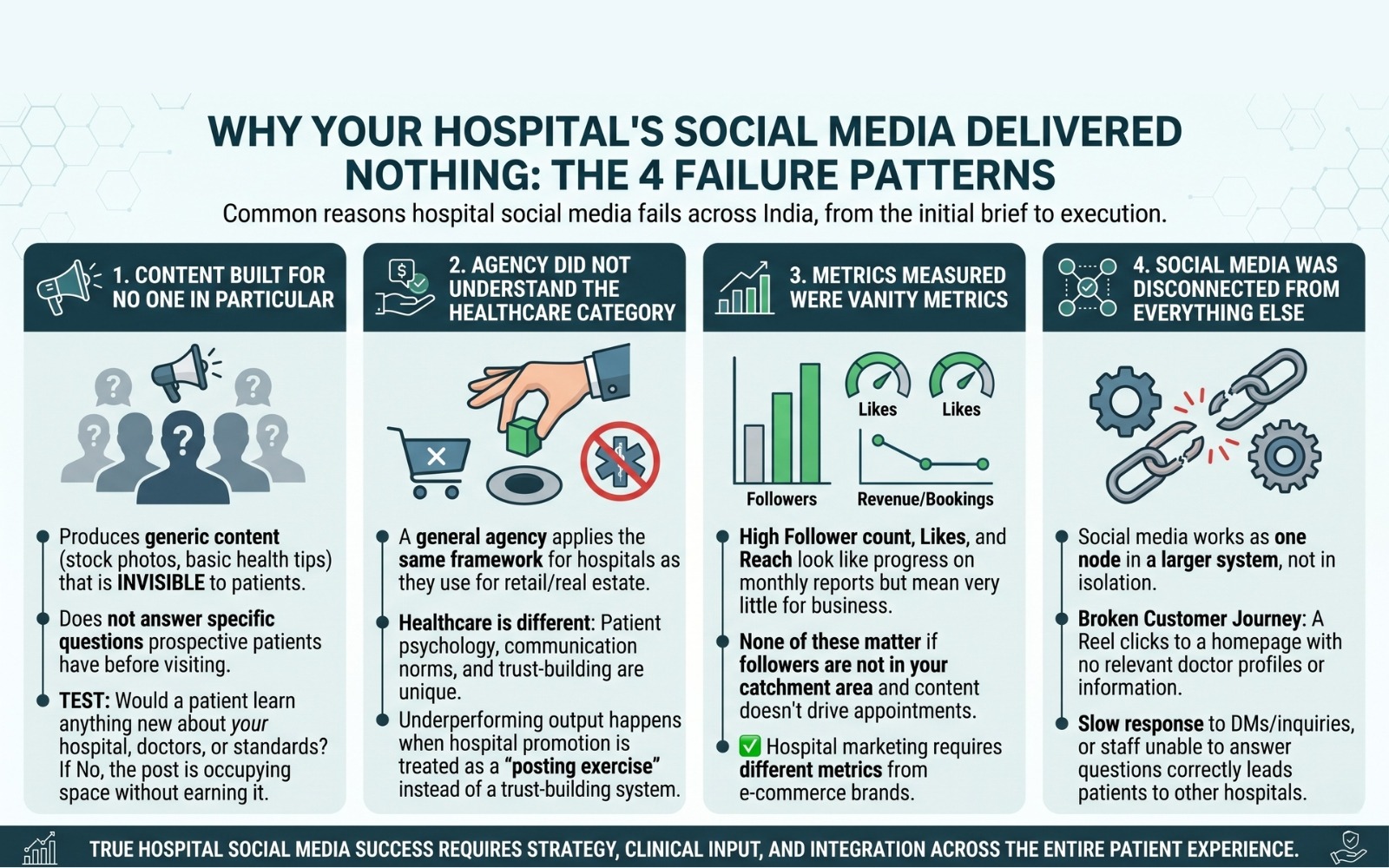
Most hospital social media fails for reasons that have nothing to do with the platform. It has everything to do with the brief. Here are the four failure patterns that repeat themselves across Indian hospitals regardless of size, city, or specialty.
Failure Pattern 1: The Content Was Built for No One in Particular
There is a recognisable genre of hospital social media content. A stock photo of a smiling doctor. A caption that reads “your health is our priority.” A World Heart Day graphic. A post about the importance of drinking water.
This content is produced in bulk because it requires nothing: no clinical input, no strategic thinking, no real understanding of what patients are anxious about before they walk through your door. It is also invisible This is not content writing in marketing. It does not tell a prospective patient anything specific about your hospital, your doctors, or your clinical standards. It does not answer a single question they have. It disappears into their feed without friction and without effect.
The test: Would a patient who saw this post know anything specific about your hospital that they did not know before? If the answer is no, the post is occupying space without earning it.
Failure Pattern 2: The Agency Did Not Understand the Healthcare Category
A general digital marketing agency that applies the same content framework to a hospital that it uses for a real estate developer or a clothing brand will produce content that looks professionally made and means nothing clinically. Healthcare is a different category. Patient psychology is different. The communication norms are different. What builds trust in this category is categorically different from what builds trust for a product brand.
An agency that cannot tell you the difference between a high-anxiety pre-surgical patient and a wellness-seeking patient, that does not know what OPD volumes look like and how social media feeds into them, that treats hospital promotion as a posting exercise rather than a trust-building system, will produce the same underperforming output regardless of budget.
Failure Pattern 3: The Metrics Measured Were Vanity Metrics
Follower count. Likes. Overall reach. These numbers look like progress on a monthly report and mean very little for a hospital’s actual business. A Facebook page with 15,000 followers and 300 likes per post is doing nothing for OPD revenue if none of those followers are in your catchment area, if none of the content is pointing toward a consultation, and if there is no mechanism connecting social media interest to an appointment.
The metrics that matter for hospital marketing strategies on social media are fundamentally different from the metrics that matter for an e-commerce brand. We cover these in detail later.
Failure Pattern 4: Social Media Was Disconnected From Everything Else
Social media does not work in isolation. A patient who sees a reel about your cardiology department and clicks through to your website needs to find a cardiologist profile page, not a homepage with no doctor information and a contact form that goes to a generic inbox.
A patient who sends a direct message asking about a procedure needs a response within hours, not silence. A patient who calls the number on your profile and reaches someone who cannot answer a clinical question or route an inquiry correctly will call another hospital instead.
Social media is one node in a system. When the website, the front desk responsiveness, and the doctor’s own digital presence do not support what social media generates, the investment leaves no trace.
What ROI From Social Media Actually Looks Like for a Hospital
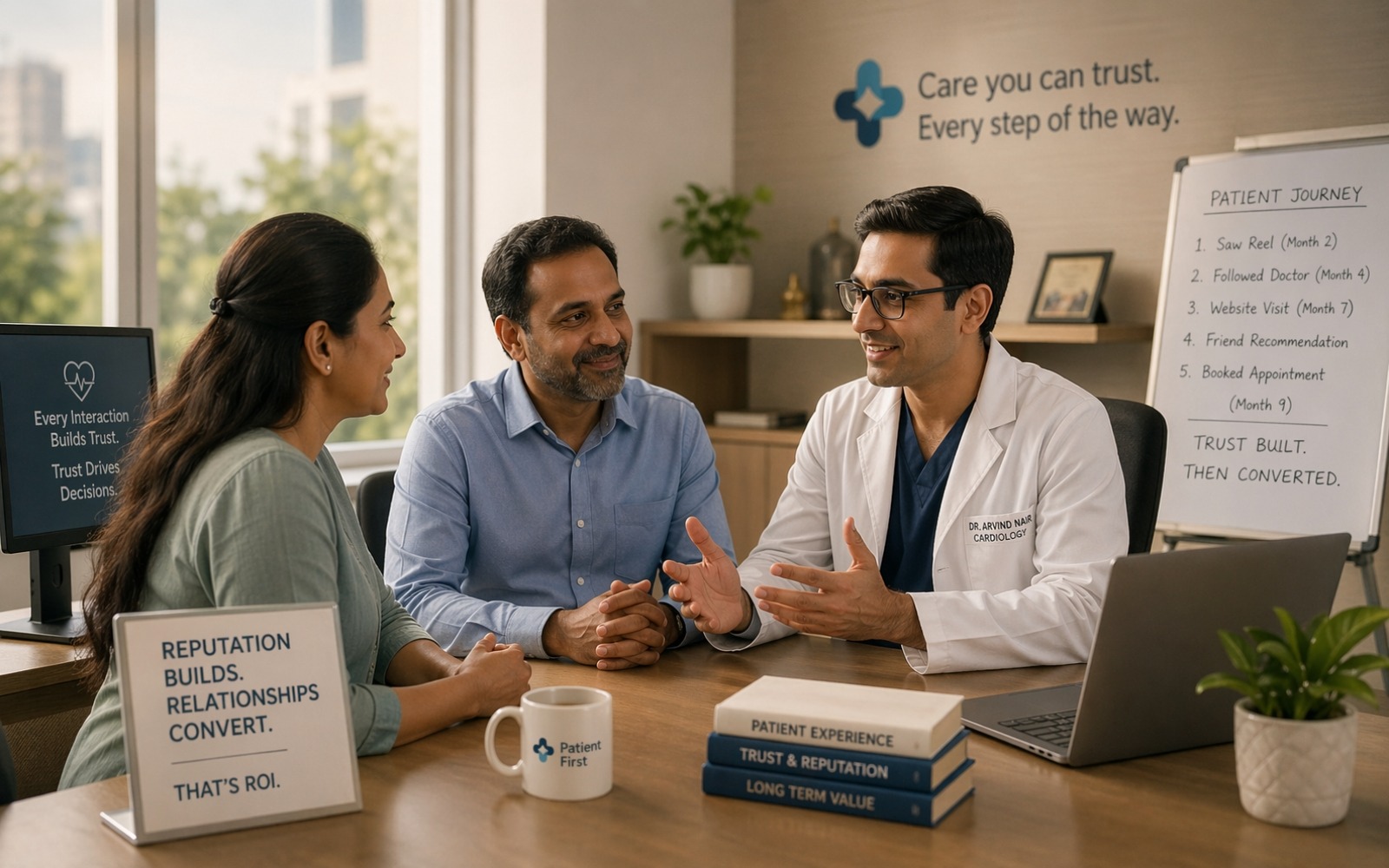
Before setting up or restructuring hospital marketing activities on social media, the most important reframe is the timeline and the measurement model. Social media for a hospital is a compounding trust asset, not a campaign. It does not work the way a health camp or a newspaper ad works. It works the way a reputation works: slowly, then in ways that are difficult to untangle from everything else.
A patient who books a cardiac consultation in month nine almost certainly did not discover your hospital in month nine. They saw a reel in month two, followed your cardiologist’s account in month four, visited your website in month seven after a friend mentioned the hospital, and called in month nine. Social media gets no credit in the CRM. It did the heaviest lifting.
This attribution gap is the reason hospitals write off social media after six months of posting. The signal is there. The measurement is broken. Here is what you should actually expect to see at each stage of a well-executed strategy.
Months 1 to 3: Building the Signal
In the first three months you are building the content infrastructure and watching early indicators. The number that matters here is not follower growth. It is post saves.
When someone saves a post about recovering from a knee replacement, or about when chest pain warrants an emergency visit versus an OPD appointment, they are bookmarking it for later consideration. That is intent. It is a stronger signal than a like, because a like costs nothing. A save means someone found the content specific enough to return to.
Track profile visits after individual posts. A spike in profile visits after a reel featuring your nephrologist tells you exactly what topic and which doctor generated real curiosity. Repeated patterns tell you what to make more of.
Months 4 to 6: Trust Accumulation
By month four, if the content has been genuinely useful and consistent, the quality of engagement changes. Comments shift from generic appreciation to specific questions. Someone asks about recovery time after a procedure. Someone tags a family member in a post about managing diabetes. Someone asks whether a particular condition can be treated at your facility.
These are trust signals. A person asking a specific clinical question in a comment section is a person actively considering your hospital for something real. How you respond to that comment publicly, whether with genuine clinical information or with a deflecting “please DM us”, is a brand moment that the 60 other people reading that thread will register.
In this phase you should also begin seeing website sessions from social referral traffic. In Google Analytics, track what these sessions do when they arrive. Clicks to doctor profile pages and the appointment section from social media referral traffic are meaningful conversion signals, even if no appointment is booked that day.
Months 7 to 12: Compounding Returns
This is where digital marketing for hospitals on social media begins producing outcomes that show up in systems beyond the platform. Patients mention a social media video during consultations. Your Google Maps review velocity increases because active social media keeps the hospital top of mind after a visit and prompts patients to leave reviews. Doctors from other specialties or cities connect on LinkedIn, feeding referral networks.
Your patient intake team will notice something else: patients arrive more informed. They have watched the procedure video. They know the doctor’s name. They have a specific question rather than a free-floating anxiety. This is social media working. It does not show up in a CRM attribution report. It shows up in the quality of the consultation.
The Content Architecture That Actually Works for Hospitals
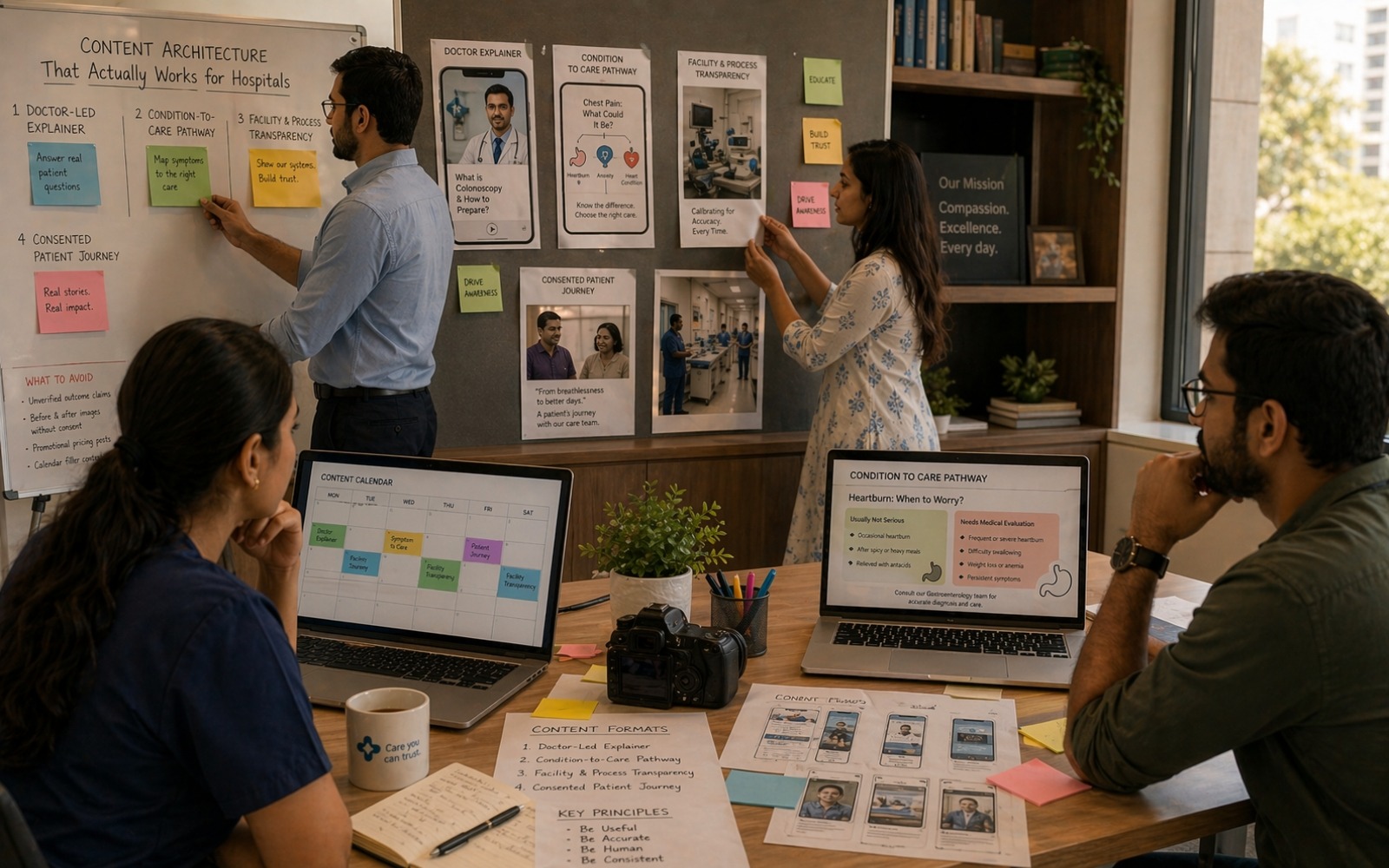
“Post educational content” is advice so vague it is useless. Here is what content marketing for hospitals actually looks like when it is built around how patients make decisions, what they are afraid of, and what earns clinical credibility in a crowded feed.
Format 1: The Doctor-Led Explainer
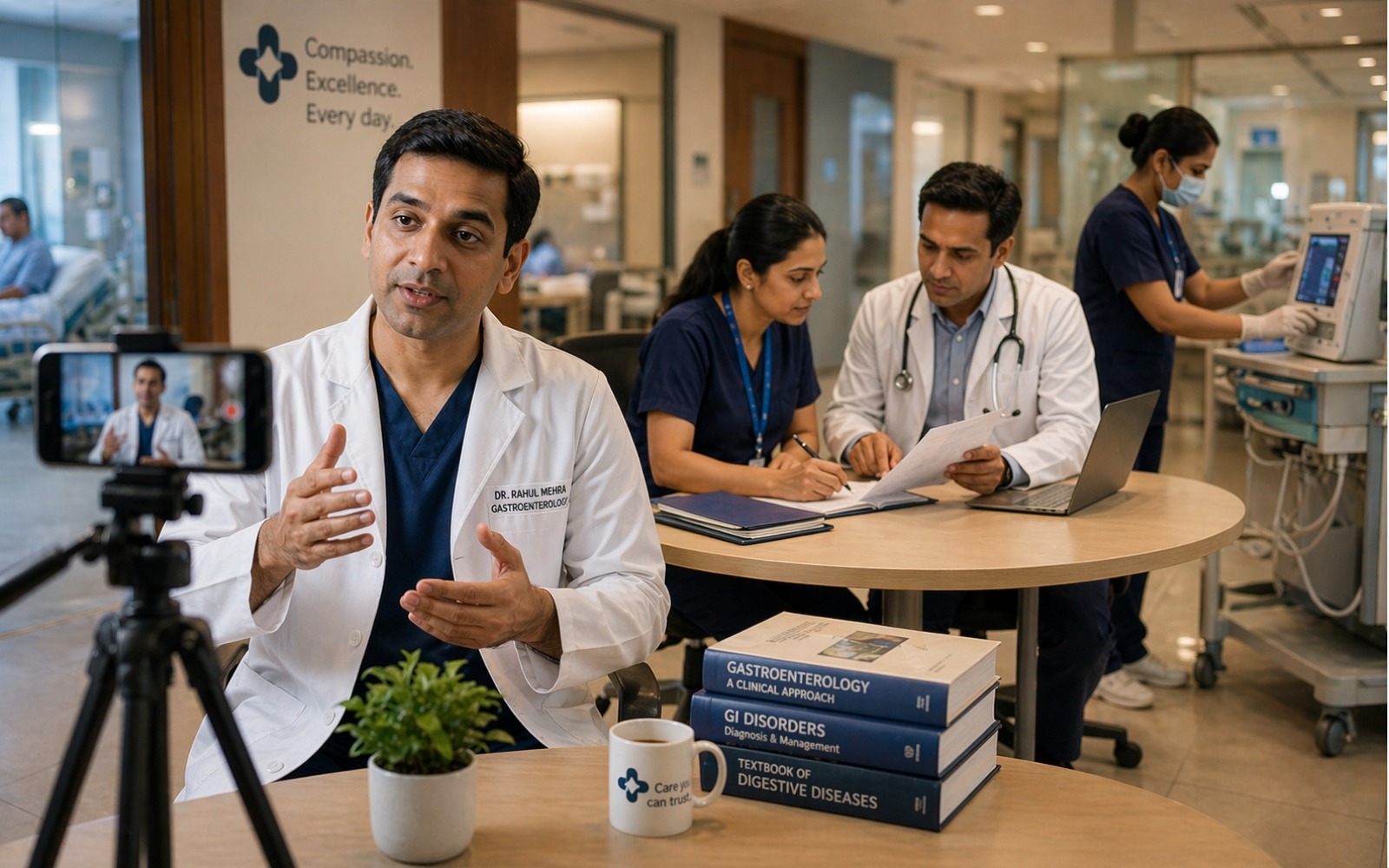
A video in which a real doctor from your team explains a condition, a procedure, or a recovery process in plain language is the single most effective content format available to a hospital. Nothing else comes close. This is the core of social media marketing for doctors within your institution.
Here is why it works so specifically. When a patient is evaluating a hospital for a significant procedure, they are not just evaluating the facility. They are evaluating whether the doctors there are the kind of people who explain things rather than past them. A ninety-second video where your gastroenterologist explains what a colonoscopy involves and how to prepare does three things simultaneously: it reduces patient anxiety before they arrive, it demonstrates that your department communicates clearly, and it establishes the doctor as a credible authority in their specialty.
What makes this executable: The doctor does not need to be on camera for more than two minutes. The content should answer one specific question, not cover an entire specialty. The question should come from what patients actually ask before they arrive. Your front desk team knows exactly what those questions are. Ask them. That list is your content calendar for the next three months.
Format 2: The Condition-to-Care Pathway
Most patients do not know what kind of doctor to see for their problem. They know the symptom. They do not know the specialty. A post that maps a common symptom to the right department, explains what the diagnostic process involves, and clarifies what treatment options exist, is genuinely useful in a way that most hospital content is not.
A post explaining the difference between heartburn that resolves with medication and heartburn that warrants an endoscopy, written with clinical accuracy and posted under your gastroenterologist’s name and photo, answers a real question that thousands of people in your city are living with and searching about. It generates saves. It generates shares to family members. It drives profile visits from people who want to know more about that doctor.
Format 3: Facility and Process Transparency
Patients choose hospitals partly on facility trust. They want evidence that the ICU is properly staffed, that infection control is taken seriously, that the diagnostic equipment is current. Most hospitals never show any of this because they assume patients are only interested in clinical outcomes.
They are wrong. A short video showing your biomedical team calibrating a diagnostic machine, or your pharmacist explaining how medication dispensing is verified, or your nursing team running through a safety protocol, communicates institutional seriousness in a way that a brochure cannot. These posts require no drama. They require specificity and truth.
Format 4: The Consented Patient Journey
A patient who gives explicit written consent to share their experience, from symptom to diagnosis to treatment to recovery, is the most powerful content format in the category. It is also the most legally sensitive.
Under India’s Digital Personal Data Protection Act (DPDP) 2023, any content that could identify an individual through their health status requires informed, documented consent. This applies to video, photography, and written testimonials. There is no grey area worth testing.
For hospitals that want the credibility of patient narratives without the legal exposure, anonymised journey content works well. “A 52-year-old patient came to our pulmonology department after two years of a breathlessness that had been misattributed to anxiety. Here is what the workup found.” This format communicates clinical capability without identifying anyone. It should still be reviewed by your legal or compliance team before posting, but the risk profile is materially different from named patient content.
What to Avoid Without Exception
- Unverified outcome claims: “95% success rate in laparoscopic surgeries” requires audited data. Post the claim only if you have the data to back it. If you do not, leave it out entirely.
- Before and after images without documented consent: This includes images shared even in private or closed groups. The legal and ethical exposure is identical.
- Promotional procedure pricing posts: These attract ASCI scrutiny and send a trust-eroding signal to patients who are evaluating your clinical seriousness.
- Calendar filler content: A generic awareness graphic that exists only to maintain posting frequency is diluting your content quality for both the algorithm and the reader. Fewer posts with genuine clinical substance consistently outperform high-frequency generic content.
Platform Logic: Where Your Hospital Should Actually Be
Maintaining a presence on every platform simultaneously with a single person and no clinical input is how you produce mediocre content across four platforms instead of strong content on two. Here is the logic for selecting platforms based on your hospital’s actual context and patient profile, which is the starting point for any serious hospital marketing strategy.
Facebook: Still the Primary OPD Discovery Platform
For hospitals whose primary patients are adults above 35 in Tier 1 and Tier 2 Indian cities, Facebook is the most consequential platform. The demographic that books the majority of general OPD appointments, admits family members, and makes decisions about elective procedures is far more active on Facebook than Instagram.
Facebook also has the strongest local discovery infrastructure of any social platform for hospitals. A hospital page’s review count, activity level, and response behaviour all factor into what gets surfaced when a patient searches locally or asks for recommendations in a community group. A dormant page with three posts from two years ago signals disorganisation before a patient has read a single review.
Facebook is also where community management is most consequential. How your team handles a critical review, how quickly it responds to a query, how clearly it answers a clinical question in a comment thread, all of this is public and visible to everyone who visits your page. Each response is a patient communication, not just a social media action.
Instagram: Specialty Credibility for the Right Demographics
Instagram works well for hospitals with specialties that have a visual or lifestyle dimension, and for reaching patients in the 25 to 44 age range making healthcare decisions for themselves or young families. Fertility clinics, orthopaedic departments, dermatology and cosmetic units, paediatric hospitals, and dental practices tend to see strong Instagram engagement relative to their Facebook results. Instagram marketing for doctors within these specialties has a compounding effect: each reel adds to a searchable archive attached to the doctor’s name and your hospital.
Reels are currently the highest-reach format on the platform. A doctor-led explainer reel of 60 to 90 seconds, answering one specific patient question in plain language, consistently reaches people outside your existing follower base. For hospitals, non-follower reach matters more than re-engaging existing followers. The person who already follows you may already be a patient. The person who discovers you through a reel is a prospective one.
LinkedIn: The Most Underused Channel in Indian Hospital Marketing
Almost no hospital in India is using LinkedIn well. This is a meaningful gap because the audience on LinkedIn has entirely different business implications from Instagram or Facebook.
On LinkedIn, your hospital speaks to referring doctors in other cities, corporate HR managers evaluating hospitals for employee health programmes, medical tourism facilitators, insurance intermediaries, prospective medical talent, and institutional partners. The content needs to reflect this: published research, clinical milestones, department achievements, thought leadership from senior doctors on clinical or healthcare management topics. A patient education graphic that performs well on Facebook is out of place on LinkedIn entirely.
LinkedIn management for hospitals requires a distinct voice and content strategy from every other channel. Repurposing Facebook content to LinkedIn is a reliable way to ensure that neither platform works well.
YouTube: Long-Form Authority That Works for Years
A five to ten minute video where a senior surgeon walks through what a patient should expect before, during, and after a specific procedure will surface in Google search results long after it is uploaded. YouTube is indexed by Google Search. A well-titled procedure explainer from your hospital can appear alongside search results for that procedure name and your city for years, at zero ongoing cost.
Production does not need to be broadcast quality. Clear audio, decent lighting, a doctor comfortable on camera, and one specific question answered completely is enough. The clinical accuracy and specificity of the content matters far more than production polish.
The Infrastructure Problem: Why Social Media Fails Even When the Content Is Good
Social media for hospitals can be executed well and still produce no measurable outcome if the surrounding infrastructure is broken. This is the part most agencies will not raise with you, because it implicates systems outside their scope of work.
Your Website Has to Be Able to Receive This Traffic
A patient who sees a reel about your neurology department will, if interested, visit your website. If your website has no individual neurologist profile pages, no department information, no appointment pathway that works on mobile, and takes more than three seconds to load on a 4G connection, that interest vanishes.
The specific pages your website needs to support social media: individual doctor profiles with photos, qualifications, and subspecialty focus; department pages explaining conditions treated and procedures offered; a mobile-first appointment request flow that routes to someone who can actually book. Without these, social media traffic has nowhere to go. As a full-service digital marketing agency in Surat with experience across healthcare and B2B verticals, we have seen this specific failure pattern often enough to call it plainly: social media investment without a functional website is a pipeline that ends at a wall.
Your Front Desk Has to Be Part of the System
Social media generates inquiries through multiple channels: direct messages, WhatsApp clicks from your profile, calls from people who found your number through a post, and walk-ins who mention having seen content online. If none of these entry points are tracked, you will have no data to attribute outcomes to social media even when it is working.
The minimum: a question added to patient intake asking how they found the hospital, with social media as an explicit option. A dedicated WhatsApp number linked from your profiles that routes to someone trained to handle clinical inquiries. A weekly review of DMs to confirm no inquiries are sitting unanswered.
An unanswered DM is a publicly visible trust failure. If a patient asks about a procedure in a direct message and receives no response for two days, they have drawn a conclusion about your hospital’s responsiveness that a future post will not undo.
Your Doctors Need to Be Willing Participants
Doctor-led content is the highest-performing format. It is also the format that requires genuine internal buy-in. The resistance from doctors is almost always one of two things: concern about professional dignity or concern about time. Both are legitimate.
The answer to the first is that content framed as patient education aligns with how most doctors already think about their professional responsibility. It is not self-promotion. It is explaining things to patients before they arrive anxious and uninformed. The answer to the second is concrete: a single 90-second video, planned and scripted in advance, shot in 20 minutes during a lunch break, is the entire weekly content commitment for that doctor. Every hospital has two or three doctors who would do this willingly if someone made it easy. Find them first.
Metrics That Tell You Something Real
Most social media reports for hospitals are full of numbers that look like progress. Here is a practical framework for what to watch and why.
Watch Weekly
- Post saves: Saves on informational content indicate that someone found it useful enough to return to. This is the strongest organic engagement signal available for hospital content.
- Profile visits after specific posts: A spike after a particular reel tells you what topic or doctor generated real curiosity. This is the clearest feedback loop between content and interest you have access to.
- DM volume and response time: Track how many direct messages arrive and how quickly they are answered. Unanswered messages are the most visible trust failure in hospital social media.
- Comment quality: The ratio of specific clinical questions to generic appreciation tells you more than total comment volume. A post with three specific questions is performing better than a post with 40 heart emojis.
Review Monthly
- Website sessions from social referral in Google Analytics: Specifically, what pages those sessions reach. Clicks to doctor profiles and the appointment section from social traffic are meaningful conversion signals.
- Non-follower reach percentage: For hospitals, reaching new people matters far more than re-engaging existing followers. This metric tells you whether your content is finding new patients or just talking to the ones you already have.
- Google Maps review velocity: Active social media keeps the hospital top of mind after a visit and correlates with more patients leaving reviews. Track new reviews per month and whether the trend is moving.
Review Quarterly
- Patient source attribution from intake data: How many patients in the past quarter cited social media as how they found the hospital? Even a rough figure gives directional evidence.
- Inbound referral contact from other doctors: On LinkedIn especially, track whether other specialists are reaching out. This is the referral network effect of a credible institutional presence.
How The Subtext Approaches Hospital Marketing
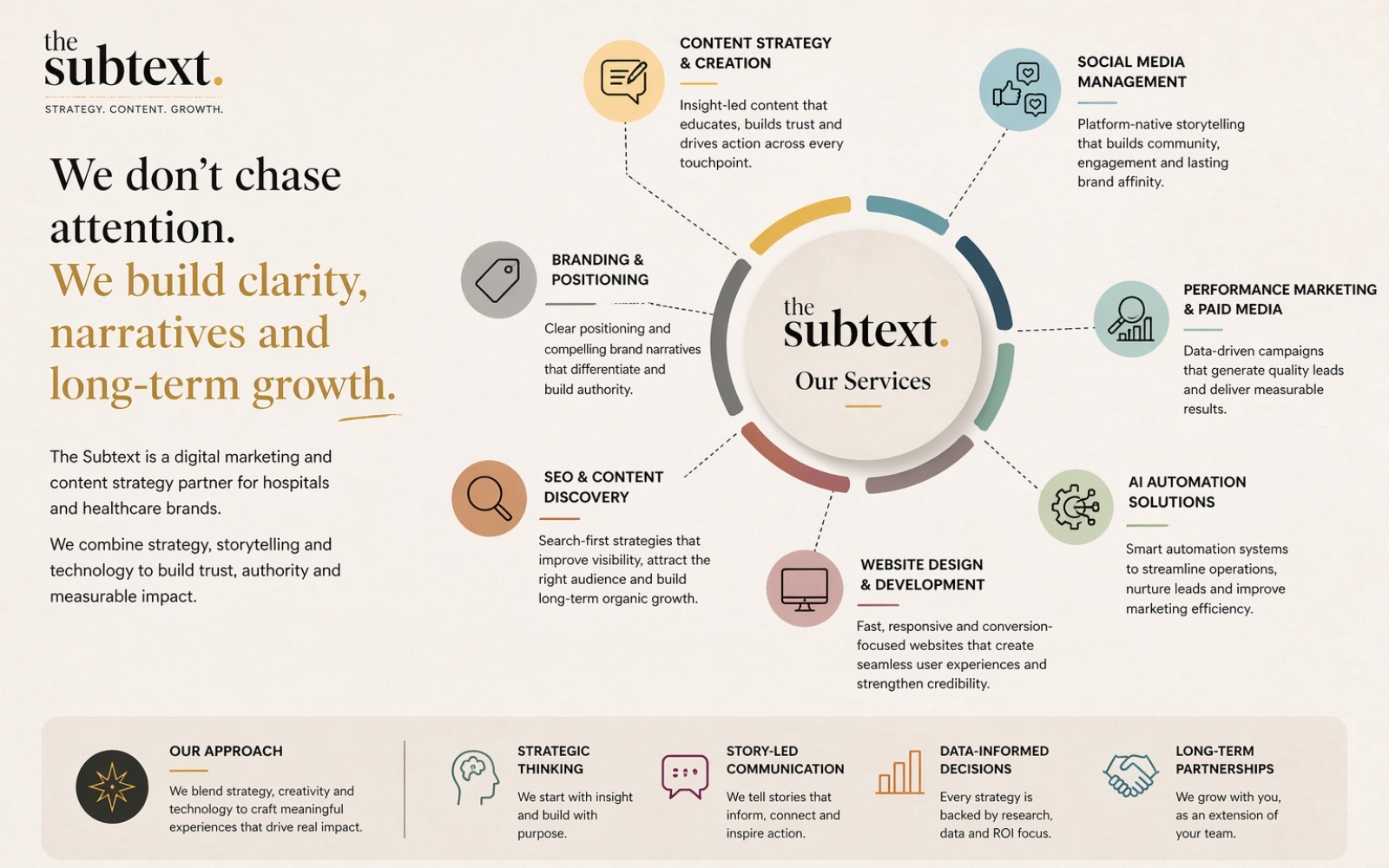
We are a boutique digital marketing agency and we are selective about the clients and verticals we take on. We entered the healthcare vertical deliberately, because we saw a consistent gap between what hospitals were receiving from their marketing partners and what the category actually requires. That gap is primarily strategic and category-specific, not creative.
Most agencies that take on hospital accounts apply a general brand marketing framework to a category where that framework does not fit. A hospital is not a retail brand. Its patients are making high-stakes decisions under anxiety and information asymmetry. The content standards are different, the regulatory obligations are real, the trust threshold is higher, and the consequences of getting the communication wrong are more serious than a poor campaign month.
Our hospital marketing work starts with understanding what your hospital is actually strong at clinically and institutionally, which departments have the capacity and the doctor engagement to build real content, and what the patient geography and demographic actually look like for your facility. From that, we build a content architecture and a platform strategy specific to your hospital, not borrowed from a template built for a completely different category.
We write content that a doctor would approve of. We manage community responses with the care the category demands. We connect social media strategy to your website performance, your appointment system, and your doctors’ own digital presence. And we are honest about timelines: hospital social media builds meaningful outcomes over six to twelve months. Any agency promising visible results faster than that is measuring the wrong things or telling you what you want to hear.
Our broader social media and branding work across verticals informs the thinking we bring to healthcare, even though the execution is meaningfully different. You can also see our social media marketing work in Surat for a sense of what we build and manage across categories.
If your hospital is serious about building a social media presence that earns trust over time, and you are done working with agencies that clearly do not understand the category, start a conversation with us.
Beyond Social Media: What Else Your Hospital Likely Needs
Social media is one part of a hospital’s digital presence. In our experience, hospitals that invest in social media without addressing the surrounding infrastructure end up with the same problem they started with: activity without outcome.
SEO: The Long-Term Discovery Engine
When someone searches “best orthopaedic hospital in Surat” or “laparoscopic surgeon near me,” they are expressing active intent. They are ready to act. Your hospital appearing on the first page for that search is worth more than any volume of social media posting because the intent is explicit and the timing is immediate. SEO and social media need each other: a strong blog post about when knee pain requires surgical intervention becomes a doctor reel, becomes an FAQ carousel, becomes a featured snippet. Content built for SEO feeds social media and content engagement feeds Google’s signals back. Our broader digital marketing services include healthcare SEO as part of full-service engagements.
Website Development: The Infrastructure Everything Depends On
A hospital website that works for digital marketing has specific requirements that general web developers rarely plan for: individual doctor profile pages structured for Google indexing, department landing pages built around patient search intent, appointment flows that work on mobile without friction, schema markup that helps search engines understand your specialties, and page speed that does not punish patients on mobile data connections.
If your current website was built as an institutional brochure, it is likely doing very little to support your marketing investment. We build hospital websites as part of our full-service digital marketing engagements and as standalone projects for hospitals with existing marketing teams.
Content Writing: The Foundation of Both SEO and Social
Generic health content written without clinical understanding reads as generic to both patients and to Google. Content that is specific, medically accurate, and structured with genuine knowledge of the conditions and procedures your hospital treats builds topical authority over time. We write hospital content in close collaboration with your clinical team: we bring the writing, the SEO architecture, and the content strategy. Your doctors bring the clinical accuracy and the experiential depth that makes the content credible.
You can see our white label content and marketing capabilities if you are evaluating a content partner alongside or instead of a full-service engagement.
Already Have an In-House Team? Consider Consultancy
Many hospitals have a marketing executive or a small communications team internally. If that describes your situation, the gap is rarely execution. It is strategic direction, content architecture, and the category knowledge that only comes from working specifically in healthcare marketing.
We offer consultancy engagements for hospitals with existing teams. We audit your current digital presence, build a strategy framework specific to your facility, and provide ongoing guidance that your team implements. This is often the most cost-effective structure for hospitals that have execution capacity but need a senior strategic layer above it. Reach out through our hospital marketing page to discuss what that structure could look like.
Frequently Asked Questions About Social Media Marketing for Hospitals
These questions reflect what hospital administrators and clinic owners most commonly ask before committing to a social media strategy. Answers are kept direct and without qualification where the evidence is clear.
Does social media marketing actually work for hospitals in India?
Yes, with a specific caveat. It works when the content is built around genuine clinical expertise, when at least some doctors are involved in content creation, and when the surrounding infrastructure, the website and the appointment system, can receive and convert the interest that social media generates. It does not work when applied as a generic brand marketing exercise. A 2021 study published in the National Medical Journal of India found that 70.4% of hospital OPD patients made healthcare decisions influenced by social media content. The platform reach is there. The question is whether your hospital is showing up with content that earns that decision.
How long does it take to see results from hospital social media?
Meaningful results, meaning appointment attribution and referral growth, build over six to twelve months of consistent, quality content. Early signals, post saves, profile visits, specific questions in comments, begin appearing in months two to four if the content is genuinely useful. Hospitals that judge social media ROI at the three-month mark are measuring a journey at its starting point and drawing conclusions about the destination.
Which social media platform is best for hospitals?
For general OPD reach and patient demographics above 35, Facebook remains the most important platform in Indian Tier 1 and Tier 2 cities. Instagram works well for specialties with a visual dimension and for reaching patients aged 25 to 44. LinkedIn is essential for referral networks, corporate health tie-ups, and talent recruitment, and is severely underused by Indian hospitals. YouTube is valuable for long-form procedure explainers that surface in Google Search. Most hospitals should start with Facebook and one of the others based on their specialty mix, rather than trying to maintain all platforms simultaneously.
What kind of content should hospitals post on social media?
Doctor-led video explainers answering specific patient questions are the highest-performing format. Condition-to-care pathway posts that map a symptom to the right specialty and diagnostic process generate strong saves and shares. Facility and process transparency content, showing how clinical protocols actually work, builds institutional trust. All of these require real clinical input. Stock photos with motivational captions and awareness-day graphics produce no measurable result.
Can a small clinic or single-specialty hospital benefit from social media marketing?
Often more than a large multispecialty hospital. A single-specialty clinic has a focused area of expertise, which makes it far easier to build content authority around a specific condition or patient need. A fertility clinic, a sports medicine centre, a paediatric dental practice, these can build genuine topical authority on social media in a way that a 200-bed multispecialty hospital, trying to cover ten departments simultaneously, often cannot. The constraint of focus is an advantage in content marketing.
How do hospitals measure ROI from social media marketing?
In three layers. Weekly: post saves, profile visits after specific content, DM volume and response time, comment quality measured by the ratio of specific questions to generic appreciation. Monthly: website sessions from social referral traffic in Google Analytics, specifically which pages those sessions reach, and Google Maps review velocity. Quarterly: patient source attribution from intake data asking how patients found the hospital, and inbound referral contact from other doctors, particularly on LinkedIn.
Do hospitals need to be careful about patient privacy on social media?
Yes, and the compliance framework is specific. Under India’s Digital Personal Data Protection Act (DPDP) 2023, any content that could identify an individual through their health condition requires explicit, documented, informed consent. This applies to patient testimonials, before and after images, named case studies, and video testimonials. Anonymised case narratives, where no identifying detail is included, carry a different risk profile but should still be reviewed by a legal or compliance professional before publishing.
Should doctors have their own social media accounts separate from the hospital’s?
Both. A doctor’s individual account builds personal clinical authority and trust. The hospital account builds institutional credibility and reach. When the two are linked and the content ecosystems reference each other, the compounding effect is significant. A patient who discovers a doctor through their individual Instagram account and then visits the hospital’s page to understand the facility is further down the trust-building journey than a patient who only saw the hospital page. Social media marketing for doctors within your team should be structured as a connected system, not isolated personal accounts.
What is the biggest mistake hospitals make with social media marketing?
Disconnecting it from everything else. Social media that has no connection to a functional website, no mechanism for routing inquiries to someone who can handle them, and no involvement from the clinical team will produce what most hospitals have already experienced: visible activity and invisible results. The content is one part of the system. The website, the front desk responsiveness, the doctor’s digital presence, and the measurement framework are the rest of it. Build the whole system or expect the results you have already seen.
The Decision in Front of You
If social media marketing for hospitals failed the first time, the question worth asking is whether the conditions that caused it to fail are still in place. If they are, a second attempt produces the same result. If they have changed, or if you are now willing to change them, the outcome can be materially different.
The conditions that need to be in place: content built around specific clinical expertise rather than generic awareness. At least some doctor involvement in content. A website that can receive and convert the traffic social media generates. A team or partner with genuine healthcare marketing understanding. A measurement framework focused on trust signals and patient attribution rather than vanity metrics.
That is a checklist. Work through it honestly. If most of those conditions are missing, address them first. If most are in place, a committed twelve-month investment in social media builds something that a one-time campaign never could: a digital presence that compounds, earns patient trust over time, and gives your hospital a visibility advantage that competitors still posting generic awareness content will find very difficult to close.