How To Generate B2B Leads Through Organic Search In 2026
Every B2B company we talk to runs some version of the same play. Paid ads, LinkedIn posts, events, referrals. When we ask where their organic search presence is, the answer is usually a blog that has twelve posts from 2021 and a homepage that Google barely touches.
That gap is where B2B lead generation SEO either wins or loses you the pipeline. And closing it in 2026 is a very different exercise than it was two years ago.
The March 2026 Google core update changed the competitive environment for B2B content in ways that most agencies have yet to fully process. Google has deepened its ability to identify whether a piece of content was written by someone who actually does the work or by someone who assembled information about the work. For B2B service businesses, this is the best possible development because your genuine expertise is now your SEO advantage. The problem is that most B2B brands have never been shown how to turn that expertise into a content architecture that ranks.
This post covers what B2B SEO actually requires, what you must get right before anything else, how we structure an organic lead generation programme at The Subtext, the tactics that consistently move the needle, what to stop doing immediately, and how to measure progress in a way that connects to revenue rather than vanity metrics.
No generic frameworks. The things written here come from running B2B SEO campaigns in real market conditions.
Why B2B SEO Is Structurally Different From Everything Else
B2B SEO is harder to execute than most other forms of content marketing. The audience is smaller, the keywords are lower volume, the sales cycle is long, and the buyer is usually one of several people involved in a decision. If you apply B2C SEO logic to a B2B programme, you will optimise for traffic and wonder why the leads are low quality.
Here is what makes B2B search behaviour distinct:
Multiple people are searching for the same deal
A single B2B purchase often involves four to seven people. The CFO might search for ROI benchmarks. The marketing manager searches for agency comparison guides. The founder might search for case studies in their specific industry. The procurement lead searches for pricing transparency. Each of those searches represents a different query type with different intent. A B2B organic strategy that targets only one of those query types leaves the majority of the buying committee unaddressed.
The practical implication: your content architecture needs to cover the same solution from multiple angles. A landing page for your service, a case study for the founder, a pricing page for procurement, a methodology post for the marketing manager. These are separate pages with separate keyword targets. They serve the same deal from different entry points.

The keywords are low volume and high value
B2B keyword research looks very different from B2C keyword research. The search volumes are smaller. A keyword with 200 monthly searches might represent thousands of crores in potential contract value if the searcher is a procurement manager at a mid-market manufacturing firm.
Teams that evaluate B2B keyword opportunity using B2C volume thresholds reject the most valuable targets. A keyword with 80 monthly searches and clear commercial intent from a decision-maker audience is worth far more than a keyword with 8,000 searches from a mixed audience with no buying intent.
The trust gap is wider
B2B buyers are more risk-averse than B2C buyers. They are spending company money. They are accountable for the decision. Organic search closes this trust gap in a way that paid ads cannot because a B2B buyer who finds your content through search, reads it, learns something useful, and comes back for more has already been pre-sold on your expertise before they ever speak to your sales team.
This is the mechanism that makes inbound B2B marketing through organic search so valuable. The buyer arrives with trust partially built. The first sales conversation is a different kind of conversation than one that starts from a cold LinkedIn outreach.
The sales cycle means attribution is harder
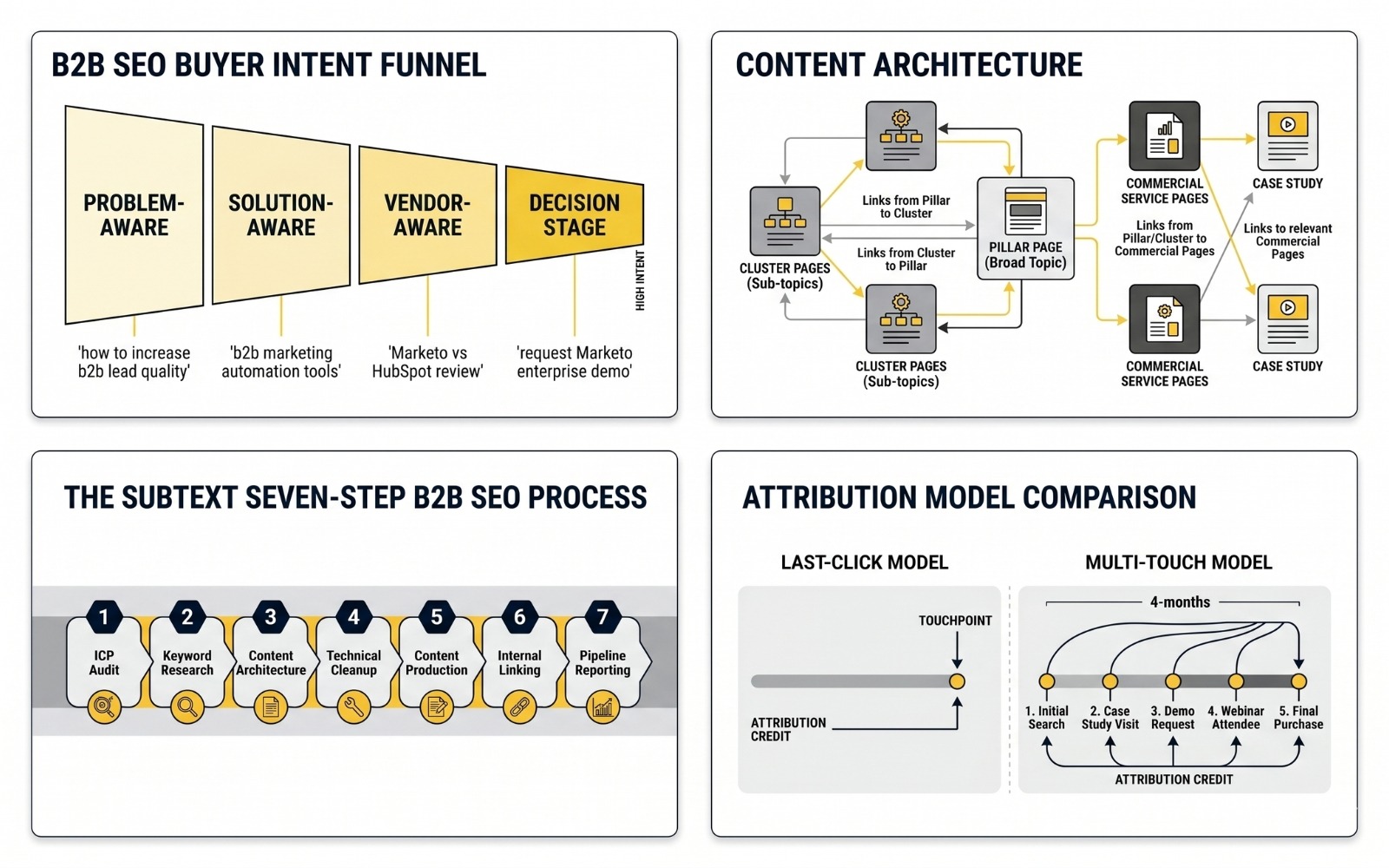
A B2B lead from organic search in January might close in September. The buyer might read six pieces of your content across four months before they fill in a form. Standard 30-day attribution models will consistently undervalue your organic investment. This matters because it shapes how long leadership is willing to fund an organic programme before calling it slow.
Setting the right attribution expectation before you start is as important as the SEO work itself. We have seen good organic programmes get killed at month four because the reporting framework was wrong.
What B2B SEO Actually Requires To Work
Before tactics, there are requirements. These are the conditions that need to be true before any B2B organic programme can produce results. Skipping any of them produces a programme that generates traffic without generating pipeline.
A defined ICP with search behaviour you can map
B2B SEO without a clear ideal customer profile is guesswork. You cannot write content that ranks for the right queries if you do not know who the right reader is, what problem they are trying to solve, and what vocabulary they use when they search.
The vocabulary part is the piece most teams underinvest in. B2B buyers often use internal company language when they search. A procurement manager might search for “vendor due diligence checklist for marketing agencies” rather than “how to hire a digital marketing agency.” A SaaS ops lead might search “GTM team content support” rather than “B2B content marketing.” Keyword tools pull from broad search volume data which skews toward common terms. The vocabulary your ICP actually uses in search queries is mined from sales call recordings, support tickets, email threads with prospects, and LinkedIn conversations. That source of research is more valuable for B2B keyword targeting than any SEO tool.
Technical health as a floor, not a destination
The March 2026 core update tightened the correlation between page experience signals and ranking performance for competitive commercial queries. Technical SEO is now table stakes. A service page loading in 4.5 seconds on mobile, with poor Core Web Vitals scores and thin internal linking, loses ranking positions to a technically cleaner competitor with equivalent content quality.
B2B marketing teams often deprioritise technical SEO under the assumption that their buyers are on desktop and patient. Both assumptions are outdated. Decision-makers research vendors on their phones constantly. Slow pages signal an inattentive business. Google reads the same signal.
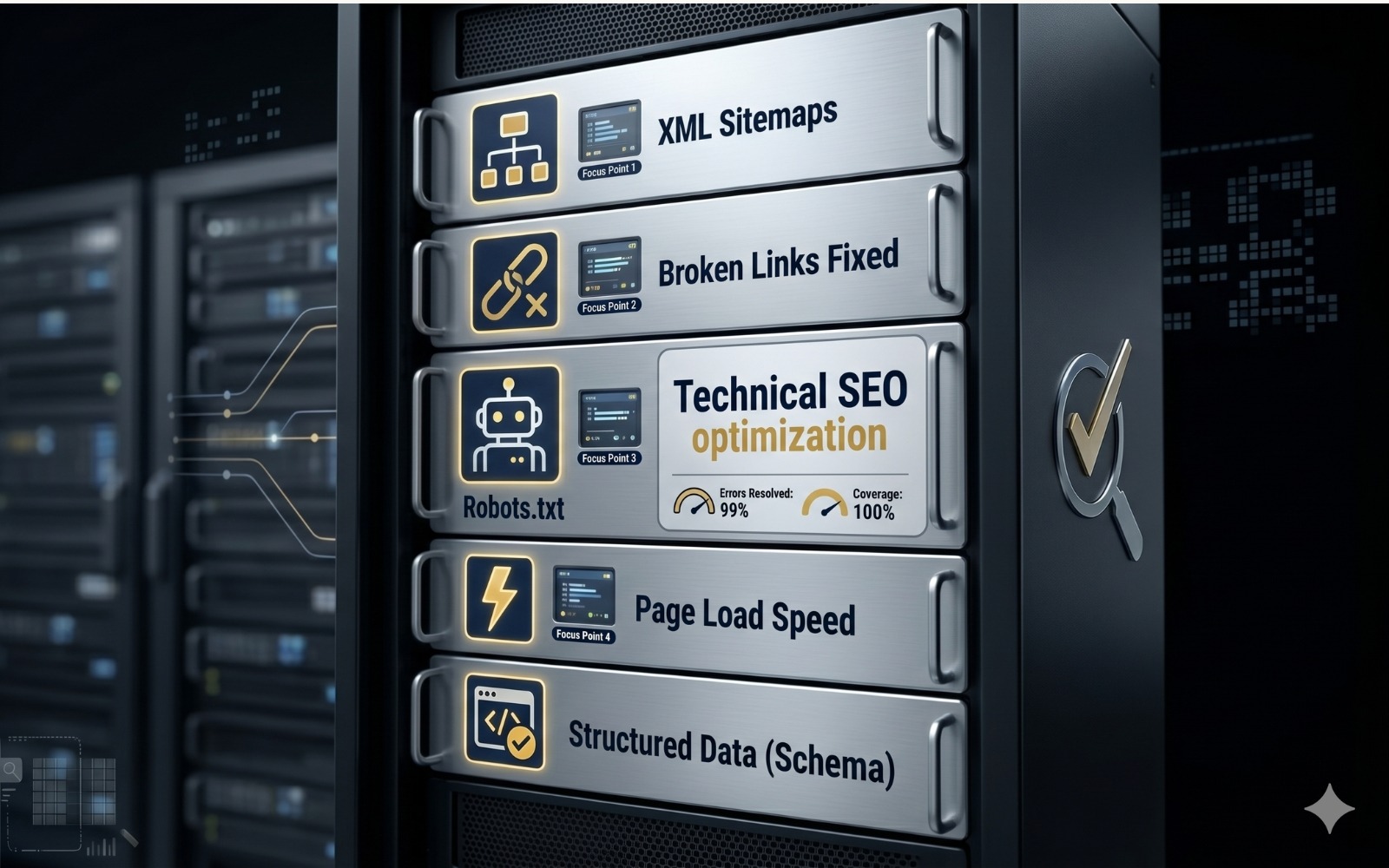
The technical baseline we confirm before any content work begins: crawlability and indexation are clean, Core Web Vitals scores are green for commercial pages, all service and landing pages are internally linked and discoverable, there are no orphan pages sitting on the sitemap with zero internal links pointing to them, and structured data is implemented on commercial pages. These are prerequisites. Content built on a broken technical foundation compounds the problem rather than solving it.
A content architecture that reflects how buyers search, not how you think about your services
Most B2B companies organise their website around their internal service categories. An agency might have pages titled “Strategy,” “Execution,” and “Reporting.” A SaaS company might have pages called “Core Product,” “Add-ons,” and “Enterprise.”
Buyers do not search using your internal service taxonomy. They search for their problem. They search for a specific outcome. They search for a comparison. The content architecture needs to map to those search patterns rather than to your org chart.
This means pillar pages built around broad problem categories, cluster pages built around specific questions and sub-topics within those categories, and commercial pages built around buying-intent queries. Each layer of the architecture has a different keyword target and a different role in the buyer’s journey.
Subject matter expertise that is actually surfaced
The March 2026 update made this requirement more concrete. Google can now differentiate between content assembled from research and content produced by someone who does the work. The signals include specificity of examples, presence of failure scenarios alongside success scenarios, consistency of the author’s presence across the web, and whether the content adds something new to a topic rather than aggregating what already exists.
For B2B brands, surfacing genuine expertise means getting practitioners involved in content production. The SEO manager at an agency cannot write a case study about a paid media campaign the way the paid media lead who ran it can. The difference is visible in the specificity of the writing. Google rewards that specificity with rankings. Buyers trust it with their attention.
The Flow We Follow at The Subtext for B2B SEO
This is the actual process we follow in our SEO services. The sequence matters as much as the individual steps.
Step 1: ICP and search behaviour audit
Before we touch a keyword tool, we spend time understanding who the client’s buyers are and how they search. This involves reviewing the client’s sales call recordings or call notes, their CRM data for win-loss patterns, their existing Search Console data for queries they are already receiving impressions for but have done little with, and any customer research they have done.
The output is a buyer vocabulary map: a documented set of terms, phrases, and question patterns that the ICP uses across each stage of the buying journey. This is the raw material for keyword research.
Step 2: Keyword research anchored to buying intent
We run keyword research across four intent layers. Problem-aware queries, where the buyer knows something is wrong but cannot name the solution. Solution-aware queries, where the buyer is evaluating approaches. Vendor-aware queries, where the buyer is comparing specific providers. Decision-stage queries, where the buyer is justifying the purchase internally, looking for pricing clarity, process transparency, and proof of results.
The output is a keyword map that assigns each target query to a specific intent stage and a specific page on the site. We never allow two pages to compete for the same primary keyword. Keyword cannibalisation across a B2B site is one of the most common causes of stalled rankings and it is almost always a planning failure rather than a content failure.
Step 3: Content architecture and gap analysis
We audit the existing site against the keyword map. This shows us which intent stages are covered, which are empty, which pages have structural problems that prevent them from ranking, and which pages are cannibalising each other.
We then build a content architecture document that maps every existing and planned page to a keyword target, an intent stage, a page type (pillar, cluster, commercial, case study), and the internal linking relationships between pages. This document becomes the editorial calendar, the technical brief, and the reporting framework all at once. No page gets written before it has a place in the architecture.
Step 4: Technical cleanup before new content
New content published on a site with technical problems does not rank as well as it should. We resolve technical issues before scaling content production. This includes fixing crawl errors, improving page speed on commercial pages, implementing structured data, repairing internal linking gaps for existing service pages, and confirming that orphan pages from previous work are properly integrated into the site structure.
On thesubtext.in itself, we know we have landing pages that exist without internal links from the main navigation or blog content. Those pages are undiscoverable to crawlers by default. Addressing that is part of the technical phase.
Step 5: Content production with an E-E-A-T brief
Every content piece we produce is briefed with four requirements. It must add information that does not already exist in the top-ranking results for the target query. It must come from or be reviewed by someone who actually does the work. It must address the specific question the searcher has at that intent stage without pivoting to a generic topic. And it must connect through internal links to a commercial destination.
The brief for a blog post targeting “B2B pipeline velocity content marketing” would include the specific client context, the primary query, the secondary queries to address, the ICP for this content, the key differentiating insight that comes from our actual client work, the internal pages to link to, and the CTA that connects this content to a service conversation.
Generic briefs produce generic content. Generic content does not rank in 2026.
Step 6: Internal linking as content goes live
Every piece of content that goes live immediately gets internal links from existing relevant pages. We maintain a running internal link map that shows which existing pages should link to each new piece. This is part of the publishing workflow rather than a cleanup task done later.
B2B organic programmes fail when internal linking is treated as optional housekeeping. Google’s ability to understand what a page is about and how authoritative it is depends heavily on the internal linking context around it. A service page with zero internal links pointing to it from blog content is functionally invisible to Google even if it is on the sitemap.
Step 7: Reporting tied to pipeline, not just traffic
Monthly reporting covers organic sessions to commercial intent pages, assisted conversions from organic, Search Console query data for commercial pages, ranking movement on target keywords, and content update priorities based on pages that are ranking on page two but have clear improvement potential.
We flag when organic is contributing to pipeline even across long cycles. A prospect who read three blog posts over two months before filling in a contact form should be attributed correctly, not credited entirely to the last click.
Search Intent For B2B: The Part Most Teams Get Fundamentally Wrong
B2B keyword research has a structural misunderstanding baked into how most teams approach it. The teams that rank well in 2026 are the ones who map content to buyer psychology rather than to keyword volume.
The four intent stages we work across:
- Problem-aware: The buyer knows something is failing but cannot yet name the solution. Queries look like “why is our B2B lead quality dropping” or “pipeline velocity slowing down reasons.” Content here builds awareness and captures the buyer earliest in the journey.
- Solution-aware: The buyer has identified what kind of solution they need. Queries shift to “B2B lead generation through content” or “inbound marketing for SaaS companies India.” This is where most B2B content strategies focus exclusively.
- Vendor-aware: The buyer is comparing options. Queries become “B2B SEO agency India” or “digital marketing agency for B2B companies Surat.” Content here needs to make a specific case for your approach over alternatives.
- Decision stage: The buyer is justifying the spend internally. Queries focus on pricing, process, and proof. “SEO pricing for B2B India” or “B2B digital marketing agency case studies” are decision-stage searches.
Most B2B content strategies live entirely in stage two and ignore the rest. Stage one content is underinvested because the volume is lower and the conversion path is longer. Stage four content is underinvested because pricing transparency makes teams uncomfortable.
Stage four is where we see the clearest conversion signal. A buyer searching for pricing information is telling you they are close to a decision. A transparent, detailed pricing page that explains what drives cost, what a buyer should evaluate, and what they should ask a vendor is both an SEO asset and a sales tool. Our SEO price list for India page ranks and converts because it answers the questions buyers have right before they pick up the phone. It takes a position. It does something that most agencies are too cautious to do.
Building A B2B Content Funnel That Generates Pipeline: Thinking Beyond Traffic
A content funnel in B2B organic search is a set of pages that capture attention at different intent stages and create a connected path toward a commercial conversation. The pages need to do different jobs and they need to be internally linked so that a buyer can move between them without leaving the site.
Top of funnel: problem-led content
These are blog posts and long-form guides built around the queries your ICP types at the beginning of their journey. The goal at this layer is topical authority. Google evaluates topical authority at the domain level after the March 2026 update. A domain that covers a topic consistently and comprehensively signals genuine expertise. A domain with twelve posts from 2021 on unrelated subtopics signals the opposite.
The rule we follow for top of funnel content: write about the operational problems your clients describe on the first sales call. Those problems are search queries that are happening right now on Google with zero good answers available.
Organic traffic for SaaS companies in the awareness stage comes from content that addresses product-market fit friction, onboarding failure patterns, churn triggers, and GTM misalignment, before the buyer ever knows they need an SEO agency. If your content is already helping them think through those problems, you are positioned as a peer rather than a vendor by the time they are ready to spend.
Middle of funnel: comparison and framework content
This is the layer most B2B teams stop investing in and it is a consistent missed opportunity. Middle of funnel content includes methodology posts, vendor comparison guides, industry-specific strategy frameworks, ROI calculators, and tool evaluations. A buyer evaluating your agency against three others will search for information that helps them compare intelligently. If your content helps them make that comparison, you earn trust before the first meeting.
Aleyda Solis, B2B SEO consultant and founder of Orainti, has argued publicly that B2B brands need to establish entity authority on a specific topic cluster before expecting to rank competitively for commercial keywords. Her position: Google’s systems evaluate whether a brand shows consistent expertise across a topic, not just on a single page. One strong landing page surrounded by thin content does not build that signal.
This is precisely why we build content architecture before writing any individual piece. A page targeting “B2B SEO services” needs supporting cluster content on B2B keyword research, B2B link building, B2B analytics, and B2B content strategy. The landing page ranks because the surrounding content builds the domain’s topical authority on B2B SEO as a subject. Without that cluster, the landing page is competing on its own against domains that have built the full topical signal.

Bottom of funnel: commercial pages and case studies
Service pages and case study pages sit at the bottom. These are the pages that convert. They need enough detail to answer objections before a buyer picks up the phone, enough specificity to signal genuine capability, and a structure that makes them candidates for featured snippet capture on decision-stage queries.
Our B2B SEO services page is built around the specific problems B2B marketing managers face rather than around a generic description of what SEO is. It speaks to multi-stakeholder search environments, long sales cycles, and the gap between traffic metrics and pipeline contribution because those are the exact concerns the buyer arrives with. That specificity is what makes the page a commercial asset rather than a brochure.
Case studies deserve a specific mention here. Most B2B teams publish case studies as PDFs behind a form. This removes them entirely from organic search. A case study published as a detailed web page, with a clear problem statement, specific metrics, methodology explanation, and outcome data, can rank for highly specific queries that no competitor is targeting. “How we increased SQL volume for a B2B SaaS company in the HR tech space using long-form content” is a query. A case study page structured around that query captures a buyer at exactly the right moment to convert.
What The March 2026 Google Core Update Actually Changed For B2B
The March 2026 core update is the most significant algorithm change for B2B content since the Helpful Content rollout. Understanding what it changed helps you build content that benefits rather than loses ground.
Practitioner experience is now measurable, not just stated
Google can now differentiate, at scale, between content written by someone who executes the work and content assembled by someone who researched it. The signals are in the specificity of examples, the presence of failure scenarios alongside success scenarios, the author’s demonstrated presence on the topic across multiple platforms, and whether the content raises questions that only a practitioner would think to address.
What this means practically: a generic post about “B2B lead generation strategies” that lists ten approaches without going deeper than the strategy name is losing rankings. The content that wins describes a specific client situation, the specific problem, what the team tried first and why it failed, what the adjustment was, and what the 90-day outcome looked like. That level of detail can only come from someone who ran the campaign.
For B2B service businesses, this update rewards exactly the content asset you are most capable of producing. The question is whether your content process is set up to extract that specificity from the people who hold it.
Structured data for AI Overview visibility
B2B commercial searches now frequently return AI Overviews above organic results. Whether your content gets surfaced in those overviews depends heavily on how structured your content is. Pages with FAQ schema, HowTo schema on process-led content, and clear logical answer architecture are more likely to be pulled into AI Overview responses than pages with well-written but unstructured body copy.
Plain blog paragraphs without schema, clear header hierarchy, and logical Q-and-A structure lose this surface. If your B2B service pages are generating impressions for commercial queries but the click-through rate is low, AI Overview displacement is likely a factor and structured data is part of the fix.
Thin topical coverage is now penalised at domain level
A site with 200 generic marketing posts is now consistently outranked by a site with 30 deeply specific posts on a coherent topic cluster. Google’s evaluation has moved from page-level quality scoring to domain-level topical authority assessment.
Publishing B2B content on a domain that also covers lifestyle topics, news summaries, and unrelated services dilutes that authority signal. The practical implication for B2B brands: narrow your topical focus before expanding it. Pick the two or three problem areas where you have genuine expertise and build coverage depth there first. The brands that tried to rank for everything in 2024 are the ones losing ground in 2026.
Real Tactics We Use That Most B2B Teams Skip
Mine your sales conversations for content, not your competitors’ blogs
The most valuable source of B2B content ideas is your own sales process. The questions prospects ask on discovery calls, the objections that come up repeatedly, the comparisons they are already making, and the misconceptions they arrive with are all search queries happening right now. A prospect who asks “how do you handle B2B content for regulated industries” in a sales call represents a query cluster worth targeting.
Competitors’ blogs will not surface these queries because competitors are doing the same keyword research you are. Your sales conversations surface the specific language of your specific ICP in a way that no tool replicates.
Build pages for job titles, not just industries
“SEO for manufacturing companies” is an industry page. “SEO for B2B marketing managers in manufacturing” is a job-title page. The second one feels too granular to most content teams, so it gets skipped. That granularity is exactly what makes it rank for low-competition queries and convert at a higher rate when it does.
Decision-makers in B2B search using their role as a filter. A marketing director at a pharma company searches differently from a founder at a Series A SaaS. Content that speaks to the job title, its specific KPIs, its reporting relationships, and its decision-making constraints signals relevance in a way that industry-level content cannot replicate.
Target the vocabulary gap, not just the volume gap
B2B buyers often search using internal company vocabulary rather than industry standard terms. A procurement manager might search “vendor qualification process for marketing agencies” rather than “how to hire an SEO agency.” A SaaS operations lead might search “content support for GTM team” rather than “content marketing for SaaS.”
Keyword tools miss these queries because they pull from broader search volume data. The vocabulary gap is closed by reading your buyers, listening to your sales calls, and paying attention to the exact words your clients use in emails. One well-targeted page built around a vocabulary-gap query can generate three or four high-quality leads per month from a keyword that a standard keyword tool would tell you has no volume.
Earn links through original data, not outreach campaigns
B2B link building through outreach to generic directories and irrelevant blogs builds domain authority at roughly the speed and quality of a leaky bucket. The links that actually move domain authority for B2B brands come from publishers who cite original data and original thinking.
Running a small annual survey with your existing clients, publishing the aggregated findings as a report, and distributing it to industry publications is one of the most reliable link-earning approaches for B2B brands. The data needs to be real and the findings need to be specific. A report titled “State of B2B SEO Investment in Indian Mid-Market Companies 2026” that surveys 50 actual marketing decision-makers will earn citations from industry publications and become a reference point for other content creators. That report earns links for two to three years. A generic outreach campaign earns links for two to three months before you have to run it again.
Original frameworks work similarly. If you have a proprietary approach to solving a specific problem, naming the framework and publishing it creates something other writers will cite. Frameworks get referenced. Generic advice gets paraphrased without attribution.
Treat content freshness as a maintenance schedule, not a bonus task
B2B pages that ranked well in 2023 are losing ground in 2026 because they were published and left alone. Google weights content freshness signals for B2B commercial queries because the information landscape shifts. A post about “B2B lead generation tactics” written before AI Overviews existed needs updating to reflect how B2B search behaviour has changed.
We run a content update calendar alongside our content creation calendar. Pages that are ranking between positions 4 and 15 on commercial queries are the highest priority for updates because improving them produces results faster than targeting new keywords. A page on position 8 that moves to position 3 generates far more traffic than a new page starting from zero.
What To Stop Doing In B2B Organic Search
Publishing content with no commercial connection
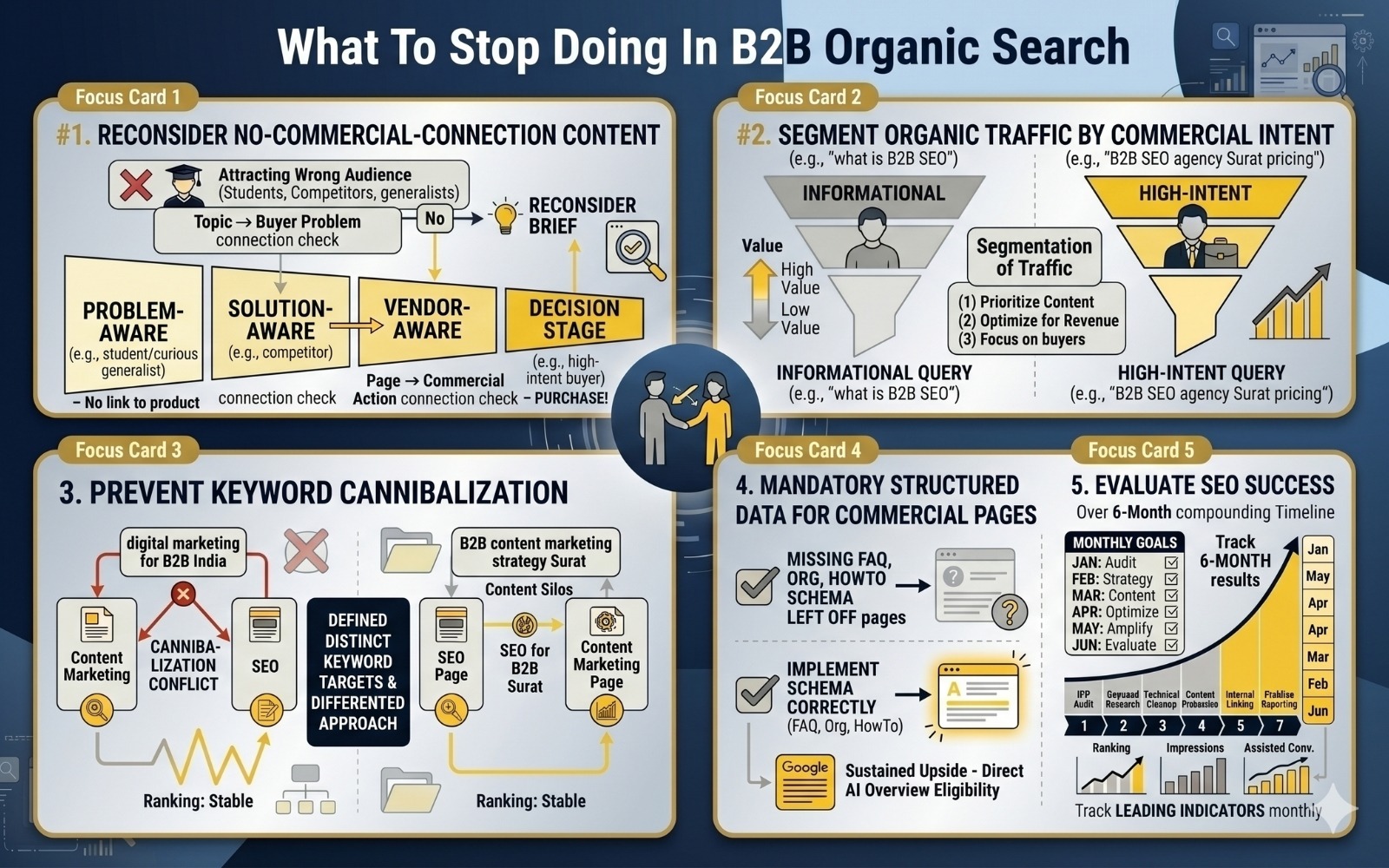
Traffic without conversion potential is a reporting number with no business impact. B2B brands consistently publish content that attracts readers who will never be buyers: students, job seekers, curious generalists, competitors. A post that ranks well and brings 2,000 monthly visitors from the wrong audience adds nothing to your pipeline.
Every content piece needs a visible line between the topic and a potential buyer’s problem and between the page and a commercial action. If you cannot draw that line clearly in the content brief, the content should be reconsidered before it is written.This is one of the most important points to remember with respect to SEO and SEM.
Treating all organic traffic as equally valuable
A session from someone who searched “what is B2B SEO” is worth less than a session from someone who searched “B2B SEO agency Surat pricing.” Both count as one session in your analytics. One of them represents a prospect who might become a client. Segmenting organic traffic by commercial intent in your reporting changes how you prioritise content investment and how you evaluate programme performance.
Allowing keyword cannibalisation across service pages
B2B agencies and service businesses often have multiple pages competing for the same keyword without knowing it. If your “content marketing” page and your “SEO” page both target “digital marketing for B2B India,” Google ranks whichever it deems most relevant on any given day. This creates ranking inconsistency. Each page in your content architecture needs a distinct primary keyword and a structurally differentiated approach so Google has no ambiguity about which page should rank for which query.
Skipping structured data on commercial pages
FAQ schema on service pages, Organisation schema on the homepage, and HowTo schema on process-led content are now direct inputs into AI Overview eligibility for B2B queries. Leaving structured data off your commercial pages is leaving a visibility surface unclaimed. It takes a few hours to implement correctly. The upside is sustained.
Measuring SEO success at 30 days
B2B organic programmes produce results on a longer timeline than paid campaigns. A programme started in January should be evaluated on a six-month basis, with leading indicators (ranking movement, impressions growth, assisted conversion data) tracked monthly. Teams that pull the plug on organic at month three because revenue has not moved are comparing the wrong metric to the wrong timeline. Organic is a compounding asset. It builds slowly and then it builds quickly.
Measuring B2b Organic Lead Generation In A Way That Connects To Revenue
The measurement framework matters as much as the execution. These are the metrics that tell the true story of an organic programme’s contribution to B2B pipeline:
- Organic sessions to commercial intent pages: the total organic traffic number is less useful than how much of that traffic lands on service pages, pricing pages, and case study pages. Filter for those pages specifically in your analytics.
- Assisted conversions from organic: set up multi-touch attribution that captures organic as a first or middle touchpoint in journeys that eventually convert. In most B2B programmes, organic-assisted conversions are 2 to 3 times the organic-last-click conversions.
- Lead quality score by landing page: track which organic pages produce the highest quality leads based on ICP fit, company size, and eventual close rate. This tells you where to double down in content investment.
- Search Console query data filtered to commercial pages: look at which queries are sending visitors to your service pages. Those are the queries where you are already competing. Improving content on those pages for those queries has a faster ROI than targeting entirely new keywords.
- Position 4 to 15 ranking opportunities: pages ranking in this range for commercial queries are your highest leverage update targets. Structured, focused improvements to these pages generate measurable traffic gains faster than new content.
One measurement discipline we enforce: every lead that comes in through a form gets tagged at the source and the tags are reviewed monthly against the content that produced it. Over time this builds a picture of which content types, which intent stages, and which topic clusters are generating the highest quality pipeline. That picture is what makes the investment case for organic search sustainable inside a B2B organisation. Consider this a content writing tip of value as far as 2026 is concerned.
The Summary
B2B leads from organic search are built on a specific sequence of decisions made consistently. Define your ICP clearly enough to know how they search. Fix the technical foundation before scaling content. Build an architecture that maps to buying intent rather than your service categories. Publish content that only your team could write. Earn links through original data and named frameworks. Update what you publish before it decays. Measure against pipeline. Do not focus just on traffic.
The March 2026 Google core update makes this harder for teams producing generic content and easier for teams producing genuine expertise. B2B service businesses are the best-positioned organisations in the market to win this shift because they have years of real client experience sitting inside sales calls, project retrospectives, and account reviews. The question is whether they build a content programme capable of surfacing that experience in a form that Google rewards and buyers trust.
If you want to understand what a structured B2B organic programme looks like in practice, our B2B SEO services page covers how we approach this in detail. If your first question is what it costs, our SEO pricing page is the clearest publicly available breakdown we know of for B2B SEO investment in the Indian market. Start with understanding what you are buying. Then have the conversation.
Questions Our B2B Clients Ask Us Before Starting
As a B2B SEO company, every client we have spoken to about organic search comes in with a version of the same handful of questions. These are the ones that come up most often, answered the way we answer them in a first meeting: directly.
We already run Google Ads. Why do we need SEO on top of that?
Google Ads stop generating leads the moment you pause spend. B2B SEO builds pages that rank and generate leads for months or years with no per-click cost. The two work differently: paid captures immediate intent, organic builds a compounding asset. Most B2B companies that rely only on paid search end up with a pipeline that resets to zero every time the budget is cut.

How long before we actually see B2B leads from organic search?
Expect the first organic leads around month three from high-intent, decision-stage pages. Consistent lead flow builds from month four onward. A clear return on investment picture typically emerges at the twelve-month mark as content compounds and domain authority strengthens. Any agency promising B2B organic leads in under sixty days is either targeting zero-competition keywords or not being honest about what organic search delivers.
We published blogs for a year and got traffic but zero leads. What went wrong?
Traffic without leads almost always means the content targeted the wrong audience. Blog posts written around broad educational topics attract students, researchers, and competitors, not buyers. The fix is auditing which pages drive traffic and whether the searcher intent on those queries matches your ICP. B2B lead generation through organic search requires content built around commercial intent, not just search volume.
Our competitors are ranking above us. How do we close that gap?
Outranking an established competitor requires two things: better topical depth and stronger relevance signals on the specific queries where they are vulnerable. We start by identifying the keywords where the gap between your position and theirs is smallest, improve those pages first since they move fastest, and build the cluster content that gives Google the context to treat your domain as the authoritative source on the topic.
How many articles or pages do we actually need to start seeing results?
A domain needs 20 to 30 pieces of content on a coherent topic cluster before Google begins treating it as a topical authority. Below that, individual pages compete without the domain-level signal that helps them rank consistently. Start with five to eight decision-stage pages that target high-intent queries, then build the surrounding cluster content that supports and strengthens them.
Does B2B SEO work for Indian markets or is it only relevant for global companies?
B2B SEO works particularly well for Indian markets because the competitive gap is wider than most teams realise. Quality localised content targeting Indian B2B buyers is undersupplied relative to demand. English-language content written from genuine Indian market experience outperforms generic global content because it addresses local pricing, business context, and decision-making structures that international content ignores. We cover this in detail on our B2B SEO services page.
How do we know if our SEO is actually contributing to pipeline and not just traffic?
Set up multi-touch attribution in GA4 and filter organic sessions specifically to commercial pages: service pages, pricing pages, and case study pages. For most B2B programmes, organic-assisted conversions are two to three times higher than last-click attribution suggests because buyers return multiple times before filling in a form. If organic traffic is flat on commercial pages and no lead has ever mentioned finding you through search after six months, something structural is wrong.
What kind of content actually brings in B2B leads versus just visitors?
Pricing pages, published case studies, comparison pages, and industry-specific service pages generate the most B2B leads from organic search. These pages attract buyers who are already evaluating options and convert at 10 to 15 percent of visitors. Broad educational posts convert below one percent. The details on how we structure commercial pages for conversion are on our B2B SEO services page.
What does a B2B SEO engagement actually cost and what are we paying for?
B2B SEO cost in India depends on the scope of work: keyword research, content architecture, technical cleanup, content production, link building, and reporting each carry a cost. What you are paying for is a compounding asset, not a monthly service that resets. A well-executed programme builds value that outlasts the engagement. We publish a transparent breakdown of what B2B SEO costs at different scopes on our SEO price list for India, which is a more useful starting point than a vague “it depends” answer.
With AI Overviews now appearing in search results, is B2B SEO still worth it?
Yes. AI Overviews reduce click-through rates on informational queries but have limited impact on commercial and decision-stage searches where a buyer needs to take action on a specific provider. The content that ranks well in traditional search is also what AI systems cite in their generated answers. If your content is authoritative, specific, and well-structured, it works across both surfaces. The bar for quality has risen, which benefits brands with genuine expertise and hurts thin, generic content.