Copywriting vs Content Writing: Key Differences for Businesses
Every few months, a business owner or marketing manager sits across from us and uses the two terms as if they mean the same thing. Sometimes they are asking for a copywriter when the work they are describing belongs to a content writer. Sometimes it is the other way around. And sometimes they have hired one when they genuinely needed both.
The confusion is understandable. Both involve writing. Both live under the marketing umbrella. One person can do both well. But the purpose of each, the craft behind each, and the business outcome each is responsible for are completely different. And if you are briefing a writer, building a team, or figuring out where your marketing spend should go, the difference matters in ways that affect your results directly.
This piece lays out how we think about copywriting and content writing, what falls under each, and where the genuine overlap lives. We work across B2B companies and D2C brands through our content marketing work, and we see both functions done well and done wrong consistently enough that the patterns are worth documenting.

The Core Distinction Nobody States Plainly Enough
Copywriting is writing that is measured on whether it changes behaviour. Content writing is writing that is measured on whether it builds understanding, trust, or presence over time.
That is the cleanest version of it. A copywriter writing an ad is accountable to the click-through rate. A copywriter writing a landing page is accountable to the conversion rate. If the writing does its job, the reader takes a specific action. If it falls short, the writing has failed regardless of how elegant it is.
A content writer is working toward a different outcome. A blog post that builds topical authority might take six months to show measurable SEO results. A case study that earns trust in a B2B sales cycle is doing its job even if it is rarely cited in a conversion path. The measurement is longer, less linear, and harder to attribute cleanly, but the purpose is real.
The mistake most businesses make is applying the wrong standard to the wrong function. They judge content writing by whether it converted a reader last week. They judge copywriting by whether it sounded thoughtful and well-written. Both miss the point entirely. That is why there is a great to understand the various types of marketing writing before setting your requirements.
Quick Reference: Copywriting vs Content Writing
| Copywriting | Content Writing |
Primary goal | Drive a specific action | Build trust and authority over time |
Measured by | Conversion rate, CTR, CPA | Traffic, rankings, engagement, pipeline |
Timescale | Immediate | Weeks to months |
Formats | Ads, landing pages, product descriptions, sales emails | Blog posts, pillar pages, case studies, white papers |
Reader state | Needs to be moved to act | Seeking information or answers |
Key skill | Persuasion architecture | Search intent mapping and original insight |
What Copywriting Actually Is (And What It Demands from the Writer)
Copywriting is the craft of writing that moves a specific person to take a specific action at a specific moment. The word “specific” matters three times in that sentence.
A marketing copywriter is working with a constraint most writers never face: the reader is often resistant, distracted, or indifferent. They came with zero interest in a sales conversation. An ad interrupted their feed. A landing page appeared after a click they may have made on autopilot. The copy has to earn engagement it was never guaranteed.
This is why copywriting has a distinct set of techniques that content writing rarely requires in the same way. Headlines that stop the scroll. Opening lines that name a problem before offering a solution. Proof structures that handle objections before the reader voices them. CTAs that feel like the natural next step rather than a sales push. These are learnable, practised skills. A capable writer who has never studied conversion psychology can write beautiful content that earns zero action.
What Falls Under Copywriting
Ad copy. This is the most concentrated form of the discipline. Google Search ads, Meta ads, display ads, and programmatic copy. Often fewer than fifteen words to earn a click from someone who may have been seeing ads for two hours. The constraint forces clarity that longer formats can avoid.
Landing page copy. The page a visitor arrives on after clicking an ad, a promotional email, or a social post. Its only job is to convert. Strong landing page copy follows a structure: name the problem, position the solution, handle objections, prove the claim, make the next step obvious. Every word is earning its place or should be cut.
Website copywriting services. This is distinct from content written for a website. Website copywriting refers specifically to the persuasion layer on service pages, homepages, pricing pages, and product pages. The writing is accountable to conversion, and it has to serve both a human reader and the search algorithm simultaneously. A homepage that describes what the company does is functional. If you want to understand how a digital marketing agency in Surat approaches this, the difference is visible in pages that address what the visitor is trying to resolve rather than what the company wants to announce.
Product descriptions. In ecommerce, a product description is doing the job a retail sales assistant would do in a physical store. It answers the questions a buyer has at the moment of decision: will this work for my situation, is this price justified, what is this actually like to use. The writing has to handle those questions in the voice of someone who genuinely understands the product, because a generic description loses the sale to a competitor who answered those questions better.
Sales emails and promotional campaigns. These are time-bound and action-oriented. A sales email for a limited offer, a product launch announcement, a re-engagement campaign. The copy is measured on open rate, click rate, and conversion. Every element, including the subject line, the preview text, the first sentence, and the CTA, is a separate conversion decision.
SMS copy and push notifications. Two lines maximum, usually one clear action, written for a reader who is already familiar with the brand. This is copywriting at its most ruthlessly edited.

The Question a Copywriter Is Always Asking
“What does the reader need to believe right now to take the next step?” That question shapes every decision: the lead, the proof, the structure, the CTA. If a copywriter cannot answer that question about a piece they are writing, the brief was incomplete or the writer is operating without a copywriter’s instincts.
What Content Writing Actually Is (And What It Demands from the Writer)
Content writing is the craft of creating written material that earns trust, builds authority, and creates an audience over time. The timescale is different, the accountability is different, and the skills required are genuinely different.
A content writer working on a long-form guide or a pillar page is thinking about a reader who came with a question and wants a thorough answer. They are also thinking about whether the page satisfies search intent, whether the information it contains is original enough to rank and hold rankings, and whether the structure serves both the reader scanning for the answer they need and the reader working through the entire piece.
After Google’s core updates in 2025 and 2026, content writing has become a more demanding discipline than many businesses realise. If you want to understand exactly what changed and why generic content is losing ground, our post on content writing after the March 2026 Google update covers it in detail. The short version: the Information Gain requirement means content that simply recombines what already ranks is being measured against content that adds something genuinely new. Original data, documented experience, a perspective that can only come from someone who has actually done the work.
What Falls Under Content Writing
Blog posts and long-form editorial. The primary engine of organic search visibility. A well-developed content marketing strategy targets the research queries buyers are asking months before they are in market, builds topical authority signal across a subject area, and creates internal link pathways toward service pages. This is writing with strategic purpose. Every post is a decision about which query to answer and what the reader should do next.
Pillar pages and topic clusters. The architecture of modern SEO content. A pillar page covers a broad topic in genuine depth and earns its own rankings. Cluster pages cover related subtopics and link back. The structure signals to search engines that the site has real expertise across a subject, which is increasingly the mechanism behind durable rankings. Content writing services that include pillar-cluster architecture are doing a fundamentally different thing than services that produce standalone articles.
Case studies. These are B2B content writing in its most persuasion-adjacent form. A case study is an extended proof point. It documents a real result, frames the problem as a reader will recognise it, and handles the internal risk objection every B2B buyer carries: “will this actually work for us, in our situation.” A well-written case study reads nothing like marketing. It reads like evidence.
White papers and research-led content. These sit at the detailed end of the content writing spectrum. A white paper explores a business problem or industry question at depth and earns authority in a way that shorter content cannot. For B2B companies, white papers are often gated and used as lead magnets. For those used as organic content, they work at a stage in the buyer journey where the buyer is evaluating vendors seriously and looking for evidence of genuine expertise.
Newsletter content and educational email sequences. These are content writing rather than copywriting because their primary function is to educate, share perspective, or build the relationship over time. A newsletter that arrives every two weeks and consistently teaches the reader something useful builds a different kind of trust than a promotional email. The measure of success is ongoing engagement over weeks and months, a sustained relationship rather than a single action.
LinkedIn and thought leadership content. For B2B brands, consistent social media marketing content keeps the company and its people visible to buyers who are months away from being in market. This is content writing operating on a relationship timeline. A decision-maker who has been reading your point of view for six months has a different starting point in a sales conversation than someone who found your website the day they started looking.
The Question a Content Writer Is Always Asking
“What does the reader genuinely need to understand, and what can I add to this topic that they cannot find anywhere else?” That question is the Information Gain requirement made practical. A content writer who cannot answer it about their piece is producing content that will be difficult to rank and difficult to justify in a strategy.
The Overlap Zone and Why It Confuses Everyone
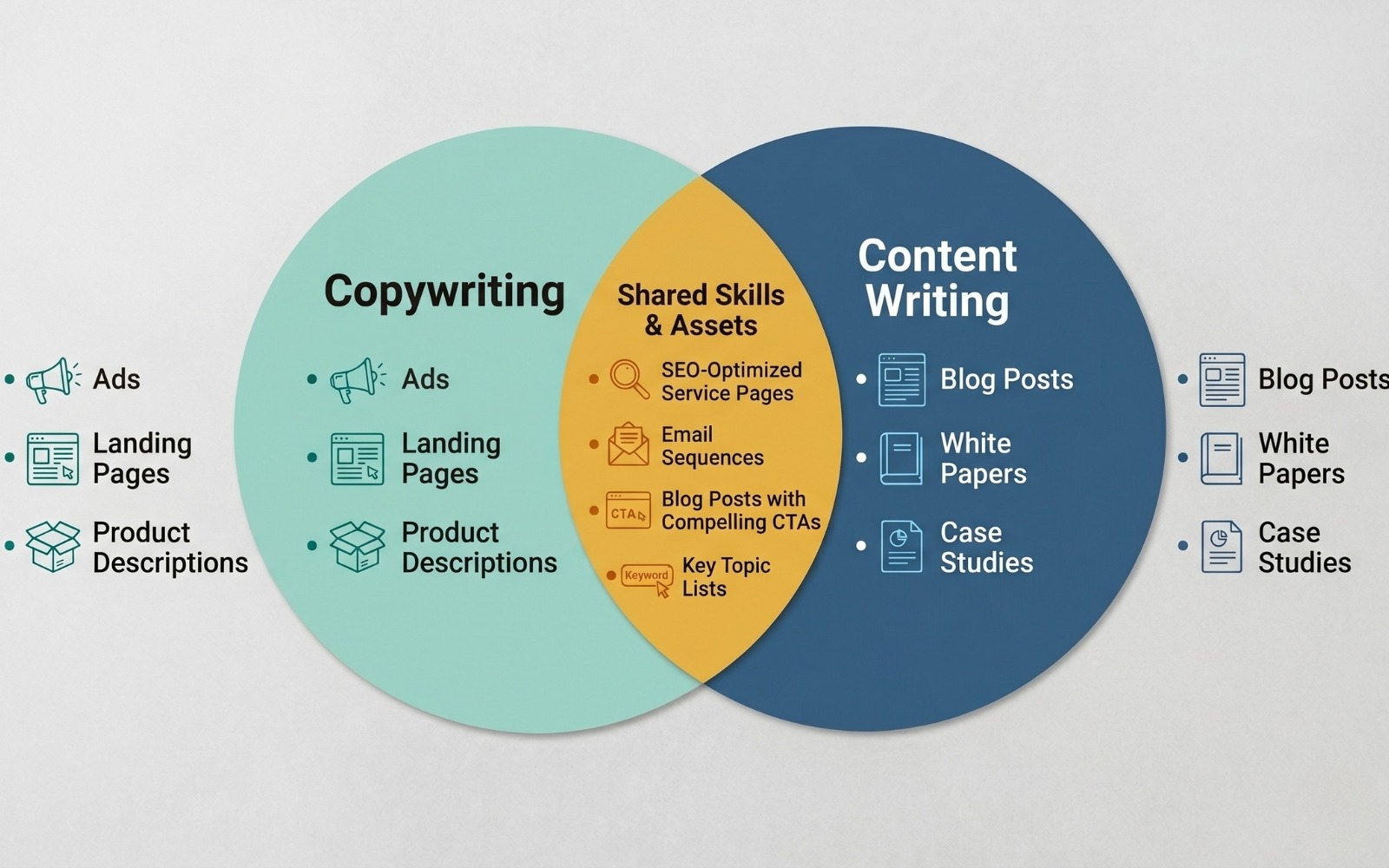
There are formats that genuinely sit between the two disciplines, and this is where most of the confusion originates. An SEO copywriting service is exactly what it sounds like: writing that has to satisfy both conversion intent and search intent simultaneously. A service page is the clearest example. It has to rank for the right query, which requires content thinking around keyword mapping, topical relevance, and E-E-A-T signals. It also has to convert the reader who arrives, which requires copywriting thinking around how to frame the offer, what objections to handle, and what the reader needs to believe to take the next step. Both sets of skills are present or the page underperforms on at least one dimension.
Email sits in a similar overlap. An onboarding sequence is content writing. It exists to educate a new user, build familiarity with the product, and establish the relationship over the first weeks. A promotional campaign email is copywriting. It has a time-bound offer, a clear action, and a conversion goal. The formats look identical. The craft underpinning them is different. A writer who approaches the promotional email with a content-writing mindset produces something that informs without ever creating urgency to act.
Blog posts with strong CTAs sit here too. A well-structured blog post is primarily content writing: it earns a ranking, it serves a reader, it builds authority. But the closing section of that post, the part where a reader who found it useful is guided toward a relevant service, is copywriting. One piece of content, two disciplines, each responsible for a different outcome.
This is why one person can do both well, and also why having a single writer do both without the right brief and the right framework tends to produce work that does neither excellently. The overlap is real. But the overlap zone is a place where both skills need to be consciously applied, and knowing which mode you are in at any given moment is the professional distinction that separates average writers from genuinely effective ones.
How to Check Whether Someone Genuinely Understands Both
This comes up often enough in conversations with clients that it is worth addressing directly. If you are hiring a writer, briefing an agency, or evaluating your own team, here are the questions that actually reveal whether someone understands the distinction in practice rather than theory.
For a copywriter, ask:
- “Walk me through how you would approach a landing page brief.” A copywriter who understands their craft will talk about the reader’s state of mind when they arrive, what they need to believe to take the next step, what objections typically appear at this stage, and how the structure moves the reader from arrival to action. Someone who lacks this foundation will describe the format without describing the persuasion logic.
- “How do you know if a piece of copy worked?” The answer should be specific and metric-driven. Conversion rate, click-through rate, cost per acquisition. A vague answer about whether it “felt right” or “read well” is the signal that this writer is applying content writing instincts to a copywriting function.
- Show them a weak landing page and ask what is wrong with it. A trained copywriter will identify structural problems: the lead buries the offer, the proof section appears before the problem has been stated, the CTA creates friction instead of removing it. Someone without this training will say the copy is “too formal” or “needs to be more engaging,” which tells you they are thinking about tone rather than persuasion architecture.
For a content writer, ask:
- “How would you research and brief a long-form guide on a topic you have never covered before?” A content writer who understands their craft will talk about identifying the search intent behind the target keyword, mapping what the top-ranking results cover and where the gaps are, and finding the Information Gain angle: what original perspective or experience can be added that the existing results omit. Someone without this foundation will describe writing about the topic thoroughly without any strategy around what makes this piece better than what already exists.
- “How do you know if a piece of content worked?” The answer should cover a timeframe and a range of signals: organic impressions, click-through rate, time on page, internal navigation from that post, and ideally whether it contributed to any conversion path. An answer that only mentions traffic volume is incomplete. An answer that says “it got good feedback” is a red flag.
- Ask them to explain E-E-A-T in practical terms. A content writer working on organic content now has to understand what Google is evaluating when it decides whether a piece deserves to rank and stay ranked. Our perspective on this is documented in our post on what changed after the March 2026 Google core update. If a writer describes E-E-A-T as a checklist of SEO tasks rather than as a genuine quality signal about documented expertise and experience, they are working from an outdated understanding of the discipline.
Why Both Functions Are Necessary From a Business Perspective
A business that invests only in content writing builds an audience it cannot convert. A business that invests only in copywriting converts an audience it cannot build. Both statements reflect a real failure mode we see in practice.
The content-only trap looks like this: a company builds organic traffic through excellent blog content. Visitors arrive, read, and leave. The content earns rankings and impressions. The pipeline shows nothing attributable to content because the content never moved readers anywhere useful. There are no service pages written with enough conversion intent to capture the interest the content created. There are no CTAs that connect the informational content to the commercial next step. This is one of the most common patterns we address in our content marketing engagements.
The copy-only trap looks like this: a company runs ads to a well-written landing page and gets conversions from paid traffic. But there is no organic presence, no content that earns trust before the ad is seen, no brand authority that makes the ad more credible than a competitor’s. The moment the ad spend stops, the revenue stops. There is no compounding asset. Every customer acquisition costs the same amount or more. The copy is good. The foundation under it is borrowed.
The businesses we see building durable growth use both functions in the right sequence. Content writing builds the audience, earns the trust, and creates the search presence. Copywriting converts that presence into action. The content strategy earns the reader’s time. The copy earns their decision.
For B2B companies specifically, the sequence matters because the sales cycle is long. A buyer researching a service partner is reading educational content weeks or months before they evaluate vendors. If your content strategy earns their attention during that research phase, your copywriting on the service page is converting a reader who already trusts you. Our work on generating B2B leads through organic search is built entirely around this sequence. If your content strategy is absent, your landing page is meeting that buyer for the first time and has to do all the trust-building work in one page. That is a harder task and a lower conversion rate.
For D2C brands, the sequence compresses but the logic holds. A first-time visitor who found your brand through an informational search query arrives with more intent and less resistance than a visitor who was interrupted by a paid ad. The content earned a warmer audience for the copy to convert.
Which One Does Your Business Actually Need Right Now
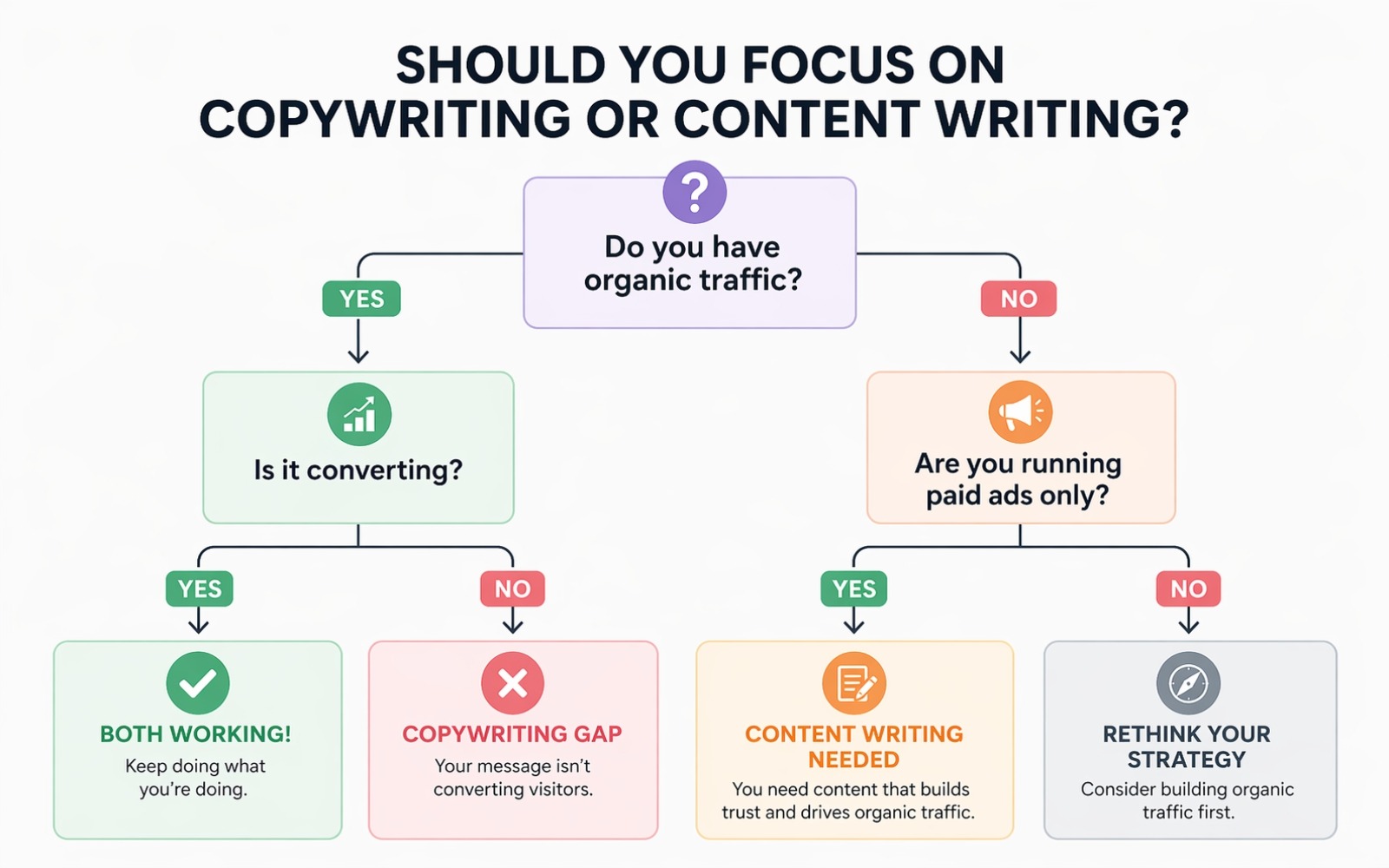
The honest answer is usually both, eventually. But the starting point depends on where your current gap is.
You likely need copywriting work first if:
- You have traffic arriving on your service pages or product pages but the conversion rate is low. The audience exists. The page is failing to convert them. This is a copywriting problem.
- You are running paid ads to landing pages that are underperforming. The ad might be fine. The landing page is probably the constraint. Website copywriting services applied to the landing page will show results faster than content work will.
- Your website describes what you do rather than why a visitor should trust you with their problem. Most small and mid-size business websites have this issue. The about page talks about the company history. The service page lists capabilities. No page answers the visitor’s actual question: “Is this the right choice for my situation?”
You likely need content writing work first if:
- Your website receives little or no organic traffic. Your pages are indexed but generating no impressions for relevant queries. This is an absence of content strategy. Copywriting improvements to your existing pages will generate zero traffic where none exists. Content writing services that build topical authority and target the right search queries will.
- You are entirely dependent on paid acquisition and need to reduce cost per customer over time. Content writing builds the compounding organic asset that paid channels cannot. This is a long-term investment with a different return profile than ad spend, but the compounding nature means it pays more per unit of effort the longer it runs.
- You sell something with a long consideration cycle and buyers who research before they buy. B2B services, professional services, high-consideration D2C categories like supplements, furniture, or financial products. The buyer is looking for answers before they are looking for a vendor. Content writing that appears during that research phase creates familiarity before the sales conversation begins.
If you are genuinely unsure, the fastest diagnostic is to look at your analytics. Traffic with low conversion points to copywriting gaps. An absence of organic traffic points to content gaps. Both problems together mean you need a strategy that addresses sequence: build the audience with content, convert it with copy.
One Person Can Do Both. Here Is What That Actually Requires.
A writer who does both well is genuinely valuable, and they exist. But the competence is far from automatic. Most writers develop a dominant mode. They are either naturally conversion-oriented and think in terms of action and persuasion, or they are naturally editorial and think in terms of depth, structure, and reader value. Both modes are learnable. The gap between knowing both in theory and executing both well under a brief is real and worth understanding before you brief someone to do it.
A writer who can do both has typically spent deliberate time on conversion psychology, beyond content strategy alone. They understand why certain sentence structures create forward momentum in copy. They know how to write a CTA that feels earned rather than imposed. They can switch modes inside a single piece, writing an informational opening that builds trust and a closing section that drives action, without the two sections feeling like they were written by different people.
When we evaluate writers for SEO copywriting service work or for content and copywriting projects that span both functions, the test is straightforward. Show me a service page you wrote and tell me how it performed. Show me a blog post with a CTA and tell me whether the CTA converted. The answers reveal which mode the writer defaults to and whether they have the range the work requires.
For clients who want one writer to handle both functions, the brief has to be explicit about which mode applies to which section. A brief that just says “write our homepage” falls short. A brief that specifies which sections are building trust and which sections are driving action gives a skilled writer the structure they need to apply both disciplines correctly.
What This Means When You Sit Down to Brief a Writer
The brief is where the distinction becomes practical. Here is how we structure briefs differently depending on which discipline the work belongs to.
A copywriting brief answers: who is the reader at the moment they encounter this piece, what action are they being asked to take, what do they need to believe to take that action, what objections are likely to stop them, and what proof exists to overcome those objections. The brief also specifies the conversion context: where is the reader coming from, what do they already know, and what is the friction between where they are and the action we want.
A content writing brief answers: what query is this targeting and what is the intent behind it, what does the reader already know, what does this piece add that the existing results omit, what is the one thing the reader should leave with, and where should they go next. The brief also specifies the topical context: which cluster does this piece belong to, what pillar page does it support, and what internal links should it carry.
A brief for a piece that spans both, like a service page or a blog post with a strong conversion close, answers both sets of questions. The content section of the brief covers the search intent and topical requirements. The copy section covers the conversion architecture: which sections need to move a reader toward action and how that happens structurally.
When we write briefs for clients across our marketing writing services work, this dual-layer structure is standard. It takes longer to build the brief correctly. It produces work that is measurably better than work written without one.

A Note for Agencies: White Label Writing That Understands Both
One context where this distinction matters acutely is white label writing. Agencies that subcontract writing work often find that a vendor produces technically competent output but misses the conversion layer entirely. The blog posts rank. The landing pages describe. Nothing converts. If you run an agency and need writing output that applies both disciplines correctly and at a standard that holds through algorithm updates, our white label SEO work includes this: content built to rank, copy built to convert, briefs structured to separate the two functions clearly before writing starts.
The brief structure is the deliverable that most white label arrangements skip. We include it as a prerequisite rather than an optional add-on. It is the reason content produced under a white label arrangement can be handed to a client without the agency having to explain why a blog post about their services carries zero conversion intent.
Frequently Asked Questions
What is the difference between a copywriter and a content writer?
A copywriter writes to drive a specific action: a click, a sign-up, a purchase, a call. Every decision in the piece, including the headline, the structure, the proof, and the CTA, is in service of that action. A content writer writes to build understanding, earn trust, and create organic visibility over time. Blog posts, pillar pages, case studies, and white papers are content writing outputs. The accountability structures are genuinely different: copy is measured on conversion, content is measured on authority, traffic, and reader engagement over weeks and months.
Can one person do both copywriting and content writing?
Yes. A writer who has developed both skill sets can switch modes within a single piece, writing an informational opening that builds trust and a closing section that drives action. What matters is whether they understand which mode applies to which section and are briefed clearly enough to apply both correctly. Most writers have a dominant mode. Without a brief that specifies the conversion intent for relevant sections, a naturally editorial writer will produce content that informs but never moves anyone toward an action.
Which is better for SEO: copywriting or content writing?
Content writing is the primary driver of organic search visibility. Blog posts, pillar pages, and topic cluster articles are content writing outputs, and they are what build the topical authority that earns rankings. But service pages and product pages that need to rank AND convert require both disciplines simultaneously. This is what an SEO copywriting service delivers: writing that satisfies the search algorithm by covering the right topics and demonstrating genuine expertise, and writing that satisfies the visitor by moving them toward an action. Applying only one discipline to these pages produces results that are half-functional.
What does a copywriter actually do day-to-day?
A copywriter spends most of their working time on: writing and testing ad copy for paid campaigns, drafting and iterating on landing pages, writing product descriptions for ecommerce, and creating email sequences for promotional campaigns and sales flows. They read conversion rate data, study headline performance, and revise based on what the metrics show. The job is closer to applied psychology than to traditional writing. If you want to understand the broader scope of marketing writing services that include both copywriting and content functions, that page covers the full range.
What does a content writer actually do day-to-day?
A content writer spends most of their time on: researching search intent and keyword opportunities, building and following content briefs, writing long-form editorial content, developing pillar pages and cluster articles, and producing case studies and thought leadership content. They study organic performance data, monitor ranking movements, and revise based on what is gaining impressions and clicks. Understanding what content writing in marketing actually covers is a useful starting point if you are building a content team or briefing an agency for the first time.
Why does my content get traffic but produce no enquiries?
This is almost always a copywriting gap sitting inside a content success. The content is earning the audience through organic search. The copy on the page, in the CTAs, on the linked service page, is failing to convert that audience into action. The fix starts with auditing what happens after a reader finishes the content: where do they go next, what does the CTA say, where does it link, and is the service page it links to written with conversion intent or just listing capabilities. Improving the conversion layer often produces tangible results from traffic that already exists.
What is content and copywriting when used together?
Content and copywriting used together refers to a strategy where content writing builds the organic audience and earns trust over time, while copywriting converts that audience into action at the right moments. A B2B business might publish a pillar page and cluster blog posts to earn organic traffic, then use conversion-focused copy on the service page those posts link to. A D2C brand might build an informational blog to earn discovery traffic, then use product page copywriting and email sequences to convert that traffic into sales. The two functions compound each other when the brief for each is structured correctly.
Is website copy the same as content writing?
The terms are often used interchangeably, but the distinction matters in practice. Website copy typically refers to the persuasion layer: homepage, service pages, product pages, and landing pages. This is copywriting, accountable to conversion. Content written for a website, including blog posts, resource articles, and guides, is content writing, accountable to organic visibility and reader value. A full website usually needs both. The pages that need to rank and inform are content writing work. The pages that need to rank and convert are copywriting work.
How We Approach Both at The Subtext
We are a boutique digital marketing agency in Surat that specialises in SEO and content marketing. Writing sits at the centre of most of what we do. We see the copywriting and content writing distinction play out in almost every client engagement, and in both directions.
Most of our B2B clients come to us with a content gap: they have a site, some activity is happening, and nothing is compounding. The SEO work we build for them starts with identifying which function is actually missing. If the site has no organic presence, the first investment is content writing. If organic traffic exists but converts at nothing, the first investment is copywriting on the pages that receive that traffic.
Most of our D2C and ecommerce clients come to us with a conversion gap: traffic exists but the pages are doing none of the persuasion work they need to do. We address that through structured briefs that call out the conversion intent for each section before a word is written.
The diagnostic is straightforward. The brief structure that follows from it takes longer to build than most clients expect. The results it produces are measurably different from work written without it.
If you want a clear read on which function is actually your gap, or if you need writing work that spans both disciplines and want it done to a standard that holds in the current content environment, write to us at hello@thesubtext.in. We are specific about what we can do and direct about what the work will actually take.