5 SEO Red Flags in Your Current Agency Report (And How to Audit)
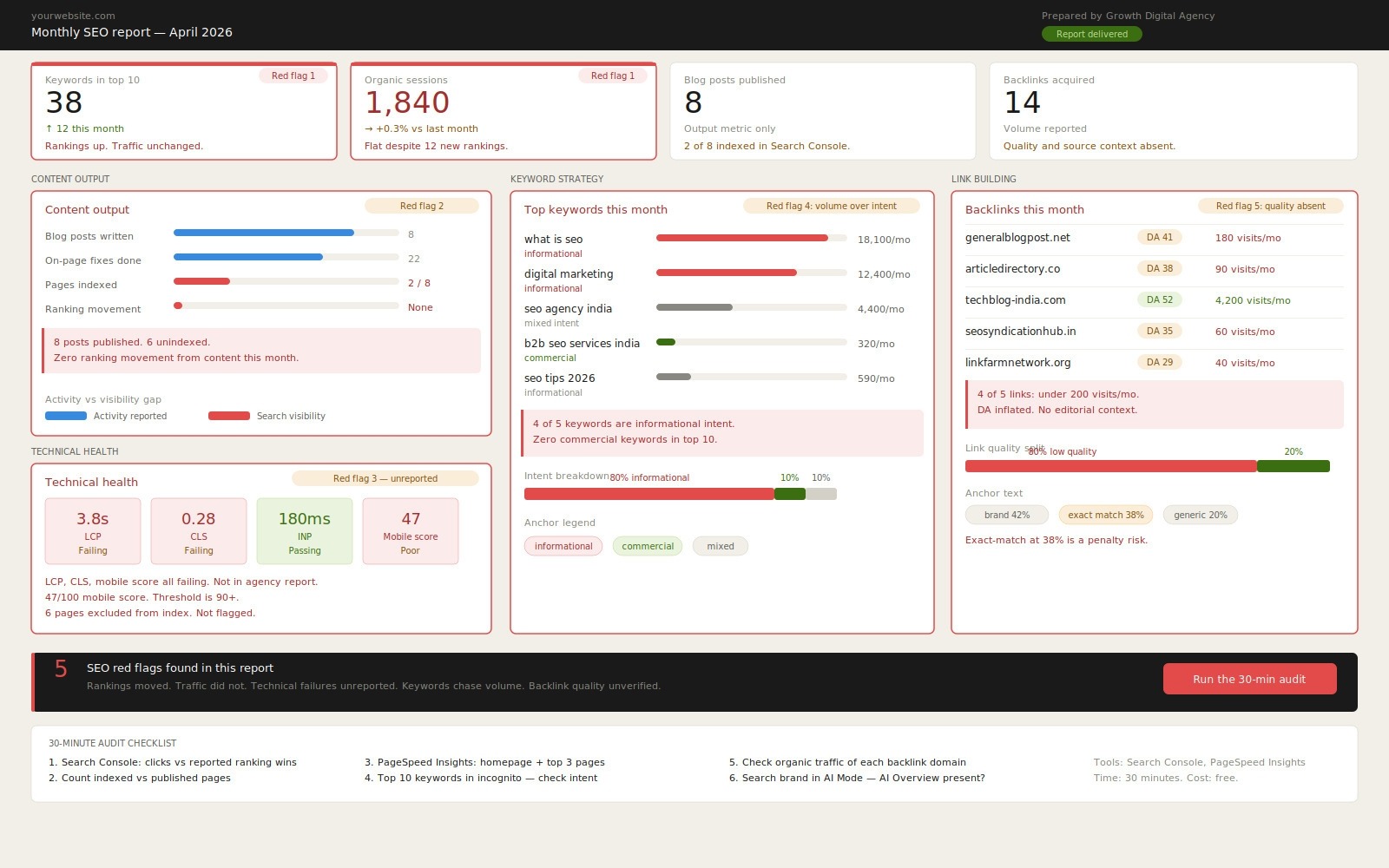
SEO red flags rarely announce themselves. They hide inside reports that look clean, behind rankings that moved without driving traffic, and underneath months of activity that produced no measurable business outcome.
Most businesses only recognise these SEO errors after the damage is done: a domain that has stalled, a content library that ranks for nothing, or a backlink profile that quietly accumulated risk. By that point, the agency has been retained for months and the report has said nothing useful the entire time.
These are the five most common SEO red flags that appear in underperforming agency accounts, what each one means, and a step-by-step process to audit your current report in under 30 minutes using only free tools.
Red Flag 1: Rankings Are Moving But Organic Traffic Remains Flat
This is the most common SEO mistakes hide in plain sight. The report shows improved keyword positions. A few head terms moved from page 2 to the bottom of page 1. The bar charts look encouraging. But scroll down to the traffic graph and the organic sessions line is flat or declining.
Rankings and traffic are different metrics. A keyword can rank on page 1 and generate zero clicks if the search intent behind it has shifted to informational results, featured snippets, or zero-click formats. An agency that is chasing rankings for their own sake without tying position to actual click-through data is optimising for optics.
What to check:
- Open Google Search Console. Go to Performance > Search Results.
- Filter by the keywords your agency reports on as wins.
- Check the Clicks column alongside the Position column. A keyword at position 4 with 2 clicks per month is a meaningless win.
- Look at the Pages tab. Identify which pages are actually pulling organic sessions. If those pages are absent from your agency report entirely, that is a structural problem.
The deeper issue this flag points to: the agency’s reporting workflow is disconnected from business outcomes. Good SEO services start from what traffic needs to do, then work backwards to the keywords worth targeting.
Red Flag 2: The Report Is Full of Output Metrics With Zero Ranking Movement
Content published: 8. Backlinks built: 14. On-page optimisations completed: 22.
These are activity metrics. They describe what the agency did. They say nothing about what changed in search visibility as a result. Output-focused reporting is one of the clearest SEO errors a retained agency can make because it substitutes effort for results.
A legitimate SEO engagement should show a direct line between activity and ranking movement or at minimum a reasonable explanation for why that movement has a lag. If your agency has been running campaigns for six months and the report shows outputs but the keyword landscape in Search Console looks identical to where you started, the work is decorative.
What to check:
- Pull the Search Console Performance report for the last 6 months. Set comparison to the 6 months prior.
- Look at total impressions and total clicks. Both should be trending upward if content production is working.
- Cross-reference the content your agency published against the pages generating impressions. If their content assets are invisible in Search Console, the content is ranking for nothing.
- Ask for a keyword ranking report that shows movement over time, not just current position.
Content marketing reporting should always show the delta, the before and after in ranking and traffic terms. Output counts without that delta are noise.
Red Flag 3: Technical SEO Errors Are Absent From Every Report
A clean-looking report is sometimes a sign that the agency is avoiding the uncomfortable parts of an account. Technical SEO errors accumulate silently. Crawl budget gets wasted on paginated URLs. Orphaned landing pages sit unindexed. Core Web Vitals degrade as the site adds plugins and third-party scripts. Page speed drops below mobile thresholds.
If your monthly report has zero mention of technical findings, one of two things is true: the agency is auditing the site and finding nothing (unlikely for any site older than 12 months) or the agency is running no technical audits at all and relying entirely on content and link activity to show movement.
What to check:
- Go to Google Search Console > Coverage. Look at the number of pages in Valid and compare against your actual published page count. A significant gap means pages are failing to index.
- Check the Excluded section. Crawled but not currently indexed and Discovered but not currently indexed are two categories worth escalating with your agency immediately.
- Run a Core Web Vitals check via PageSpeed Insights for your homepage and top 3 landing pages. Failing scores that appear in no agency report should be a direct conversation.
- Use Screaming Frog or Sitebulb’s free tier to crawl your site. Look for broken internal links, redirect chains longer than two hops, and missing meta descriptions on ranking pages.
Technical debt is the SEO issue that compounds the fastest. One missed crawl directive can suppress an entire subfolder from indexing for months. A website technical audit should be a standing deliverable in any SEO retainer, at minimum once per quarter.
If your site runs on WordPress, mobile performance deserves its own audit pass. There is a detailed breakdown of mobile optimisation for WordPress sites that covers the specific failure points agencies tend to overlook.
Red Flag 4: The Keyword Strategy Is Targeting Volume Over Intent
High search volume is seductive. An agency that lands a client on a 10,000-monthly-search keyword looks capable, even if that keyword generates zero qualified leads. This SEO mistake is especially destructive for B2B businesses because the gap between search volume and commercial intent is widest in that segment.
A manufacturer in Gujarat ranking for ‘what is supply chain management’ is capturing an audience of students and researchers. The same manufacturer ranking for ‘B2B procurement platform for industrial components’ is capturing buyers. The volume numbers are incomparable. The business value is not.
Agencies that optimise for vanity keywords do it because ranking for broad terms is easier to demonstrate and harder for the client to connect back to lead quality. It is a retention strategy dressed up as SEO strategy.
What to check:
- Pull your top 20 keywords from Search Console by impressions. For each keyword, open an incognito window and run the search.
- Look at the SERP. Is the page 1 result a mix of editorial content, forums, and informational guides? That keyword has informational intent. If your product or service page is ranking there, the traffic will bounce.
- Ask your agency for a conversion rate breakdown by keyword source. If they cannot produce this, they are measuring SEO in isolation from business outcomes.
- For B2B accounts specifically, check whether any of the target keywords contain buyer signals: vendor, supplier, pricing, for manufacturers, enterprise, bulk. Volume will be lower. Conversion potential is significantly higher.
Intent-led keyword targeting is the foundation of real B2B SEO. Chasing broad informational terms to build impressive ranking reports is one of the most persistent SEO errors in the industry. A B2B SEO company worth working with will always connect keyword targeting to pipeline, not pageviews.
Red Flag 5: The Link Building Section Shows Volume Without Context
14 backlinks acquired this month. The report lists the domains. The DA scores look solid. The anchor text column shows brand and generic terms. And yet the page being linked to has seen zero movement in three months.
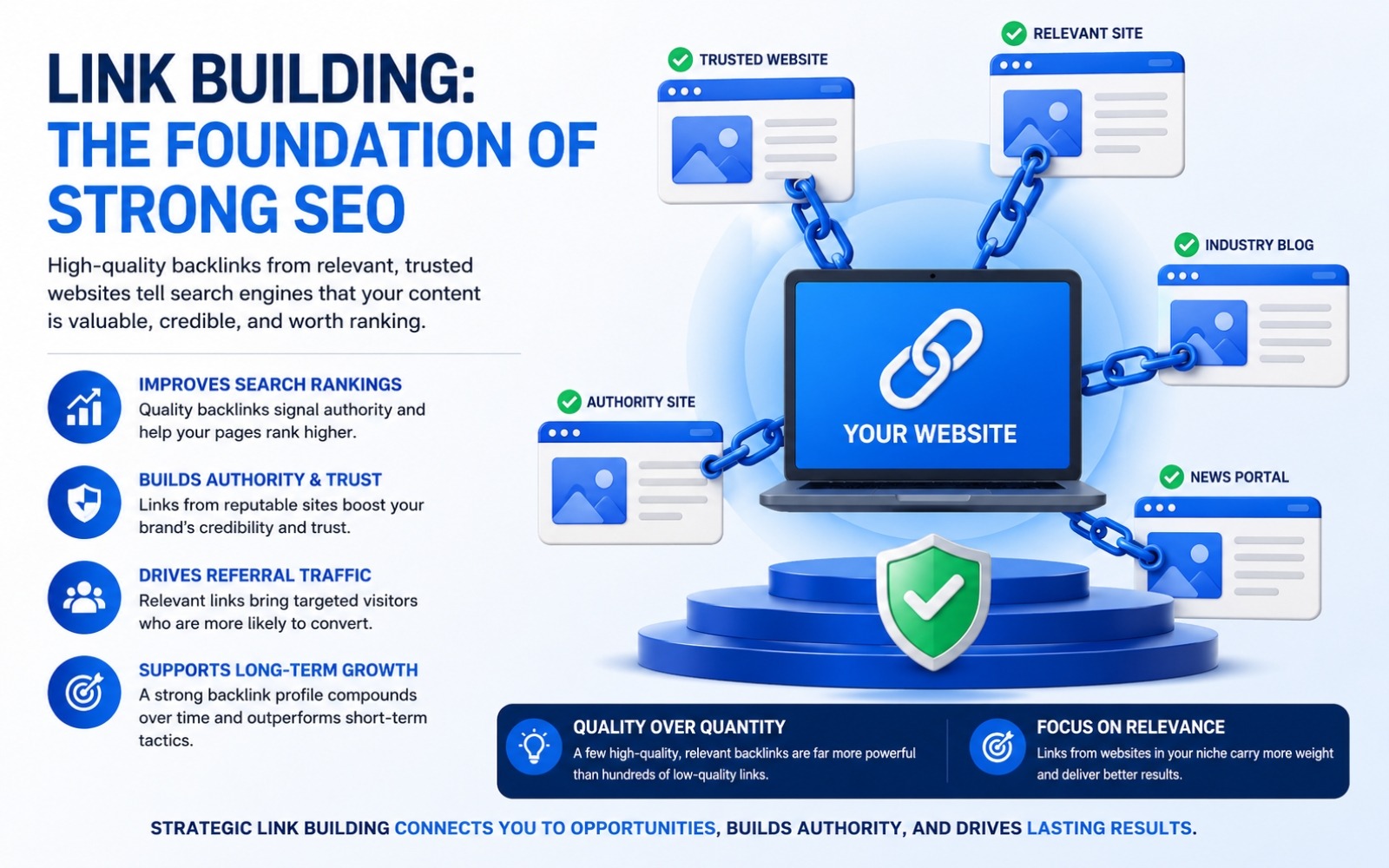
Link building at volume without strategic context is one of the SEO red flags that separates experienced practitioners from those running checklists. Links from irrelevant domains in unrelated niches pass minimal authority. Links from sites with inflated DA but low real-world traffic pass almost nothing. Links buried in footer syndication networks or sitewide widgets are actively discounted by search algorithms.
The question to ask about any link building report is: where did these links come from and are those sources the kind of sites that would link to a business like mine organically? If the answer requires significant explanation, that is a sign the link acquisition process prioritises output over quality.
What to check:
- Take the 5 most recent backlinks from your agency report. Run each domain through Ahrefs Site Explorer or Semrush’s Backlink Checker (free tier available for both).
- Look at the organic traffic column for the linking domain. A site with DA 40 and 200 monthly organic visitors is a red flag. That DA is inflated and the link carries no real signal.
- Check the page the link appears on, specifically whether it contains real editorial content or is a paid placement, a directory listing, or a syndication feed.
- Look at the anchor text distribution across your full backlink profile. Excessive exact-match anchors are a penalty risk. Healthy profiles are predominantly brand, naked URL, and generic terms.
Link building done correctly operates within white hat SEO boundaries, which means acquiring links that would exist even if Google did not exist. Editorial links from relevant publications, supplier or partner cross-links, and content that earns citations organically are the long-term compounding assets. Volume-based outreach campaigns that fill a report but move nothing are a liability.
What a Weak Report Shows vs What a Strong One Should
Most clients read their agency report and feel reassured because the format looks professional. The issue is that professional formatting and strategic substance are different things. This table maps the most common report entries against what the same information should look like in a well-structured engagement.
What a weak report shows | What a strong report should show | What to ask your agency |
Keywords moved to page 1 | Clicks and CTR from those keywords | Show me Search Console clicks for each win |
8 blog posts published | Impressions and ranking movement from those posts | Which of these pages are indexed and ranking? |
14 backlinks acquired | Domain relevance and traffic of linking sites | Share the outreach process and editorial context |
Core Web Vitals: Pass | Actual CWV scores with trend over time | Show me PageSpeed scores for our top 5 pages |
Traffic up 12% MoM | Traffic segmented by intent and conversion path | What percentage of this traffic is commercial intent? |
AI Overview: not tracked | AI Overview presence for target queries | Which of our pages are being cited in AI Overviews? |
If your current report maps mostly to the left column, the reporting is structured around activity rather than outcomes. The right column is the minimum expectation for any retained SEO engagement past the three-month mark. The final row on AI Overview tracking is the most common gap in accounts inherited from agencies that have not updated their methodology in the last 12 months.
What SEO Actually Does for a Business (Beyond Rankings)
The conversation about SEO often collapses into rankings and traffic because those are the metrics that fit on a slide. The actual business function of SEO is different.
SEO structures your digital presence around the exact questions your buyers are asking at every stage of their decision-making process. A business with a well-built SEO architecture is reachable at the research stage, the comparison stage, and the vendor shortlisting stage. Most of its competitors are only reachable at the comparison stage because they rely on paid search for bottom-of-funnel intent.
This means SEO-driven businesses compound their visibility over time. A piece of content that ranks for a research-stage query in month three continues to build trust and generate traffic in month thirty. Paid acquisition stops the moment the budget stops. Organic visibility builds equity.
For B2B businesses in particular, where sales cycles are long and procurement decisions involve multiple stakeholders, SEO works as a trust-building mechanism. A prospect who found your brand through a genuinely useful piece of content has a different relationship with your business than a prospect who clicked a retargeting ad. That difference shows up in conversion rates and average deal size over time.
Understanding the current state of the discipline matters too. SEO and SEM best practices in 2026 have shifted significantly from the playbook that most agencies still run. The agencies that have kept pace with algorithm changes are operating with a fundamentally different methodology than those still relying on volume-based tactics.
Content quality is now a ranking signal in a much more substantive sense than it was three years ago. The March 2026 Google update accelerated the suppression of generic, formulaic content and surfaced pages that demonstrate genuine subject matter depth. If your agency is still publishing templated 800-word articles, that output is working against your domain authority.
What Google’s AI Overhaul Means for the SEO Your Agency Is Running
The conversation about SEO red flags has a new layer that most agency reports are completely silent on. The search engine your agency was optimising for 18 months ago has been structurally rebuilt, and the surface area of that rebuild is wider than most clients realise.
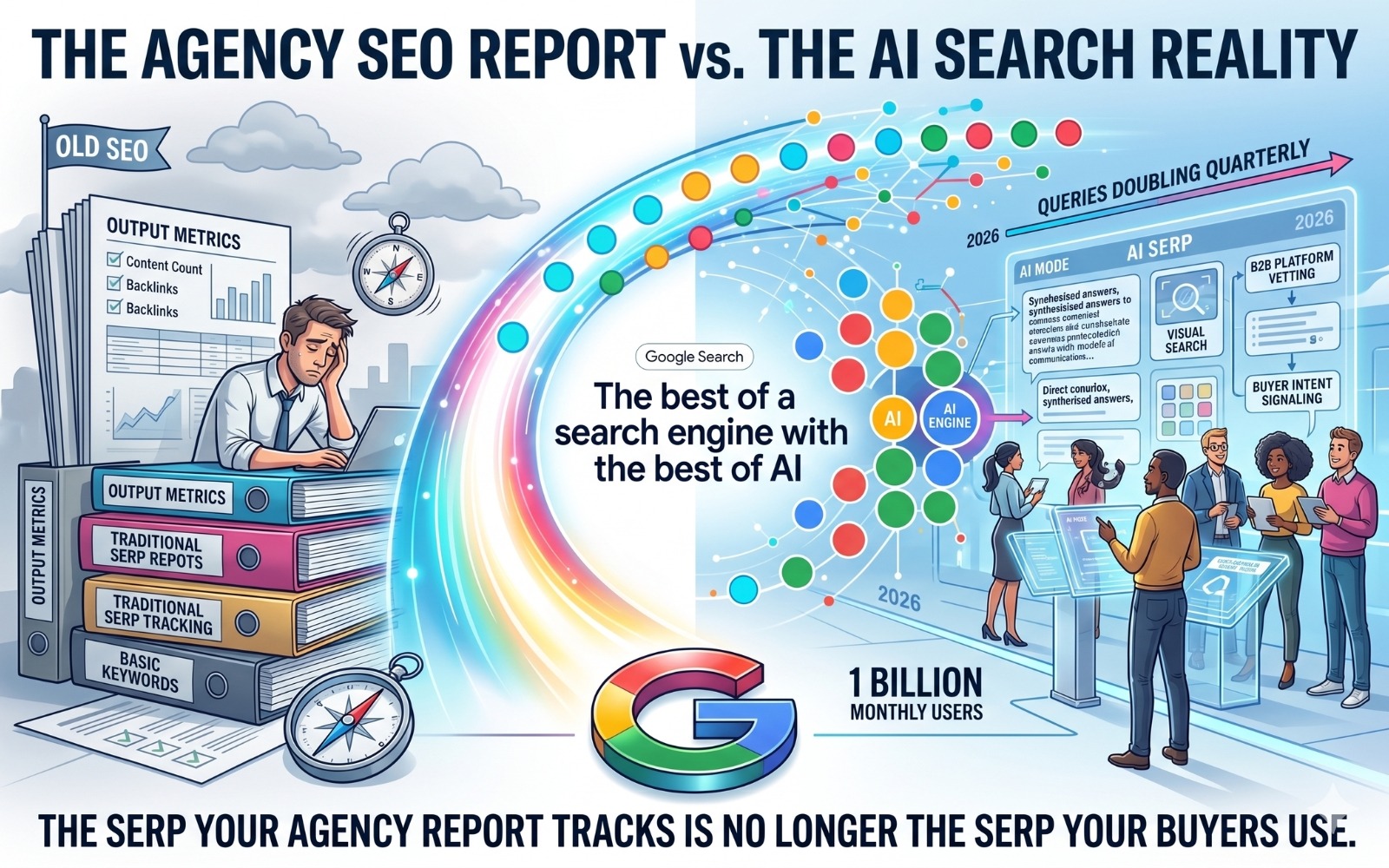
At Google I/O 2026, Google confirmed that AI Mode in Search has surpassed one billion monthly users. Queries through AI Mode are more than doubling every quarter. Google has now merged AI Overviews and AI Mode into a single seamless experience, meaning the path from a typed query to an AI-synthesised answer is shorter than it has ever been. The changes announced at I/O extend well beyond Search itself.
For any business evaluating their current agency’s performance, this matters for one reason: the SERP your agency is optimising for and the SERP your buyers are using are increasingly different things.
AI Overviews are now a primary visibility layer
AI Overviews pull from pages that demonstrate clear topical authority, genuine depth, and structured content that is easy to extract. A page optimised for traditional ranking signals, keyword density and backlink volume may hold its position in blue-link results while generating zero impressions in the AI Overview sitting above it.
If your agency report shows traditional ranking movement but your brand is absent from AI Overviews on your target queries, that is a gap worth examining directly. Ask your agency to show you which of your pages are being cited in AI Overviews. If they cannot answer that question, the reporting is operating on an outdated model of what search visibility means.
Search Agents are monitoring the web on behalf of your buyers
Google announced at I/O 2026 the arrival of Search Agents: persistent AI agents that users can create inside Search to monitor the web 24/7 on specific topics, automatically synthesising updates from blogs, news sites, social posts, and real-time data sources. The full detail is in Google’s I/O 2026 announcements.
For B2B procurement teams doing category research, this shifts discovery from active search sessions to passive background monitoring. A buyer in your sector can set an agent to track vendors, suppliers, or technology in your space. The businesses that get surfaced in those agent-synthesised updates are the ones with consistent topical depth across a subject area. A single optimised page with strong rankings will have far less presence in agent results than a domain that has built genuine authority across a cluster of related topics.
If your agency’s content strategy is built around individual keyword targets rather than topic clusters, the Search Agent update is a direct structural risk to your discovery pipeline. Your agency report should be addressing this explicitly.
Ask YouTube is changing how buyers consume vendor content
Google’s Ask YouTube feature lets users ask complex conversational questions and receive synthesised responses drawn from across YouTube’s full catalogue, including both long-form videos and Shorts.
For businesses that use video as part of their content mix, this changes the value proposition of YouTube SEO significantly. A well-optimised explainer video about your product category, your process, or a common problem your buyers face can now be surfaced as a cited source inside Ask YouTube responses. Video content that previously competed only for direct search traffic on YouTube now has a second discovery layer through conversational AI responses.
If your agency is managing your content strategy but has said nothing about how your video assets or YouTube presence connects to this shift, that is a gap in their understanding of where content discovery is heading.
Ask Maps is reshaping local and physical business discovery
Google launched Ask Maps in March 2026, a conversational AI feature inside Google Maps that answers complex real-world questions by drawing from information across over 300 million places and a contributor community of more than 500 million users. Instead of a standard search, users can ask questions like ‘Is there a supplier near me with same-day availability for industrial fittings?’ and receive a personalised, map-anchored response.
For businesses with a physical presence or location-dependent services, Ask Maps represents a new discovery channel that sits entirely outside the traditional SERP. Your Google Business Profile, the consistency of your location data, the quality of your reviews, and the completeness of your attributes all feed into Ask Maps responses.
Most agency reports cover Google Business Profile as a checkbox item at best. The Ask Maps launch means local data quality is now a component of AI-powered discovery, and an agency that treats it as a secondary concern is leaving a meaningful channel unoptimised.
Generative UI means position 1 is no longer the goal
Google confirmed at I/O 2026 that Search can now build custom layouts, tables, interactive visuals and graphs in real time for complex queries. The traditional idea of ranking at position 1 is being replaced by being the source that the generative interface draws from.
Pages structured with clear headings, logical information hierarchy, and schema markup are significantly better positioned as sources for generative responses. An agency that has not updated its on-page optimisation approach to account for extraction-ready content formatting is optimising for a version of Search that is fading.
SynthID verification is coming to Search and Chrome
Google confirmed at I/O 2026 that SynthID, its content watermarking and verification technology, is expanding from the Gemini app to both Search and Chrome. Google will increasingly be able to identify AI-generated content at the infrastructure level.
Agencies that have been generating bulk content with minimal editorial oversight are building an asset base that is becoming more exposed with each infrastructure update. The content quality signals that determine whether a page gets cited in AI responses are moving in the opposite direction from what a high-volume, low-editorial-investment content strategy produces.
What your agency should be doing differently right now
- Tracking AI Overview presence for target queries alongside traditional rank position.
- Building content in topic clusters rather than isolated keyword targets to establish the depth that Search Agent discovery rewards.
- Structuring pages with extraction-ready formatting: clear H2 and H3 hierarchy, definition-style opening sentences, structured data markup.
- Treating Google Business Profile completeness as an AI discovery signal, not a local SEO checkbox.
- Connecting video content strategy to Ask YouTube’s conversational discovery layer.
- Auditing content for genuine subject matter depth rather than surface-level keyword coverage, in the context of the E-E-A-T signals that AI-powered results increasingly rely on.
The practical question to put to your current agency: can they show you your brand’s presence in AI Overviews for your target queries? Can they demonstrate how content is being structured for the generative search interface? Can they explain how your Google Business Profile feeds into Ask Maps responses? If those questions produce blank answers, the reporting gap is structural.
The January 2026 algorithm updates and the subsequent Search infrastructure changes are detailed in the Google algorithm updates overview. Understanding that trajectory is important context for evaluating whether your current agency has kept pace.

Why Surat’s B2B Companies Are Underestimating This
Surat’s manufacturing and trading economy has historically operated through a combination of trade associations, distributor networks, and personal referrals. For decades, that was sufficient. The sales cycle was built on trust that developed over years, and digital visibility had a minimal role in it.
That model is under strain. Procurement teams at large enterprises now conduct a significant portion of their vendor research online before they speak to a sales representative. Industrial buyers use Google the same way consumer buyers do: they search, they compare, they shortlist. The difference is that the keywords they search are longer, more specific, and lower volume. An agency without B2B SEO expertise will look at those search volumes and decide the keywords are too small to target.
That is the wrong framework. A Surat-based textile machinery supplier ranking for ‘shuttleless loom suppliers Gujarat’ is visible to exactly the buyers who need what they sell. The search volume for that term is low. The commercial value per conversion is substantial.
The other objection that comes up frequently from Surat B2B companies is this: their customers come through industry contacts and exhibitions, so why invest in digital visibility? The answer is that the exhibition lead and the Google lead are often the same person at different stages. Someone who met you at a trade show will search your company name before calling. What they find at that point determines whether the conversation continues.
A business with a thin digital footprint, slow website, and two pages of generic content loses that trust check. A business with a well-structured site, useful content, and genuine search presence passes it. SEO is the infrastructure that supports every other sales and marketing activity, including the relationship-driven ones.
The AI changes above make this more urgent for Surat B2B companies specifically. Search Agents will synthesise vendor information for procurement teams doing category research. A business with thin digital content has no presence in those syntheses. Ask Maps means that a buyer searching for suppliers in Gujarat with certain capabilities will get a conversational, personalised response that draws from location data, reviews, and content authority. The companies that invest in this now are building a compounding advantage over competitors who are still relying entirely on trade relationships.
For companies in Surat specifically, local search visibility plays an important supporting role alongside broader B2B SEO. Appearing in relevant searches tied to location signals builds authority in the regional market while the broader keyword strategy builds national or sector-wide reach.
The question of what SEO costs relative to what it delivers is worth addressing directly. A breakdown of SEO pricing in India sets realistic expectations about what different engagement levels look like and what outcomes they are structured to produce.
The 30-Minute SEO Report Audit
This is the step-by-step process to run against your current agency report. The goal is to identify which of the five red flags above are present and how severe the gap is.
Minutes 1-5: Verify traffic against ranking claims
- Open Google Search Console > Performance.
- Set date range to match your agency report period.
- Compare the keywords in the report against actual click data in Search Console.
- Flag any keyword the agency marks as a win that shows fewer than 10 clicks in the period.
Minutes 6-12: Check content output against indexing reality
- Run a site: search in Google for your domain.
- Compare the number of indexed pages against the total pages on your site.
- Go to Search Console > Coverage > Excluded. Note the number of pages in Crawled but not currently indexed.
- Ask your agency which of the content assets they produced appear in that excluded list.
Minutes 13-18: Run a quick technical check
- Run your homepage and top landing page through PageSpeed Insights. Screenshot the scores.
- Check the Core Web Vitals section in Search Console under Experience.
- Look at the Enhancements section. Any structured data errors flagged there should be in your agency report.
Minutes 19-24: Audit the keyword strategy for intent
- Take your top 10 keywords by impressions from Search Console.
- Open each in an incognito SERP and categorise the intent: informational, commercial, transactional.
- Mark which category each keyword falls into and calculate what percentage of your SEO effort targets commercial or transactional intent.
- If fewer than 40 percent of targeted keywords carry commercial or transactional intent, that is a structural misalignment.
Minutes 25-30: Validate link quality and AI visibility
- Take the 5 most recent backlinks from your agency report. Check organic traffic of the linking domain using any free backlink tool.
- Identify whether each link appears on a page with real editorial content.
- Open your top 5 target queries in an incognito browser. Check whether your brand or content appears in the AI Overview. Note whether any competitor does.
- Search your business name in Google Maps and check whether your Google Business Profile attributes, categories, and review volume are complete. This feeds directly into Ask Maps responses.
Questions Clients Ask Us Before Starting an SEO Review
We have been with the same agency for two years. Does that mean the red flags do not apply to us?
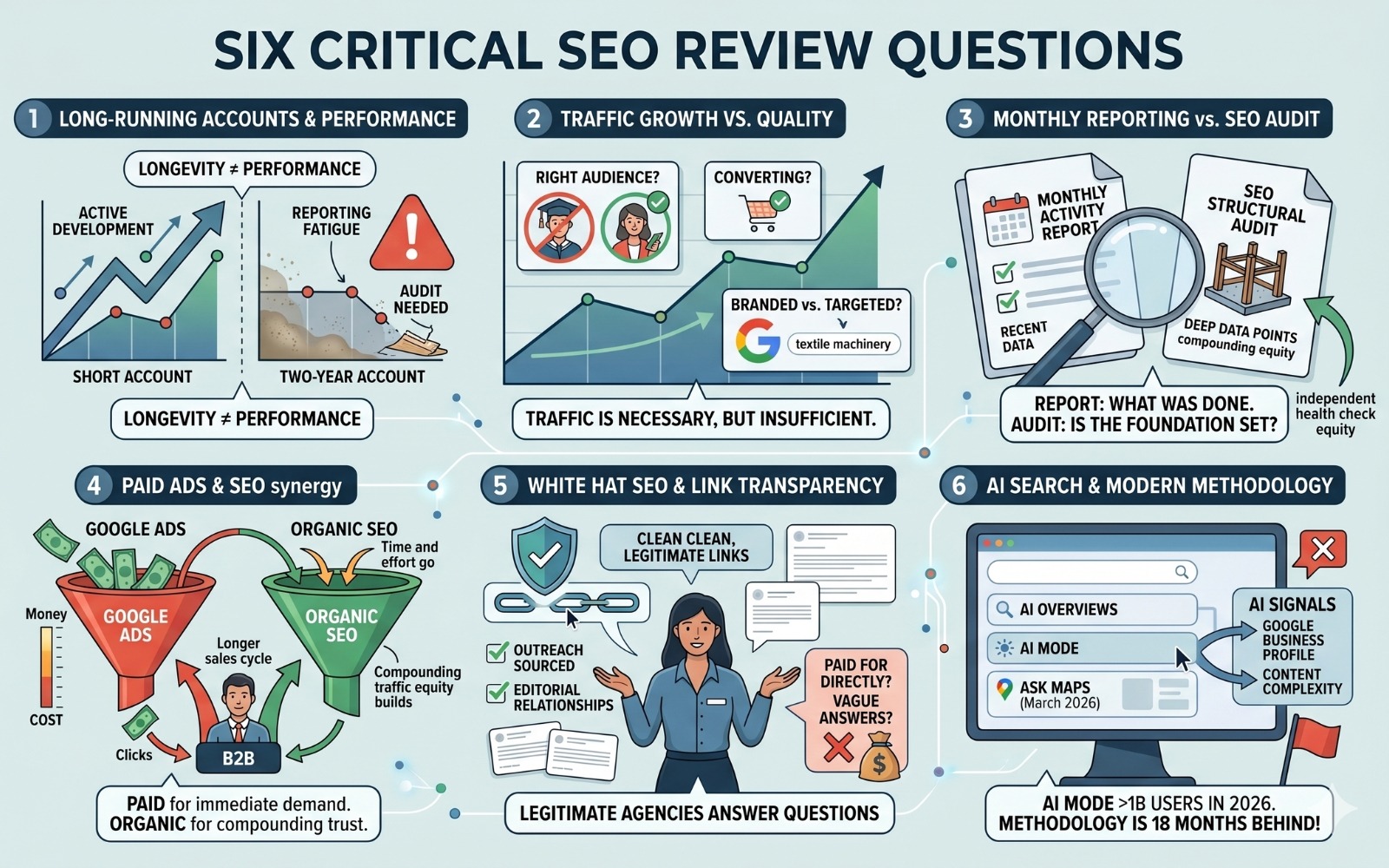
Longevity with an agency says nothing about performance quality. The red flags above are more common in long-running accounts because reporting fatigue sets in on both sides. The client stops scrutinising. The agency stops innovating. A two-year account with flat organic traffic is a stronger argument for an audit than a two-month account.
Our traffic is growing. Is that enough to rule out these SEO errors?
Traffic growth is a necessary condition for a healthy SEO campaign. It is insufficient on its own as a measure of quality. The questions to ask alongside traffic growth are: is the traffic from the right audience, is it converting, and is the growth coming from targeted keywords or from branded search and direct? Branded search growth driven by offline activity shows up as organic traffic even when SEO is doing nothing.
What is the difference between an SEO audit and what my current agency does monthly?
A monthly agency report documents recent activity and its apparent impact. An SEO audit is a structural review of the account’s health independent of recent activity. The two serve different purposes. A monthly report answers what the agency did and what moved. An audit answers whether the foundation of this account is set up to compound over time or is being maintained at the surface level only.
We already run Google Ads. Why do we need SEO?
Paid search operates on a linear cost model. Every click has a price and the cost scales with competition. Organic search operates on a compounding equity model. A page that earns its ranking continues to generate traffic without incremental spend. For B2B businesses with longer sales cycles, the combination of paid search for immediate demand capture and organic search for trust-building and research-stage visibility produces better cost-per-acquisition outcomes than either channel alone.
How do I know whether my agency is actually doing white hat SEO?
Ask for the source of every backlink in the last three months. Ask to see the outreach emails or the editorial relationships behind each placement. Ask whether any links were paid for directly. An agency doing clean work will answer these questions without hesitation. Deflection or vague answers about proprietary methodology are the response pattern that warrants concern.
My agency has said nothing about AI Mode, AI Overviews, or Ask Maps. Is that a red flag?
Yes. AI Mode surpassed one billion monthly users in 2026 and is now the default Search experience for a substantial portion of queries. Ask Maps launched in March 2026 and introduced conversational AI discovery inside Google Maps. An agency producing SEO reports with zero reference to AI Overview visibility, Search Agent implications, or Google Business Profile completeness as an AI signal is operating on a methodology that predates the current environment by at least 18 months.
An Independent Review Changes What You Can See
The five SEO red flags covered here are unlikely to appear in a self-prepared agency report. That is the nature of the problem: the entity being evaluated is also producing the evaluation.
An independent audit looks at the same account with different incentives. The goal is accuracy rather than retention. What it surfaces tends to be the information a business needs to make a genuine decision about whether its current SEO investment is structured correctly for the environment it is operating in today, including the AI-driven changes that most agency reports are still silent on.
If the patterns above feel familiar when held against your current reporting, a marketing consultancy conversation is a low-cost way to establish what an independent view of your account looks like.
For businesses considering what SEO should cost relative to what it produces, a review of SEO pricing structures in India provides a reference point for calibrating what a well-structured retainer looks like at different budget levels.
The 30-minute audit framework above requires no paid tools and no agency access. Run it against your current report. The gaps it reveals are the conversation to have next.