Types of Marketing Writing and When to Use Them
Pick any two formats from this list: a Google Search ad, a landing page, a welcome email sequence, a pillar blog post. All of them are marketing writing. All of them require someone who can write. Beyond that, they have almost nothing in common.
Different reader context. Different length. Different structure. Different metric. An ad is measured on whether it earns a click from someone who was doing something else entirely. A pillar blog post is measured on whether it still earns organic traffic eighteen months from now. Treating these as variations of the same task is where most marketing writing budgets go wrong.
This post maps every major format: what it is built to do, how the process behind it actually works, and what it costs you when the wrong format gets applied to the right goal. We work across content marketing, SEO, and marketing writing services for B2B companies and D2C brands, and this is genuinely the clearest map we can give you. If you want to go deeper on the strategic distinction between copywriting and content writing specifically, that is covered in full on our copywriting and content writing post. This one stays on the formats.

The Seven Types of Marketing Writing, and the Work Each One Is Actually Doing
1. Ad Copy
A Google Search ad gives you roughly 90 characters of headline space across three fields and 180 characters for descriptions. That is it. The person reading it typed a query, saw your ad among several others, and is going to decide whether to click within about two seconds.
Ad copy is the most constrained writing in marketing, and that constraint is the point. It forces decisions that longer formats can defer. You cannot explain your way to a click. You have to name something the reader already cares about and give them a reason to move. The structure that works is consistent across formats: surface the reader’s situation first, then the solution, then a specific reason to act. A headline that reads “Digital Marketing Agency Surat” is a label. A headline that reads “Your Website Is Losing Leads Every Day” is an interruption.
Search ads and social ads are genuinely different briefs. Someone who typed “B2B SEO company India” has already expressed intent. They are looking. The ad can be direct and specific because the reader is already in the right mode. A Meta ad appears to someone who was scrolling through their feed and had no plans to think about SEO today. The copy needs to earn attention before it can ask for a click. That shift in approach, from serving intent to creating it, is the core skill difference between search copywriting and social ad copywriting.
Ad copy performance lives in click-through rate and cost per click for the ad itself, then conversion rate for what happens after. When a campaign underperforms, the diagnosis usually sits in one of those two places. Strong click-through with low conversion usually means the ad is working but the landing page is the problem. Low click-through usually means the ad copy itself, or the targeting, needs rework.
2. Web Copy
Web copy is the persuasion layer of your site. Homepage, service pages, product pages, about page. The visitor who arrives has already found you somehow — through search, a referral, an ad, a LinkedIn post. Web copy is what either converts that arrival into a conversation or sends them back to Google to look at whoever ranked below you.
The thing most web copy gets wrong is the orientation. Company-first versus reader-first. Company-first copy explains what the business does, how long it has been operating, the services it offers. Reader-first copy asks what the visitor is trying to figure out and answers that. These two orientations produce completely different pages. The company-first version usually looks like most small business websites. The reader-first version actually converts.
Homepage copy carries the hardest brief because it serves multiple visitor types. Someone who found you through a branded search already knows roughly what you do. Someone who found you through an informational blog post is still figuring out whether you are relevant. Both land on the same page. The hierarchy that works: lead with what you do and who you do it for, immediately. Then give each visitor type a path that serves their specific intent. The worst homepages we see spend their first screen on awards, years in business, or a generic tagline. The reader’s only question at that point is whether they are in the right place. Answer that first.
Service pages are a tighter job. The visitor is already considering the category. They came looking for something specific. The page needs to confirm they are in the right place, explain what makes this option worth considering, handle the objections a buyer in this category typically carries, and give them a friction-free next step. The mistake is leading with the service description before the reader has been oriented to the problem the service solves. State the problem first. The service becomes the answer to a question the reader was already asking.
Service pages also have to rank. Website copywriting services that hold both — organic visibility and conversion — are doing two jobs at once. A page that ranks but does not convert is attracting attention it cannot use. A page that converts paid traffic but has no organic presence is renting its audience indefinitely. The brief for a service page needs to account for both, separately, before the writing starts.
3. Email Copywriting
Email is the one marketing channel where the reader has already given you explicit permission to be in their inbox. That changes the writing substantially. The resistance level is lower. The familiarity level is higher. But the attention window is still narrow — email is read in between other things, often on a phone, in a moment the reader did not plan for.
The most important thing about email copywriting is that different email types are completely different briefs. A welcome sequence for someone who just signed up for a newsletter is writing to someone curious but uncommitted. A promotional campaign for an existing customer base is writing to people who already trust the brand and need a specific reason to act. A re-engagement sequence is writing to people who went cold and need something worth coming back for. Using the same tone and structure across all three produces email that feels off-key in at least two of those situations.
Subject lines do the most work in the least space. The open rate is almost entirely a subject line decision. Lines that name a specific reader concern, state something counterintuitive, or promise something narrow and concrete outperform lines that announce. “Q3 marketing tips” is an announcement. “The blog format that stopped working in March” is something a reader decides about. Preview text is not a throwaway field — it is a second line of the subject, and it should be written as one.
Body copy for email follows the reading context, not the writing instinct. Short paragraphs. One ask per email, visible before the reader has to scroll significantly. The temptation to put multiple calls to action in a single email usually comes from wanting to be efficient with the audience. What it actually does is dilute the action rate. Pick one thing the reader should do. Make that thing obvious. Everything else in the email earns their way to that one point.

4. Blog Content and Long-Form Articles
Blog content is the format that compounds. An ad stops the moment the budget stops. A blog post that earns a ranking in month three can still be generating qualified organic traffic in month thirty. That compounding quality is what makes long-form content different from every other format on this list, and it is also what makes it the hardest to evaluate on a short timeline. If your content marketing strategy is being judged on leads generated in the first six weeks, the evaluation frame is wrong for the asset class.
The process behind blog content starts with search intent, not with topic ideas. A topic is what you want to write about. Search intent is what the person actually types into Google and what they expect to find when they do. Those two things are often different. A post titled “Why Content Marketing Matters for B2B Companies” might feel like good content. But if nobody is searching that exact question, or if the people who are searching it want a short overview and the post is 3,000 words of depth, the intent mismatch will show up in bounce rate and time on page before it shows up in rankings.
After intent comes what we call the Information Gain question. What does this specific post add that the posts already ranking for this query do not? Not just “we covered it too” but a genuinely different angle: original data from client work, a documented observation from a specific vertical, a process that came from figuring something out the hard way. Posts that restate what is already ranking have no structural reason to outrank it. The specificity has to come from actual experience, which is why generic content lost ground significantly after the March 2026 Google core update. If you want the full breakdown of what shifted and why generic content is losing rankings, our post on content writing after the March 2026 Google update has the specifics.
Structure matters more in long-form content than in any other format. Each H2 section needs to stand alone clearly, because Google’s AI Overviews pull sections from pages, not pages whole. A reader who arrives from a featured snippet might only read one section. That section has to deliver its answer without requiring the reader to have read everything before it. This changes how you write transitions, how you open each section, and how much context you assume.
5. Landing Pages
Landing pages are where ad spend meets the written argument. The visitor arrived because something upstream — an ad, an email, a social post — made them a promise. The landing page has one job: keep that promise and convert the visit into a specific action.
The brief for a landing page is the most precisely defined of any format because the reader context is known. You know where they came from. You know what they saw before they arrived. You know what action you want them to take. That precision is an advantage when the copy is built around it. It becomes a liability when the landing page ignores it and tries to do too much.
The persuasion sequence on a landing page follows the reader’s state of mind on arrival. They have a question or a problem in mind. The opening line confirms you understand it. The next section shows the solution. The middle section handles the objections that typically stop buyers at this stage, and does it with specifics rather than reassurances. The CTA at the bottom is the next step, not the ask. There is a meaningful difference between those two frames, and it shows in conversion rates.
Sales pages for higher-consideration decisions, B2B services, high-value products, professional services, follow the same logic but run longer. The length is earned by the complexity of the decision. A reader being asked to commit to a six-month engagement needs more reassurance, more proof, and more objection-handling than a reader being asked to buy a product they can return. The length of a sales page is not a style choice. It follows from the size of the commitment being asked.
6. Product Descriptions and Ecommerce Copy
Most ecommerce businesses underinvest in product copy. The standard is to lift the manufacturer specification and add a sentence about quality or suitability. That approach produces pages that look like every other page in the category, which means search engines have no reason to prefer yours and buyers have no reason to feel more confident on yours than on a competitor’s.
A product description is doing the job a good retail sales assistant would do if you were standing in a store. Not reading out the spec sheet. Actually answering the question the buyer is really asking: will this work for my situation, is the price justified for what I get, what does this feel like to use. Those questions are specific to each product and each buyer type. Generic descriptions answer none of them.
The dual pressure on product copy is real. The writing has to use the language buyers use to search for the product, so search surfaces the page for the right queries. It also has to speak directly to the person reading it right now, who is at the decision point and needs to feel confident. Both goals point in the same direction: specific, product-knowledgeable writing that treats the buyer’s real concern as the brief rather than the product spec as the brief.

7. Social and LinkedIn Content
Platform-specific content is its own writing discipline. What earns engagement on LinkedIn is genuinely different from what works on Instagram, and applying the same voice and structure across both produces content that feels off on at least one of them. For B2B brands, LinkedIn content is a long-game visibility format. The buyer who sees consistent substantive posts from your brand over four months has a different starting point in a sales conversation than someone who found your website the day they started looking. That familiarity is worth more than most B2B companies track.
LinkedIn content that works in a B2B context is usually built around a specific observation: something noticed across clients in a vertical, a pattern that keeps showing up in audits, a counterintuitive finding from a recent project. The posts that get ignored are the ones that state the obvious in an authoritative tone. The posts that earn saves and shares are the ones that say something the reader had half-thought but never seen stated clearly.
The first line is the only thing most readers will see before they decide to expand or scroll. LinkedIn truncates post text. That first line is the entire argument for whether the rest is worth reading. It cannot start with context. It cannot start with “As a marketer, you know…” It has to say something specific enough that the right reader immediately wants to know more.
Where the Format Boundaries Get Genuinely Blurry
Some formats do not sit neatly in one category, and that is usually why they are written badly. The writer applies one discipline when the format needs two.
Case studies are the clearest example. The narrative structure is editorial: document a situation, show what happened, explain the result. The purpose is persuasion: handle the objection every B2B buyer is carrying internally, which is whether a solution will actually work in their specific situation. A case study written purely as editorial produces something thorough but non-committal. A case study written purely as copy produces something that reads like a promotional brochure. The format needs both. The brief has to specify which sections are doing which job.
White papers sit between content marketing and credibility assets. They are too dense for discovery-stage readers who want answers quickly, and too informational to function as sales collateral in the traditional sense. They earn authority with buyers who are already in serious evaluation mode, the people who want evidence that the people behind the brand actually understand the subject at depth. White papers that work are built on original research or documented experience. White papers that do not work restate what is available in any industry blog, just longer.
SEO-focused service pages are the format that requires both disciplines simultaneously. They have to earn a ranking for a relevant query, which requires topical depth, keyword architecture, and demonstrated expertise. They also have to convert the visitor who arrives from that ranking. Most service pages do one of these adequately. The ones that earn organic visibility and convert are built from briefs that hold both requirements and assign each to the right section of the page.
How to Read Your Own Situation and Pick the Right Format
The right format depends on where the actual gap is, and most businesses have a clearer signal than they realise.
Pull up your Google Search Console. If your pages are getting impressions but low click-through rates, the meta titles and descriptions are failing to earn the click even when the rank is adequate. That is a copy problem, specifically homepage and service page copy. If your pages are getting clicks but the session data shows high bounce and low time on page, the landing experience is not matching what the search result promised. That is a web copy brief.
If Search Console shows almost no impressions for your service-related queries, the site lacks topical authority for those topics. Improving the copy on existing pages will produce no change if those pages are receiving no organic traffic. The investment needs to go into blog content and the pillar-cluster architecture that builds the authority signal over time. Copy improvements come after audience exists.
If you are running paid campaigns with a cost per acquisition that is too high, the diagnosis sits in two places: the quality of the click (targeting and ad copy) or the quality of the conversion (landing page copy). A campaign audit that separates those two variables tells you exactly which brief to write. Our post on B2B leads through organic search covers what this looks like specifically for B2B companies with longer decision cycles.
For B2B businesses, there is a format decision that rarely gets asked explicitly: are you present during the research phase your buyers go through before they start evaluating vendors? That research phase typically involves search queries for guides, comparisons, and answers to specific operational questions. If your content is absent from those searches, the first time a buyer encounters your brand is your service page. That page is then doing all the trust-building work that six months of blog content would have done before the buyer arrived. The conversion rate reflects that.
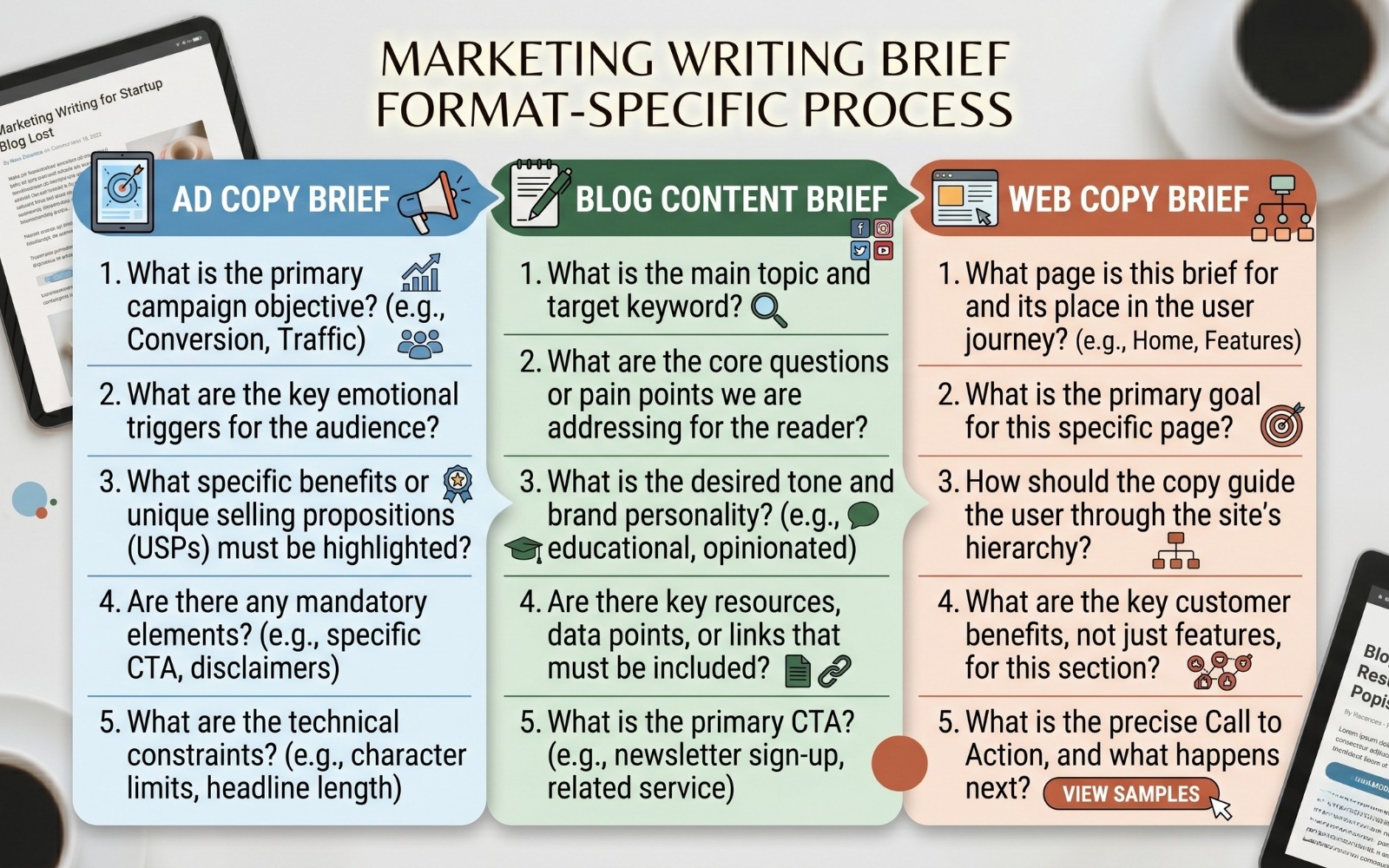
What Happens Before the Writing: The Brief as the Real Differentiator
The brief is what separates marketing writing that performs from marketing writing that fills a word count. This is worth stating plainly because most businesses skip it.
A brief for ad copy answers different questions than a brief for a landing page, which answers different questions than a brief for a blog post. Ad copy briefs need to know the reader’s mental state at the moment of encounter, the single action being requested, and what the reader needs to believe to take that action. Landing page briefs need to know exactly where the visitor came from, what was promised upstream, and what the most common objections are at this stage of the decision. Blog content briefs need to know the search query, the intent behind it, and what this specific post adds that the posts currently ranking for it do not.
When these questions are left unanswered, the writer fills the gaps with reasonable assumptions. Those assumptions are often wrong in ways that are hard to see from inside the writing process but show up clearly in performance data. A landing page that assumes the reader arrived knowing the brand writes very differently from one that assumes they arrived having just clicked an ad about a specific pain point. The wrong assumption produces a page that misses the reader’s actual state.
We build format-specific briefs for every project. The brief template for a blog post targeting B2B organic search looks nothing like the template for a service page, and neither looks like the one for an ad copy set. The brief is where the format knowledge gets applied before a word is written. Agencies doing white label SEO work benefit from this the most — a brief that handles format-specific requirements means fewer revision cycles and cleaner deliverables.
Frequently Asked Questions
What are the main types of marketing writing for business?
Ad copy, web copy, email copywriting, blog content and long-form articles, landing pages, product descriptions for ecommerce, and platform-specific social content. Each has its own structure, its own reader context, and its own accountability metric. Ad copy is measured on click-through rate and cost per click. Blog content is measured on organic rankings and traffic over time. Web copy is measured on conversion rate from visitors who arrive. Using the right metric for each format is as important as writing the format well.
How is ad copy different from web copy?
Ad copy is written for someone mid-scroll or mid-search who has given you no attention yet. Web copy is written for someone who has already arrived on your site. The mental state is completely different. Ad copy has to earn attention in two seconds. Web copy has already earned the visit and needs to earn the conversion. Ad copy wins on specificity and interruption. Web copy wins on orientation and trust. The structure of each follows from those different starting points.
What is email copywriting and when does it matter most?
Email copywriting matters whenever you have an opted-in audience and a specific action you want them to take. The highest-leverage email copy is usually the welcome sequence (first impression, sets expectations, establishes trust) and the promotional campaign (time-bound, specific offer, single ask). Re-engagement sequences are underused by most brands despite having strong potential ROI because the audience already knew the brand at some point. Subject lines are the single highest-leverage element in email writing. Most brands write them last and spend the least time on them, which is exactly backwards.
What makes blog content different from other marketing writing formats?
The compounding timeline. A well-ranked blog post earns organic traffic for months or years without ongoing spend. Every other format on this list stops the moment the effort stops. Blog content also requires the most investment upfront — not in word count but in research, intent mapping, and the Information Gain angle that makes a post worth ranking over what already exists. The brief for a blog post is genuinely more complex than the brief for most other formats, which is why most blog content underperforms: it is written without a brief that answers the right questions.
How do I know which type of marketing writing my business needs first?
Check Search Console for impressions on your service-related queries. Low impressions mean the site lacks topical authority and the investment needs to go into blog content first. Present impressions with low clicks mean the titles and meta descriptions are the problem. Present clicks with low conversion mean the web copy on landing pages is the problem. Each signal points to a different format priority. If you are also running paid campaigns, isolate the ad click-through rate from the landing page conversion rate separately. The gap in each tells you which brief to write. Our post on what is content writing in marketing covers the funnel-stage implications of this in more detail.
What is an SEO copywriting service?
A service that produces writing meeting two requirements at once: earning an organic ranking for a relevant query and converting the visitors who arrive from that ranking. Standard copywriting focuses on conversion and may not account for what makes a page rank. Standard content writing focuses on rankings and topical authority but may not be written with conversion architecture. An SEO copywriting service builds briefs that hold both requirements before writing starts, usually at the service page and category page level where both matter most.
Can one writer handle all types of marketing writing well?
A writer with genuine experience across formats can. The variable is the brief, not the person. A skilled writer given a landing page brief that specifies reader context, upstream promise, conversion goal, and objections to handle will produce conversion-focused copy. The same writer given a blog content brief that specifies search intent, Information Gain angle, and topical placement will produce rankable content. The brief is what makes format knowledge transferable. A writer defaulting to their natural mode without a format-specific brief will produce good writing of the wrong type.
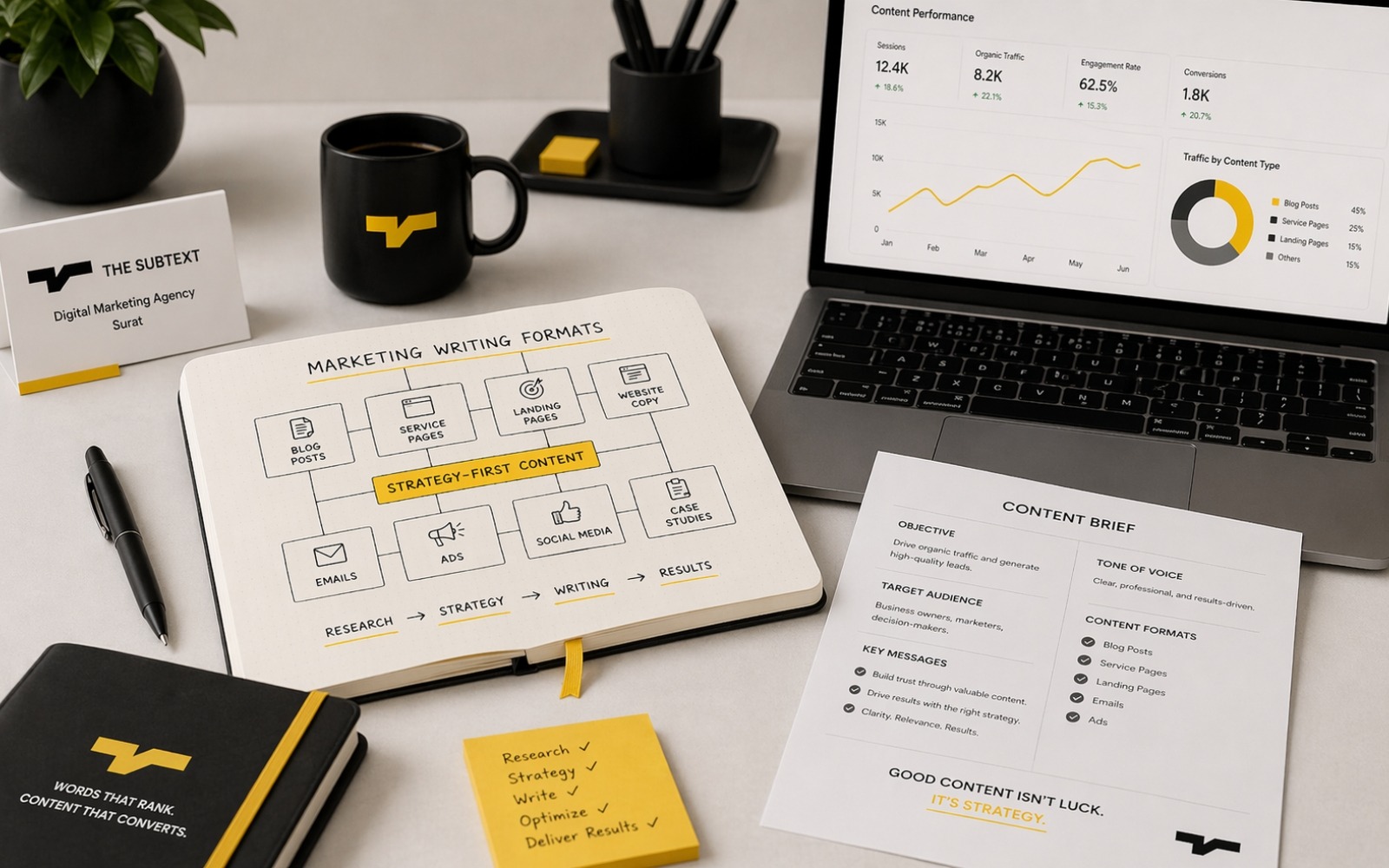
A Note on How We Think About This Work
We have been doing this long enough to have a strong opinion about where most marketing writing strategies go wrong. It is almost never the writing quality. It is the format match.
A client will spend three months building a content calendar of blog posts targeting head terms their domain authority cannot compete for yet, then wonder why organic traffic has not moved. Another will run ads to a homepage instead of a dedicated landing page and diagnose the campaign as underperforming when the campaign itself is fine. Another will hire a copywriter to produce service pages that rank without any content architecture supporting them, which is a bit like designing a shop front without building the road that leads to it.
The format map in this post is the conversation we have before we start any engagement. Which formats exist on the site currently? What is each one actually doing? Where is the clearest gap between what exists and what the business needs? Those answers determine the brief, and the brief determines the output quality more than anything else. If you want to understand how this plays out specifically in the context of SEO for generating B2B leads, that post documents the sequencing in detail.
We are a digital marketing agency in Surat and most of what we do lives at the intersection of format strategy and writing execution. If you want to talk through what your site currently has and where the format gap actually is, write to us at hello@thesubtext.in.