Why Your Website Isn’t Ranking on Google Despite Good Content
Six months. Sometimes twelve. That’s how long most businesses wait before accepting that something is broken and hence their website is not ranking on Google. The content went up. The posts got published. Someone ran keyword research, the topics seemed right. And still, organic traffic is flat, the phone isn’t ringing any differently, and page one feels as distant as it did when the site launched.
The frustrating part about SEO isn’t the wait. It’s that there’s usually a clear reason things aren’t moving… Sometimes, several reasons, often stacked on top of each other, and none of them are visible from inside the website dashboard.
Working with B2B manufacturers, D2C brands, professional services firms, and local businesses across industries, the same picture keeps emerging: the sites that can’t rank are being blocked by problems that have nothing to do with how well the articles are written. Technical gaps. Structural errors. Misread intent. Authority signals that aren’t accumulating the way they should. This piece goes through all of it: what to look for, why it matters, and what actually moves the needle.
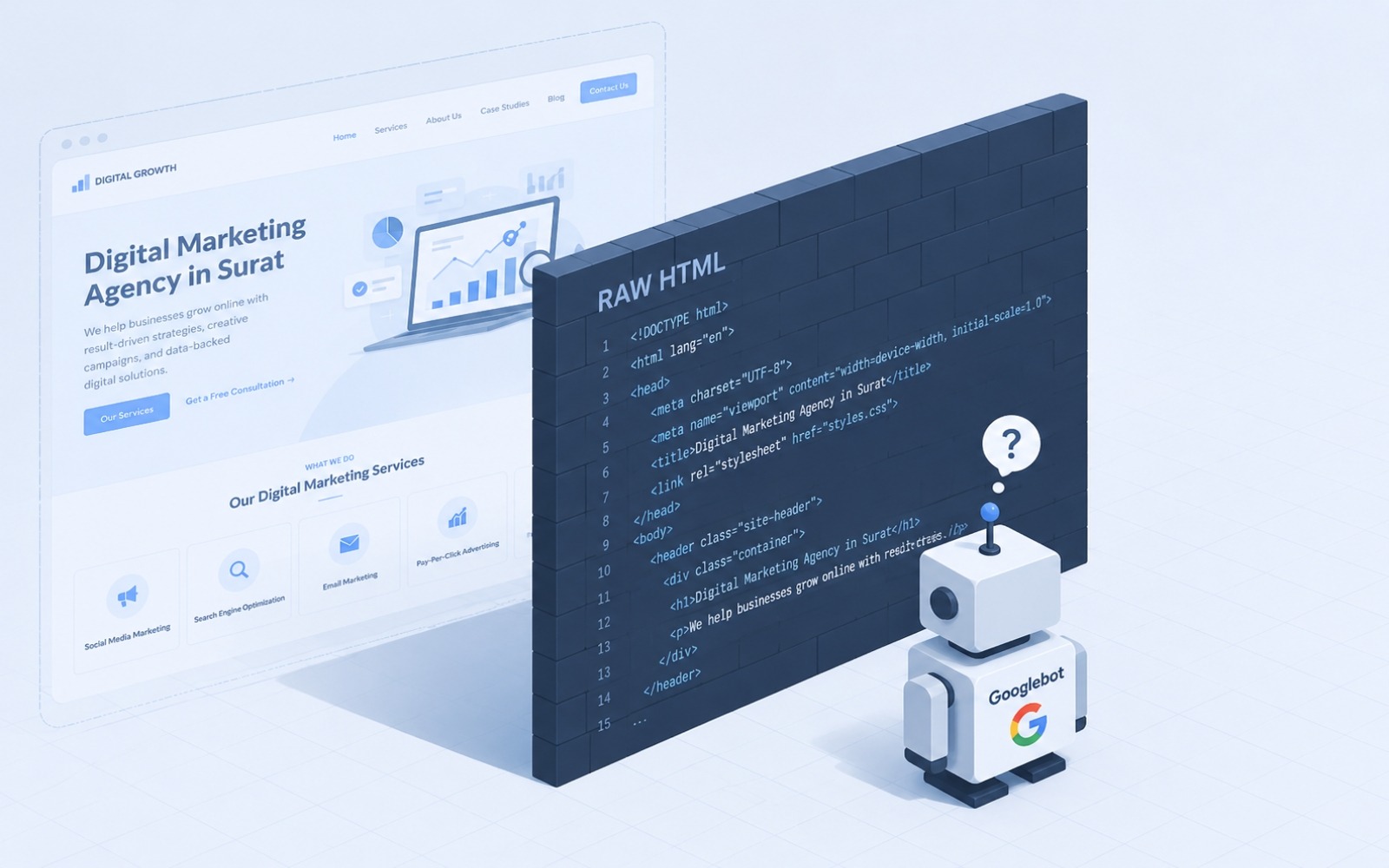
Google Doesn’t See What You See
When someone opens their website in a browser, they see a finished product. Fonts, images, layout, everything rendered. Google’s crawler sees raw HTML, and increasingly, it sees it with significant delays around JavaScript-rendered content.
A large portion of websites built on modern frameworks serve much of their content through JavaScript. Google does eventually crawl and render these pages but the delay can be weeks. During that gap, your content may as well not exist from a ranking standpoint.
Run your website through Google Search Console’s URL Inspection tool. Look at the rendered HTML. If the content you want to rank for is missing from that view, that’s your first problem.
The crawl budget question nobody asks
For smaller sites this rarely matters. But once a website crosses a few hundred pages, crawl budget becomes real. If Google’s crawlers are spending their allocated visits on low-value URLs like filtered pages, session parameters, or tag archives, the pages you actually want ranked may get crawled infrequently. Audit your robots.txt and XML sitemap. Block what doesn’t need to be crawled. Surface what does.
Core Web Vitals are a ranking signal
Google has been explicit about this since 2021 and most sites are still failing on at least one metric. INP (Interaction to Next Paint) replaced FID in 2024 and remains poorly understood. A page with slow interactivity may rank below a thinner piece of content on a faster site. This is especially brutal for WordPress sites that have accumulated plugins over the years.
The fix isn’t always a full rebuild. Lazy-loading images, deferring non-critical scripts, using a proper caching layer, and switching to a faster host can move INP from failing to passing without touching the design.
Google Search Console Tells You More Than Most People Read
Most businesses with a Google Search Console account use it to check impressions and clicks. That’s about 20 percent of what it’s actually showing.
The Coverage report is where the real diagnostic work happens. Pages split into four categories: valid, excluded, warning, and error. The excluded category is the one worth sitting with. Pages listed as ‘Crawled — currently not indexed’ have been seen by Google but deliberately excluded from the index. That’s a quality signal, and it’s a useful one: Google looked at those pages and decided they weren’t worth serving to users. ‘Discovered — currently not indexed’ is a different problem, usually a crawl priority or site speed issue.
The queries report most sites misread
Search Console shows what queries a site is already appearing for, even at low positions. A business ranking in positions 14 through 20 for a set of terms is close. Those pages need refinement, not replacement. The data is sitting there. The instinct to create new content instead of improving what’s already performing at the margins is one of the more expensive habits in SEO.
Page experience signals worth monitoring
The Core Web Vitals report in Search Console shows field data like real measurements from real users on the site, split by mobile and desktop. This is more useful than PageSpeed Insights scores because it reflects actual behaviour rather than a simulated test. A page passing on PageSpeed and failing in field data has a real-world performance problem that a lab score missed.
For a site with more than 100 pages, the Index Coverage and Core Web Vitals reports in Search Console should be reviewed monthly. The patterns that show up there such as clusters of excluded pages, groups of URLs failing CWV that point to systemic issues that page-level fixes won’t resolve.
What E-E-A-T Actually Means for Your Site
Experience, Expertise, Authoritativeness, Trustworthiness. Google’s quality rater guidelines for content writing have described this framework for years but the March 2024 and subsequent 2025 core updates made it operationally significant in a way it wasn’t before.
Content that sounds authoritative but has no signals to back it up is being systematically deprioritised. This hits harder in categories Google treats as YMYL (Your Money or Your Life): finance, health, legal, and to a growing extent, B2B procurement decisions.
What signals actually support E-E-A-T
- Author bylines that link to verifiable profiles or LinkedIn pages
- About pages that describe real experience and credentials, not a generic pitch
- Case studies and original data, even if modest in scale
- Consistent publishing history on the domain
- Third-party mentions, citations, or coverage from recognisable sources in the industry
A company blog that publishes generic industry overviews with no named authors, no original insight, and no external validation is exactly what Google’s quality signals are designed to filter out. The content may be accurate. But accuracy alone has never been the bar.
For B2B sites specifically
B2B buyers search differently. Their queries are more specific, longer in form, and often phrased as operational questions. ‘Best CRM for manufacturing SMEs’ is a very different intent than ‘best CRM.’ And as such, in B2B SEO ranking for the former requires content that reflects genuine familiarity with how manufacturing businesses evaluate software, including the objections, the IT constraints, the procurement process. Generic content about CRM features won’t touch it.
The Internal Structure Problem
Internal linking is the most undervalued lever in SEO. Most sites use it as an afterthought, dropping a few links at the bottom of posts after everything else is done. That’s the wrong model.
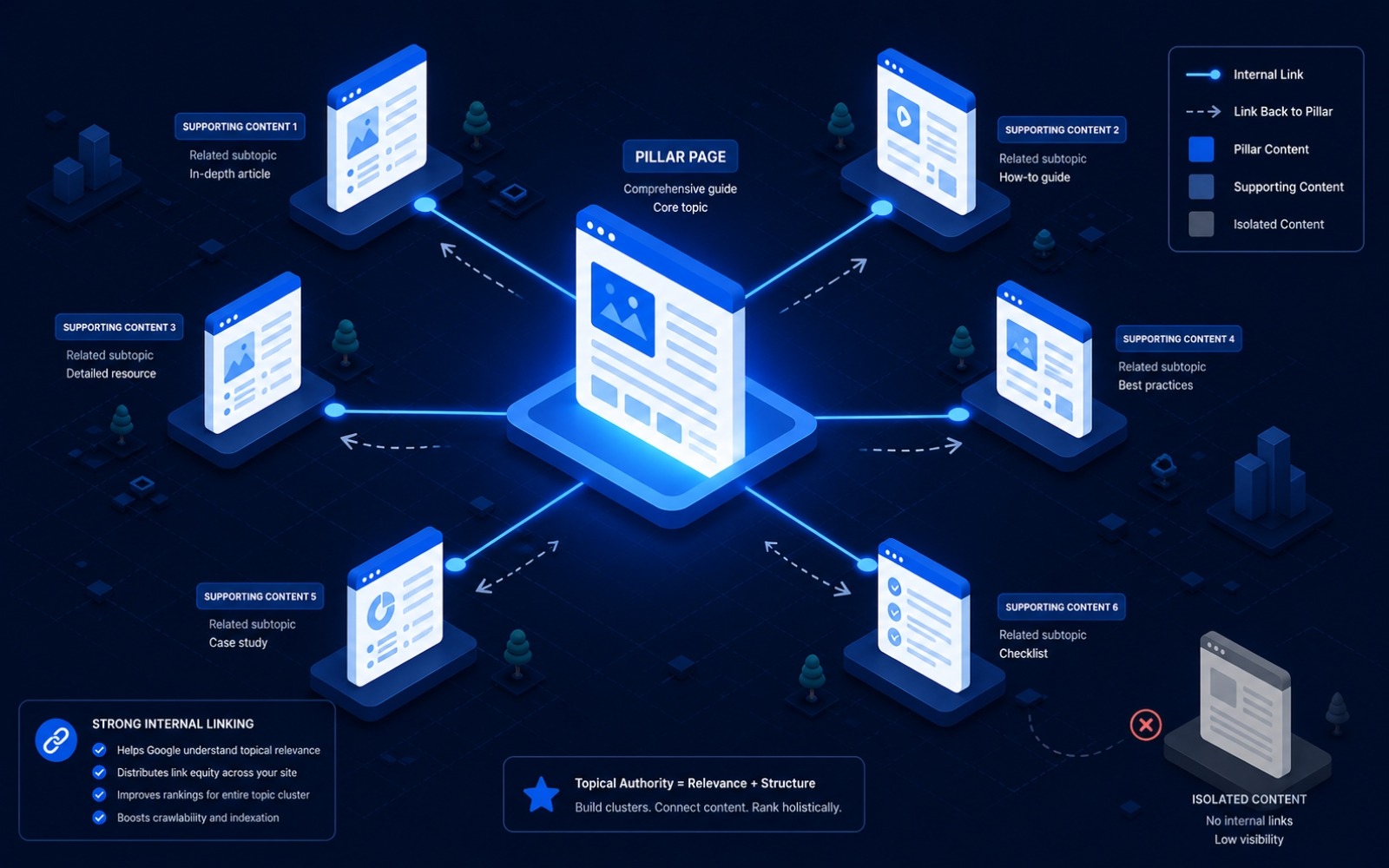
Google uses internal links to understand the topical architecture of a website. Which pages are most important? What is this site fundamentally about? A site that has thirty blog posts but no clear internal hierarchy around its core topics sends a muddled signal.
Topic clusters done properly
The framework that consistently works is pillar content linked to by multiple supporting pieces, with those pieces also linking back to the pillar. A company that sells B2B SEO services should have a primary page optimised for that term, surrounded by content covering adjacent queries like B2B lead generation, keyword research for manufacturers, or how organic traffic translates into qualified pipeline. Each supporting piece links to the pillar. The pillar links to the most relevant supporting pieces.
Sites that do this well rank faster, hold positions better through algorithm updates, and recover more predictably after drops.
Orphan pages are a silent ranking killer
An orphan page is any page with no internal links pointing to it. Google’s crawlers may never find it. Even if it’s indexed, it receives no PageRank flow from the rest of the site. For most sites audited across industries, somewhere between 15 and 30 percent of published pages are effectively orphaned. This isn’t a content quality issue. It’s a structural one.
Keyword Strategy vs. Keyword Guessing
Many sites are targeting keywords that seem right but have either the wrong intent or the wrong competition profile. Both problems produce the same outcome: content that ranks nowhere near page one, for reasons that aren’t immediately obvious.
Intent mismatch
Google classifies search intent into four broad categories: informational, navigational, commercial, and transactional. A page optimised around an informational keyword but structured like a product page will struggle to rank for either. The content type must match what Google is already surfacing for that query.
Before writing anything, search the target keyword. Look at the top five results. Are they listicles? Long-form guides? Product pages? Comparison posts? That tells you what Google has determined users want for that query. Produce the same type of content, then make it better.
The competition problem that volume hides
A keyword with 1,000 monthly searches sounds attractive. But if the top results are from established domain authorities with years of topical coverage and hundreds of backlinks to those specific pages, a new or low-authority site has almost no path to ranking there.
The sites that grow organic traffic reliably are the ones that find specific, lower-competition queries where the intent matches their product or service closely. A Surat-based industrial supplier ranking for ‘industrial supply chain partners India’ with 200 searches per month will generate more qualified pipeline than chasing ‘industrial suppliers’ with 10,000 searches and impenetrable competition.
Long tail queries deserve more credit
Queries of four or more words are where B2B sites win. The buyer who types a detailed operational question is far closer to a purchase decision than someone typing a two-word generic term. A blog post that answers ‘how to evaluate ERP vendors for mid-size manufacturers’ will convert better than one optimised for ‘ERP software’ even if the traffic numbers look inferior.
What Your Competitors Are Doing That You Can Reverse-Engineer
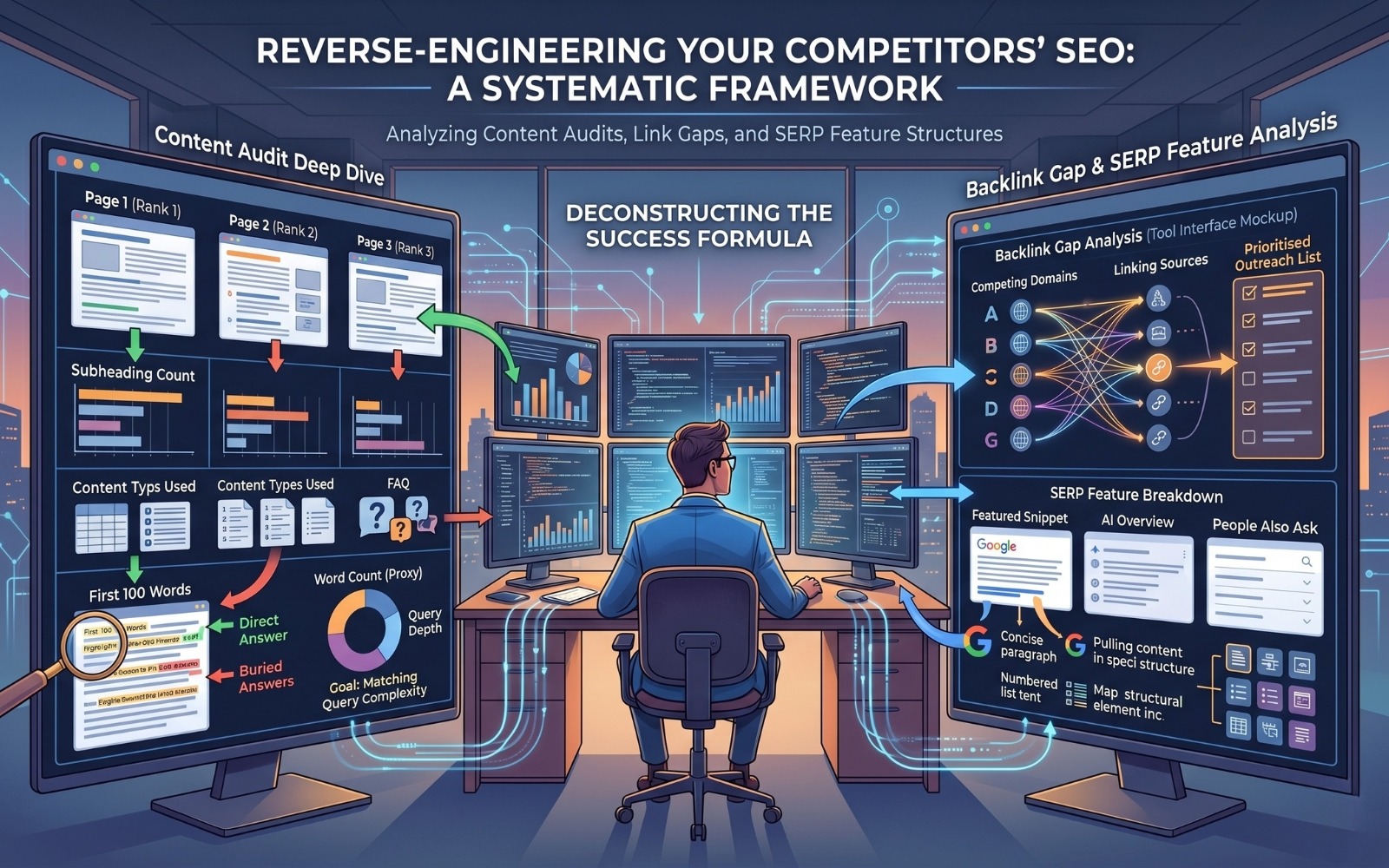
Pages that rank on page one for a competitive term got there by satisfying a set of signals. Those signals are largely visible. A business that is serious about ranking for a given term should spend time understanding exactly why the current top results are there before writing a single word.
The content audit that actually tells you something
Take the top three ranking pages for a target keyword. Count the subheadings. Note the content types used — is there a table? A numbered list? An FAQ? Look at how the question gets answered in the first 100 words. Most top-ranking content answers the core query directly and quickly before expanding. Pages that bury the answer tend to have lower positions or high bounce rates despite good traffic.
Word count is a proxy, not a target. A 600-word page that answers a specific question precisely will beat a 2,500-word piece that circles the topic without landing. The goal is matching depth to query complexity, and the top results show you what that looks like for each specific search.
Backlink gap analysis
Tools like Ahrefs or Semrush show which domains link to a competitor’s ranking page but not to a site targeting the same term. That list is a prioritised outreach list. The sites already linking to similar content in the same space are the most viable prospects as they’ve already demonstrated interest in that topic by linking to it once.
The SERP feature your competitor is pulling
If a competitor is appearing in a featured snippet, an AI Overview, or a People Also Ask box, the structure of their content is doing something specific. Featured snippets are almost always pulled from pages that answer a defined question in a concise paragraph, a numbered list, or a table. Knowing which format Google is pulling for a given query tells exactly what structure the content needs.
Backlinks: What Still Matters and What Doesn’t
Backlinks remain a significant ranking signal. Anyone claiming otherwise is either misreading the data or selling something. But the way backlinks work has become substantially more nuanced.
Domain authority is a third-party metric, not a Google signal
Google doesn’t use Moz’s DA or Ahrefs’ DR as ranking inputs. What Google cares about is the quality, relevance, and context of the linking page. A link from a mid-sized industry publication that covers manufacturing operations is worth more to a B2B manufacturer than a link from a generic DA-80 news site in an unrelated niche.
Chasing high-DA links without regard for topical relevance is a strategy that produces vanity metrics, not rankings.
What actually builds authority
- Original research, surveys, or data that others in the industry cite
- Guest contributions on industry publications where the readership matches the target audience
- Being quoted as a source in trade media or sector-specific coverage
- Building genuine relationships with complementary businesses that share an audience
For most small and mid-size businesses, a realistic backlink strategy looks less like outreach campaigns and more like earning citations through consistent original perspective. Publish something that people in your industry actually want to reference. That takes longer but it compounds.
The link quality audit
Sites that have been around for several years often have legacy backlinks from directories, PBNs, or low-quality exchanges. These can actively drag rankings down. A disavow exercise is occasionally necessary but should be approached carefully since disavowing legitimate links by mistake causes real damage.

Mobile Performance Is a Ranking Factor, Not a UX Nicety
Google indexes the mobile version of your site. The desktop version is secondary. This has been true since 2019 but the implications are still surprising websites in 2025 and 2026.
A site that looks fine on desktop but has text that requires zooming on mobile, tap targets that are too small, or a layout that shifts during scroll will underperform on mobile search. And most searches happen on mobile. And hence, optimizing any website for mobile performance is a must.
What to look for beyond the obvious
Page speed on mobile networks is a different animal from desktop speed. A site that scores 90 on PageSpeed Insights from a desktop connection may fall to 45 on a simulated 4G connection. That gap directly affects where pages appear in mobile search results.
Font sizes below 16px on mobile cause readability issues that contribute to high bounce rates. Bounce rate alone isn’t a direct ranking signal but the downstream behaviour, short dwell time and immediate back-navigation, does affect how Google calibrates the relevance of a page for a given query.
Schema Markup and Structured Data
Schema markup doesn’t guarantee rankings. What it does is give Google cleaner signals about what a page contains, which can improve how the content appears in results, and in some cases opens up eligibility for rich results like FAQ dropdowns, review stars, or how-to steps.
For B2B sites, Organization schema and FAQ schema on service pages are the baseline. For ecommerce, Product schema with accurate pricing and availability data is non-negotiable. A page without schema is leaving visibility on the table.
Where most sites get this wrong
Schema is added once and never maintained. Prices change. Products go out of stock. Services evolve. Outdated structured data creates a mismatch between what Google reads in the schema and what the page actually contains. Google penalises structured data that contradicts page content.
Ranking Beyond Google: LLMs, AI Search, and What’s Changing
This section matters more with each passing month. A growing share of search behaviour is moving toward AI-powered interfaces: ChatGPT’s web search, Perplexity, Google’s AI Overviews, and others. The visibility rules for these platforms are different from traditional search, and the content that performs well on them has specific characteristics.
How LLMs surface content
AI search engines pull from a combination of indexed content, citations from authoritative sources, and what their training data established as reliable perspectives on a topic. Sites that get cited in AI answers tend to have several things in common: clear factual assertions, structured content that answers questions directly, named authors with traceable credentials, and a publishing history that signals longevity.
A page buried in hedging language, vague overviews, and no specific claims is unlikely to be cited by an AI system. These systems are looking for content they can confidently attribute.
AI Overviews and featured snippet optimisation
Google’s AI Overviews draw heavily from pages that already rank in the top five for a query. Getting into AI Overviews therefore requires traditional ranking strength first. But the content structure matters too. Concise answers to specific questions, defined terms, numbered steps for processes, and clearly labelled sections all increase the probability of a page’s content being pulled into an overview.
Perplexity and citation-based visibility
Perplexity operates more like a research aggregator than a traditional search engine. It cites sources inline. Being cited there depends on the quality of the content’s specific claims and whether those claims are backed by something Perplexity can verify. Original data, direct quotes from industry practitioners, and specific case outcomes are more likely to surface as citations than general commentary.
What this means practically
Optimising for AI search requires the same foundations as traditional white hat SEO but with stronger emphasis on factual density, structured formatting, and clear sourcing. A business that has been treating its blog as a thought leadership platform without the rigour of actual thought leadership will struggle on both fronts.
Algorithm Updates and Why Rankings Drop
Sites that were ranking well in 2023 and dropped in 2024 or 2025 often point to a specific update as the cause. The cause is usually more systemic. Google’s core updates adjust how signals are weighted across the entire index. A site that was coasting on thin content with decent backlinks may have ranked adequately under an older weighting model and dropped when that model shifted.
The January 2026 update and what changed
The January 2026 core update continued a pattern that has been building since mid-2023: reduction in visibility for sites with high traffic but low information value. Pages that rank purely on domain authority without offering genuine depth or original perspective are losing ground to newer, more specific content from smaller sites that actually demonstrate subject expertise.
For businesses: the path back from a traffic drop is almost never more content. It’s better content on fewer topics, backed by stronger authority signals.
Recovery timelines
After a core update drop, recovery is measured in months, not weeks. Google processes algorithm adjustments across the index gradually. A site that improves its content and technical signals after a drop should expect to see movement in the next core update cycle, typically three to four months later. Sites waiting for a faster recovery are often making it worse by repeatedly changing things that then need to be re-evaluated.
The Compounding Problems Nobody Talks About
Duplicate content within your own site
This surfaces in unexpected places. Product variants with near-identical descriptions. Blog categories that generate their own indexable pages. Pagination without canonical tags. Service pages that share 80 percent of their copy because they cover adjacent topics. Google doesn’t penalise duplicate content in the dramatic sense most people imagine, but it does dilute ranking signals across pages that should be consolidated. The result is two weak pages instead of one strong one.
Thin content at scale
A site with 400 published posts where 300 of them are under 400 words with no original insight has an authority problem that isn’t solved by publishing 50 more. The legacy thin content actively suppresses the quality signal of the entire domain. Auditing and consolidating or expanding existing content often produces faster results than fresh publishing.
Misaligned anchor text
Both internal and external links that use generic anchor text like ‘click here’ or ‘read more’ waste a ranking signal. Every anchor text is a description of the target page. Use it intentionally. A link to a B2B SEO services page should anchor on something like ‘B2B search optimisation’ or ‘web SEO services for B2B companies’, not ‘learn more.’
NAP inconsistency for local businesses
Name, Address, Phone number. For businesses with a physical location or serving a defined geographic area, inconsistency across Google Business Profile, the website, and directory listings creates a trust gap that suppresses local rankings. A phone number listed differently on Google than on the website is enough to cause problems. This sounds minor. The ranking impact is real. This makes local SEO for businesses a serious focus point.
Old Content Is Either an Asset or a Liability. It’s Rarely Neutral.
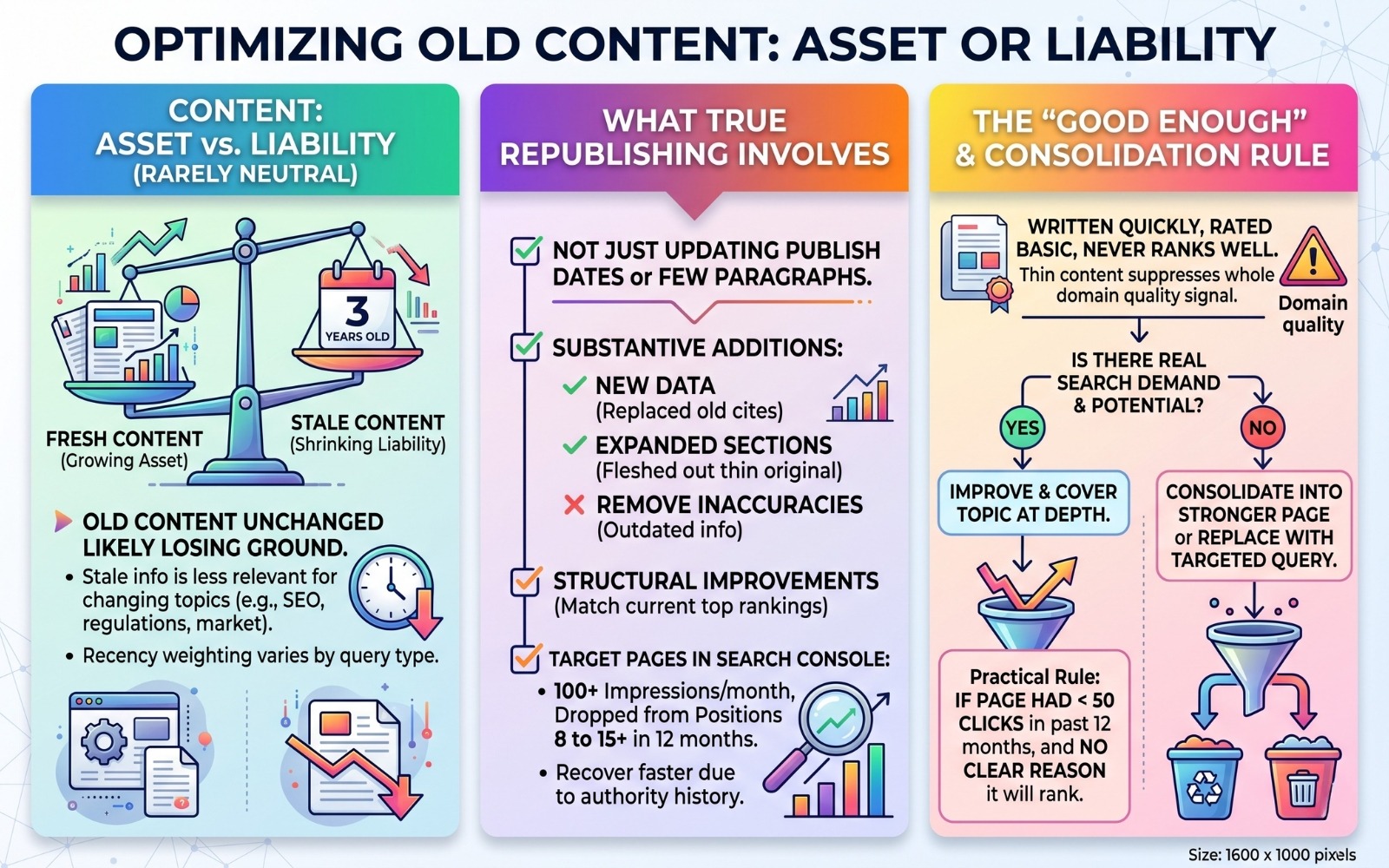
A post published three years ago that ranked well in 2022 and has sat unchanged since then is probably ranking worse now. Content freshness isn’t merely about publish dates these days. Google weights recency differently depending on the query type, but for topics where information changes, like SEO practices, software tools, regulations, or market conditions, stale content loses ground to updated competitors.
What republishing actually involves
Updating the publish date and changing two paragraphs isn’t republishing. The kind of update that moves rankings involves substantive additions: new data where old data was cited, expanded sections where the original was thin, removal of sections that are now inaccurate, and structural improvements that bring the page in line with what’s currently ranking.
The pages worth updating are identifiable in Search Console: anything with 100 or more impressions per month that has dropped from positions 8 to 15 or lower in the past twelve months. These pages had authority, lost ground to newer content, and can recover faster than a new page because they already have some signal history.
The ‘good enough’ problem
A lot of published content was written quickly, passed a basic review, and went live without ever being genuinely good. It ranks nowhere now and it never will in its current form. The decision to be made is whether to improve it or consolidate it into a stronger page that actually covers the topic at depth. The worst outcome is leaving thin content live indefinitely as it suppresses the domain’s overall quality signal and it occupies URL space that could be used more effectively.
As a practical rule: if a published page has had fewer than 50 clicks in the past twelve months and there is no clear reason it will rank, it should be consolidated into a stronger piece or replaced with something that addresses a more specific query with real search demand.
What Getting It Right Actually Looks Like
None of this is abstract. Sites in competitive verticals rank by doing the fundamentals correctly and consistently, then adding depth in the areas where their competitors are still treating SEO as a content volume game.
A B2B industrial supplies company that publishes two genuinely useful posts a month, maintains clean technical signals, builds internal linking deliberately, earns three or four relevant external citations per quarter, and runs lean Schema across its service pages will outrank a competitor publishing twelve generic posts a month with no internal architecture.
The quantity vs. quality argument is over. Quality won. The sites that haven’t updated their strategy to reflect that are the ones in the discovery calls asking why nothing is moving.
Questions We Get Asked Before Starting
How do I get my website higher up on Google?
There’s no single lever. The sites that move consistently are the ones fixing technical issues first, then building content depth in content marketing around a focused set of topics, then earning external signals. In our experience, most sites skip step one and wonder why steps two and three aren’t working.
How do I put my website on top of Google search results?
For competitive head terms, the honest answer is that it takes time and accumulated authority. For specific long-tail queries where the intent matches your offering closely, a well-structured page from a technically clean site can rank within weeks. Target those first. Use the traffic and the data to build toward harder terms.
We already run Google Ads. Why do we need SEO?
Paid search stops the moment the budget stops. Organic rankings compound. A page that ranks well in organic search keeps sending traffic for months or years without ongoing spend. The economics are fundamentally different, and so is the buyer behaviour: clicks from organic search convert differently than paid clicks, particularly in B2B where buyers often visit a site multiple times before making contact.
How long before we see results from SEO?
For a site with existing authority and decent technical health, meaningful movement on targeted queries typically appears within three to six months. For a new domain or a site recovering from a penalty or a core update drop, twelve months is a more realistic baseline. Anyone promising page-one rankings in thirty days is selling something that won’t hold.
Does website design affect SEO?
Significantly. Page structure, heading hierarchy, internal navigation, mobile rendering, and page speed are all ranking factors. A well-written page buried in poor site architecture will underperform a thinner page on a technically clean site. Design and SEO are not separate workstreams.
What are some easy ways to improve SEO rankings?
The fastest wins are usually technical: fixing broken internal links, adding missing meta descriptions, consolidating thin content, submitting an accurate sitemap, and ensuring mobile rendering is correct. These often produce visible movement within weeks without requiring new content creation.
Where to Actually Start
The list of problems in this post can feel paralyzing if read as a to-do list. It isn’t meant to be. Most sites have two or three root causes driving 80 percent of their ranking problems. The rest are secondary effects.
The order matters more than the ambition. Technical issues first. A site that Google struggles to crawl properly cannot rank reliably, regardless of content quality. Then structure: internal linking, topic clusters, and orphaned pages. Then content depth and freshness on the pages with existing impressions. Backlink acquisition comes after the foundation is sound, because links pointing to a structurally broken site don’t produce the results they should.
The sites that move fastest aren’t the ones doing the most things simultaneously. They’re the ones that identified the specific bottleneck and addressed it before moving to the next problem.
A proper SEO audit will surface this in a few weeks. For businesses working through it independently, start with Search Console’s Coverage and Core Web Vitals reports. That data will point to the most urgent issues faster than any checklist.
For businesses that want a structured diagnosis of what’s blocking their rankings, The Subtext runs technical and content SEO audits across industries, from B2B manufacturers to local service businesses. The starting point is always the same: understand what’s actually wrong before deciding what to fix.