Digital Marketing for Surat’s Textile Industry
The Textile Business Has Changed. The Sales Process Has Too.
A buyer sitting in Dubai does a Google search before picking up the phone. A sourcing manager in Mumbai checks a supplier’s Instagram page before scheduling a factory visit. A boutique owner in Hyderabad reads online reviews of fabric vendors before placing a bulk order.
This is the reality of how business happens today across the textile industry in Surat and across India’s entire textile trade. Decisions happen online before conversations begin. Relationships that used to be built through travel and trade fairs are now being replaced or preceded by digital impressions.
The textile businesses that have accepted this are steadily taking market share. The ones that rely purely on personal networks are watching their pipeline narrow year by year without understanding why.
This is what digital marketing for textile industry is actually solving. It is solving a visibility problem, a trust problem, and a pipeline problem. The businesses that figure this out first have a structural advantage that compounds over time.

What Is Actually Going Wrong and Why Most Textile Businesses Miss It
Textile businesses are operationally sharp. Production timelines, yarn quality, GSM specifications, fabric counts are managed with precision. But the same businesses often have no clear answer to these questions:
- When a new buyer searches for your product category, does your business appear in Google?
- Does your website clearly communicate what you make, who you supply to, and why a buyer should trust you?
- When someone visits your site, does anything prompt them to contact you?
- Is your business findable by buyers who do not already know your name?
The answer for the majority of textile manufacturers, exporters, and traders is no on all four counts. The consequence is invisible.
There is no moment where you lose a specific buyer. The loss happens in aggregate, over months, as buyers consistently find and call your competitor instead of you. The sales numbers look flat or declining without a clear cause. The real cause is discoverability.
This is the core problem that textile manufacturer SEO exists to solve. When your business shows up for the searches your buyers are running, you enter conversations you would otherwise never have had.
Real Problems Textile Businesses Face and the Digital Marketing Solutions That Address Them
Most textile businesses arrive at digital marketing because something has gone wrong in their pipeline. The inquiry rate has dropped. A long-standing buyer has gone quiet. A competitor is winning orders they used to win. These are symptoms. The root cause is almost always a gap in digital presence, and each symptom maps to a specific fix.
Problem: Buyers are finding competitors first
A buyer searching for “polyester fabric supplier Gujarat” or “saree wholesaler Surat” is ready to place an order. If your business does not appear in those results, the buyer calls someone else. You are losing orders before the conversation begins.
The fix is textile manufacturer SEO targeted at the specific product and geography searches your buyers run. This is keyword research followed by properly structured product pages, not generic website content. Our SEO agency in Surat approach builds this architecture systematically.
Problem: Inquiries from unknown buyers have dried up
Businesses running entirely on referrals and existing relationships have a ceiling. When those relationships age out, retire, or shift suppliers, there is no pipeline to replace them. The business has no mechanism for meeting new buyers.
The fix is inbound content and SEO that generates discovery from buyers who have no prior connection to your business. This is how digital marketing for textile industry creates pipeline that referrals alone cannot.
Problem: Website exists but generates zero inquiries
A brochure website with a generic “contact us” form and no product-specific pages is invisible to search engines and unconvincing to buyers who do land on it. Most textile business websites fall into this category.
The fix involves restructuring the site around buyer intent: product category pages, capability pages, certifications, lead times, and MOQs displayed clearly. Every page should answer a question a buyer would ask before deciding to contact you. Our web marketing solutions for manufacturers address this architecture specifically.
Problem: Social media activity produces no business
Posting on Instagram or Facebook without a strategy produces engagement from the wrong audience. A textile manufacturer posting generic fabric photos is reaching consumers with no purchase intent rather than procurement managers who buy at volume.
The fix is platform-audience alignment. B2B manufacturers belong on LinkedIn with content written for procurement professionals. D2C brands belong on Instagram with content designed to drive product discovery and purchase. Our social media marketing in Surat work starts with this fundamental targeting decision before any content is produced.
Problem: International buyers do not follow up after trade fairs
An international buyer meets you at a fair, takes your catalogue, and goes quiet. In almost every case, they searched your business name after the meeting and found either nothing or a website that failed to build confidence.
The fix is a digital presence credible enough to close the loop after an in-person meeting. Export credentials displayed clearly, product range visible online, and a professional brand identity across all touchpoints. The brand identity design work we do for exporters specifically addresses this post-meeting credibility gap.
Problem: D2C brand sales are flat despite social media following
A following on Instagram does not guarantee sales. If the website conversion rate is low, if there is no email retention system, and if the product pages are thin, social media traffic exits without purchasing.
The fix is a conversion-focused website structure combined with email retention. Our digital marketing agency in Surat approach for D2C textile brands addresses both the traffic quality and the conversion infrastructure simultaneously.
Why Textile Manufacturers Specifically Need SEO and What It Actually Does
SEO for a textile manufacturer is fundamentally different from SEO for a clothing brand or an e-commerce store. The buyer journey is longer. The search terms are specific. The decision-makers are procurement heads, business owners, and sourcing consultants.
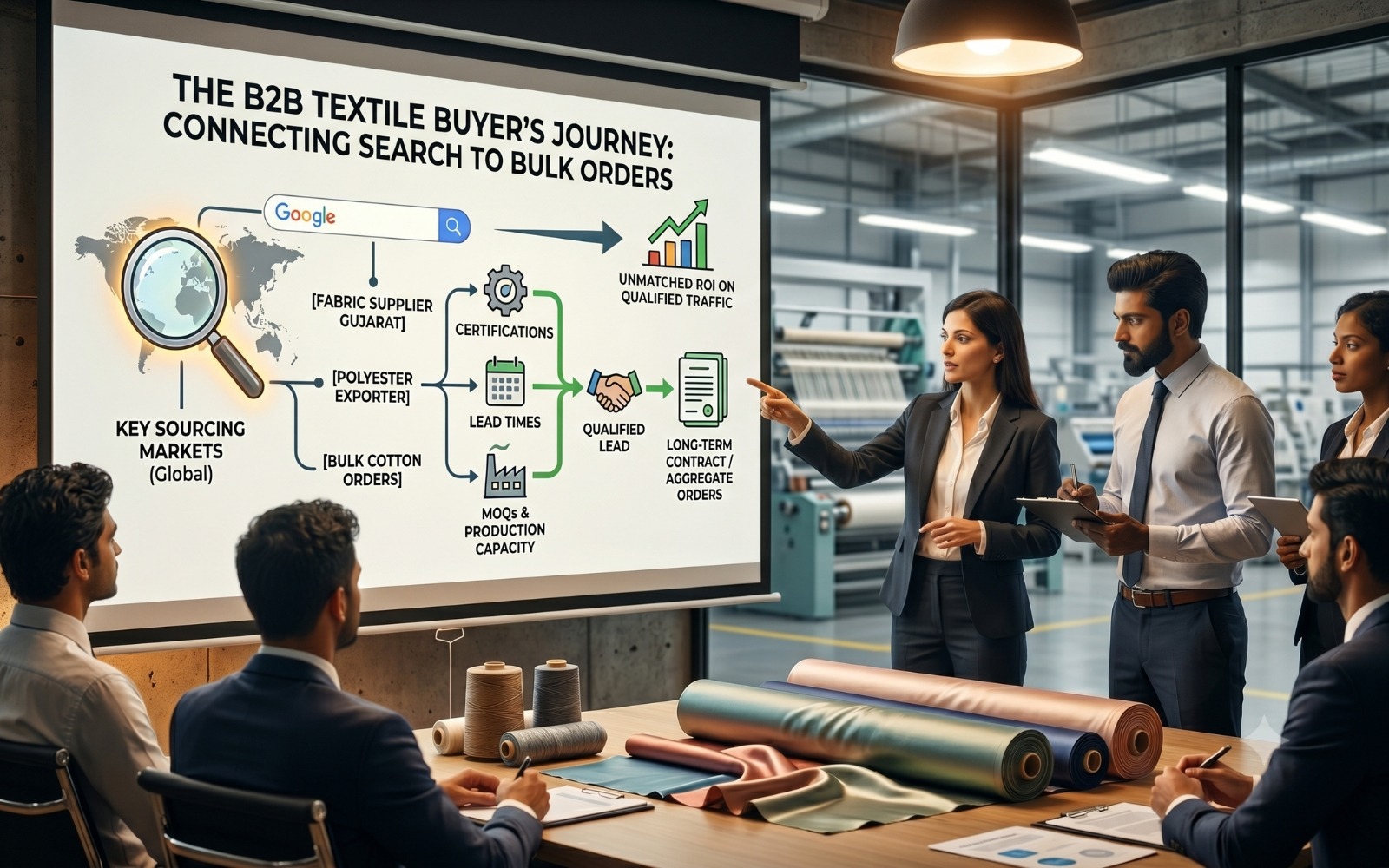
A textile manufacturer ranking for terms like “polyester fabric supplier India” or “bulk cotton fabric exporter Gujarat” is being discovered by exactly the buyer profile that matters. These searches have purchase intent baked in. The person running them is looking to place an order and just needs to find a reliable supplier.
Our B2B SEO services are specifically built for manufacturers and industrial suppliers where the sales cycle involves multiple decision-makers and long-form trust-building. The strategy is different from standard SEO because the content, the keywords, and the conversion path all need to speak to a professional buyer.
For a textile manufacturer, this translates to:
- Product and category pages optimised for what buyers actually search
- Case study and capability content that builds credibility without fabrication
- Technical content around certifications, lead times, MOQs, and production capacity
- Geographic SEO targeting buyers in key sourcing markets
The ROI on B2B SEO for manufacturers is difficult to match with any other channel because the traffic is qualified. People already searching for what you make are far easier to convert than audiences reached through interruption advertising.
Textile Exporters and the Digital Problem That Trade Fairs Cannot Fix
Trade fairs remain valuable. The relationships built at Texworld Paris or GTTES still matter. But there is a gap in how textile exporter digital marketing is approached, and the gap is costing exporters more than they realise.
A buyer who met you at a fair will search your business name online before following up. What they find either confirms their intent to work with you or introduces doubt. An outdated website, sparse social presence, or zero Google presence sends a signal that the business may be small, inconsistent, or behind the curve.
Conversely, textile exporters with a strong digital presence convert fair meetings more efficiently. The follow-up email lands differently when the buyer has already explored your product range, read about your certifications, and seen your export portfolio online.
For exporters targeting international markets, the digital stack matters even more. International buyers rarely travel to verify suppliers they find only through referrals. Your digital presence is the proxy for your credibility.
Our web marketing solutions for exporters typically include a structured website with product catalogues, export capabilities clearly listed, certifications displayed, and landing pages in multiple languages where applicable. This is infrastructure that earns returns for years after the initial build.
The Surat Textile Industry: Why Digital Marketing Here Is an Entirely Different Conversation
Surat occupies a unique position in the Indian textile economy. Over 40% of India’s synthetic fabric production passes through this city. The city has approximately 700,000 power looms. The Textile Market, the Millennium Textile Market, and Ring Road’s wholesale clusters process volumes that are difficult to contextualise for anyone outside the industry.
And almost none of it is visible online in a structured way.
That is the specific opportunity for businesses operating in the textile industry Surat market. The competition for digital visibility is low relative to the commercial volume. A manufacturer or trader who builds a credible online presence in Surat-specific searches is essentially capturing territory that others have left completely open.
What This Looks Like in Practice
A grey fabric manufacturer in Ring Road can rank for queries like “grey fabric supplier Surat” or “polyester grey fabric manufacturer Gujarat” within months with a targeted SEO strategy. There are buyers in Tirupur, Jaipur, Kolkata, and internationally in Bangladesh, Vietnam, and Turkey who source from Surat regularly. They are searching online. They find very little of substance.
A job worker specialising in digital printing at GIDC can rank for specific capability searches. A saree manufacturer on Sahara Darwaja can rank for terms that connect with retailers across India. A yarn trader can appear in searches run by weavers across the country looking for specific counts.
The digital infrastructure of Surat’s textile market is five to seven years behind its commercial scale. That is the honest assessment. The businesses that move now take a position that will be difficult to displace once the rest of the market catches up.
The digital marketing services we offer in Surat have been designed specifically for this market context. We understand the product categories, the buyer personas, the trade terminology, and the sale cycles that define how business works here.
Local Visibility Is Also a Product
A buyer visiting Surat for sourcing will often search “fabric suppliers in Surat” or “saree wholesalers Surat” before arriving. Local SEO means your business appears in those searches. Google Business profiles, location-specific landing pages, and local keyword targeting are tools with immediate, measurable impact for Surat-based textile businesses.
Our work on local business search engine marketing consistently shows that local visibility for B2B businesses drives qualified foot traffic and inquiry calls.
Social Media for Textile Companies: What Actually Works
Fashion and textile marketing on social media is misunderstood by most textile businesses. The assumption is that it is for consumer brands and retail stores. The reality is that LinkedIn, Instagram, and even WhatsApp Business are active buying environments for textile professionals.
LinkedIn is where procurement managers share vendor updates, where industry publications get read, where sourcing consultants build their networks. A textile manufacturer with a credible LinkedIn presence is engaging the exact decision-makers who determine vendor shortlists. Our LinkedIn management services for industrial and manufacturing businesses focus on this exact dynamic.
Instagram for textile businesses operates differently. For D2C fabric brands, regional saree labels, and printed textile sellers, Instagram is a primary discovery channel. Buyers and consumers both use it. Product photography, drape videos, and behind-the-scenes manufacturing content consistently outperform every other content format for engagement and conversion in this segment.
Our social media marketing in Surat work covers both ends. B2B positioning through LinkedIn and professional content. D2C growth through Instagram and visual storytelling grounded in your actual product strengths.
For Textile Retailers and Wholesale Markets
The wholesale cluster model in Surat means most buyers already know where to walk. But the next generation of buyers is discovering vendors online before visiting markets physically. A retailer on Ghod Dod Road with an Instagram page showing inventory, fabric quality, and pricing ranges is meeting a buyer’s research needs before they arrive at the market.
WhatsApp Business integration with a structured catalogue is another underused tool. Buyers who find you online want to request samples or check availability without calling. A structured digital catalogue connected to your WhatsApp inbox converts that interest immediately.
Branding for Textile Businesses: Why It Is a Revenue Decision
When Gujarat textile brand online marketing comes up in conversations with manufacturers, the first objection is predictable: “We are a B2B business. We do not need branding like a consumer brand.”
This framing misunderstands what branding does for a B2B business. Brand identity for a manufacturer is about reducing the sales friction that comes from being indistinguishable from competitors.
When three suppliers are competing for the same export order and the buyer cannot visit all three factories, the vendor with a clear professional brand, a consistent visual identity, a credible website, and a clear articulation of what makes them different wins the shortlist. Every time.
Brand identity is also what makes your content memorable and your communications trustworthy. Our brand identity design work for textile businesses focuses on exactly this: creating a visual and verbal identity that signals reliability, consistency, and expertise to a professional buyer.
For businesses that have a logo but little else, there is a significant gap. A coherent brand across your website, your samples packaging, your email signature, your LinkedIn profile, and your trade fair materials creates a unified impression that builds with every touchpoint.
Read our deeper thinking on brand identity design for Indian businesses to understand the strategic framework we apply when building brand systems for manufacturers and exporters.
For D2C Textile Brands: The Digital Stack That Actually Converts
The D2C textile space in India has exploded in the last five years. Regional weave labels, sustainable fabric brands, handloom-based fashion labels, and contemporary saree businesses have found audiences through digital channels that their wholesale models could never reach.
But most D2C textile brands plateau. The Instagram growth stalls, the website conversion rate sits below 1%, and paid ads eat into margins without reliable returns.
The problem is usually structural. A D2C textile brand needs three things working together: content that drives discovery, a website that converts that discovery into a decision, and a retention system that turns one-time buyers into repeat customers.
The Website Problem Textile D2C Brands Overlook
A single-page website with a product grid works for the first hundred orders. It does not work at scale. The question of one-page versus multi-page websites for business is directly relevant here. A multi-page site with category landing pages, brand story content, and fabric education pages gives Google far more to index and far more reason to rank you across a wider range of searches.
A D2C silk brand that has a page specifically about their weaving process, their sourcing of raw silk, their region of origin, and their design philosophy is building organic traffic across dozens of searches that a generic product catalogue never captures.
SEO for D2C Textile Brands
Fashion and textile marketing for D2C brands requires a content strategy built around what buyers search before they are ready to buy. They search fabric care instructions. They search “difference between Banarasi and Kanjivaram silk.” They search “how to style block print cotton sarees.” These are searches at the start of a buying journey.
Brands that answer these questions through well-structured content pages earn the first impression. When the buyer is ready to purchase, they return to the brand they already trust from the research phase.
Our SEO agency in Surat works with D2C textile brands on this full-funnel content approach, from awareness content to category pages to product-level optimisation.
Visual Content and Video: The Missing Revenue Layer for Textile Businesses
Fabric is tactile. The entire challenge of selling textiles online is that the buyer cannot touch what you are showing them. The businesses that solve this problem through visual content are pulling ahead across every segment of the industry.
For D2C fabric brands, short-form video demonstrating drape, fall, and texture does what product photography cannot. A 20-second video of a handloom cotton fabric in natural light, showing how it moves, tells a buyer more than five static images. This is why Instagram Reels and short video content from textile brands consistently generate higher inquiry rates than static posts.
For B2B manufacturers and exporters, the equivalent is capability video. A two-minute walkthrough of your production floor, your quality testing process, or your dyeing facility gives an international buyer confidence that a product catalogue page never achieves. Buyers who cannot visit your factory make shortlisting decisions based on digital proxies. Video is the strongest proxy available.
Lookbooks as SEO Assets
Fashion and textile marketing has long used lookbooks as a sales tool. The shift is that lookbooks built as web pages rather than PDFs become indexable content. A seasonal lookbook for a printed cotton range, structured as a properly optimised web page with fabric descriptions, care instructions, and styling guidance, ranks for queries that a plain product grid never captures.
Competitors in the textile digital space who have invested in this content format are consistently pulling category traffic that manufacturers and wholesalers with static websites simply never see.
What Textile Businesses Should Prioritise First
- Product photography with consistent lighting, neutral backgrounds, and multiple drape angles as the baseline
- Short-form video for texture and movement on Instagram and WhatsApp catalogues
- Capability or facility video for B2B exporters and manufacturers targeting international buyers
- Seasonal web-based lookbooks with full SEO treatment for D2C brands
Visual content requires investment upfront. The return is durable. A well-photographed product range continues to convert for years. The cost of poor visual content is equally durable: buyers who land on low-quality product images leave without inquiring and rarely return.
Companies in Surat Doing Digital Marketing: What Separates Real Strategy from Activity
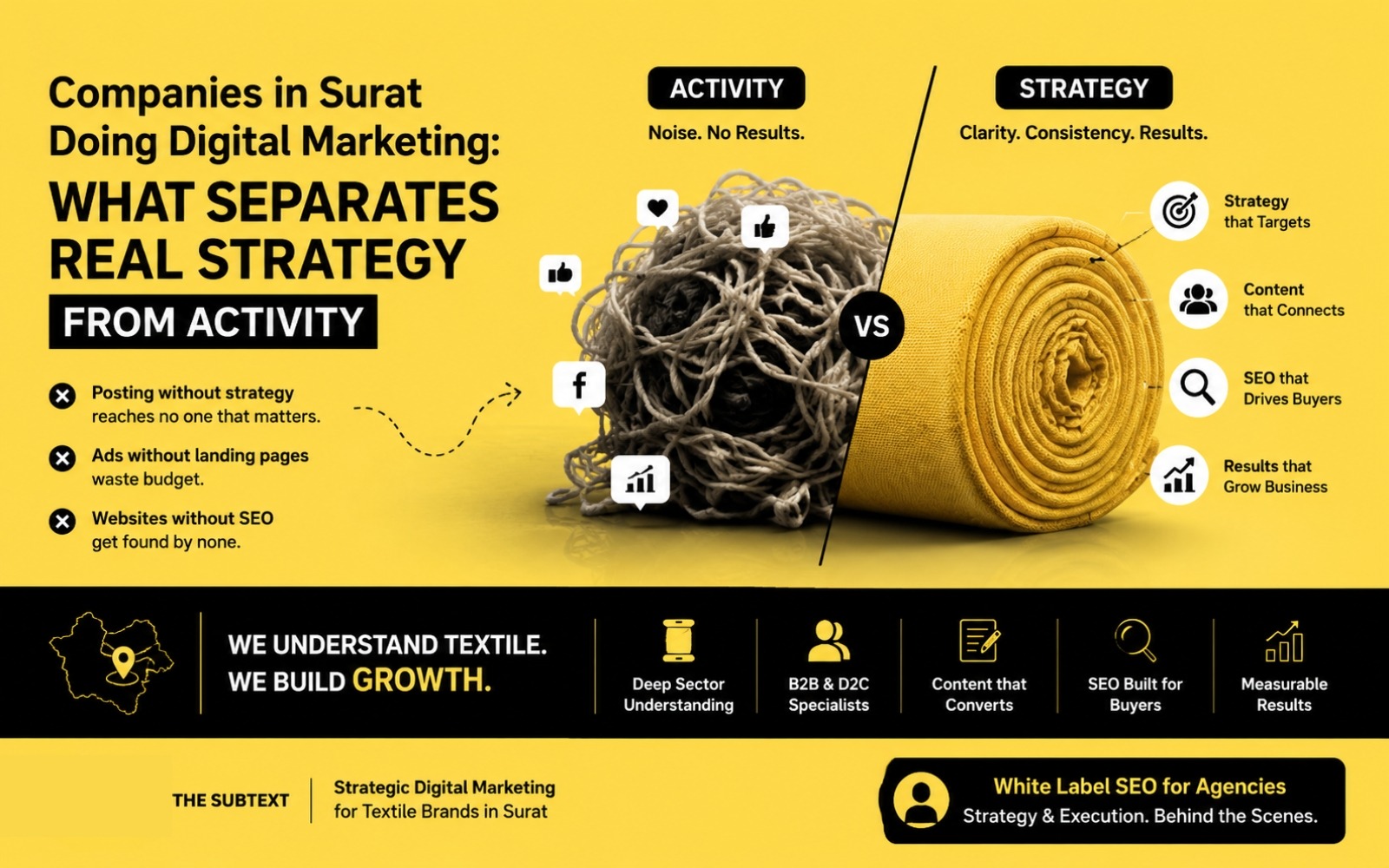
There are many companies in Surat offering digital marketing services. There are also many textile businesses that have tried digital marketing, found it produced little return, and concluded it does not work for their industry.
The reason it failed was almost always the approach. Posting on social media without a strategy, running Google Ads without a landing page that converts, investing in a website that has zero keyword targeting built in. Activity without architecture produces nothing.
Textile industry marketing requires a practitioner who understands the product categories, the buyer personas, the trade terminology, and the commercial timelines involved. A generic digital agency applying consumer brand tactics to a B2B manufacturer will consistently produce disappointing results.
This is why The Subtext positions itself specifically. We work with B2B and D2C brands where we understand the sector deeply enough to write product descriptions, create content strategies, and build SEO architecture that speaks accurately to the right buyer. Our digital marketing agency in Surat practice is deliberately selective because generic client acquisition produces generic work.
For agencies looking to offer textile industry digital marketing under their own brand, we also offer white label SEO engagements where we provide strategy and execution behind the scenes.
Email Marketing for Textile Businesses: The Channel Most Are Ignoring
Every textile business has a buyer list. Retailers they have supplied. Exporters who have inquired. Brands they have sampled. That list is an asset that most businesses do nothing with after the transaction closes.
Email marketing for textile companies is the discipline of using that list systematically. For B2B businesses, this means regular communication that keeps your business top-of-mind with buyers who may place the next order in three months or six months. For D2C brands, it is the primary retention tool.
The economics are straightforward. A buyer who purchased once already knows your quality, your lead time, and your reliability. Converting that buyer to a second order costs a fraction of acquiring a new one. An email that reaches them at the right moment with a new collection, a seasonal fabric range, or a capacity update is one of the most cost-efficient marketing activities a textile business can run.
What Textile Email Marketing Actually Looks Like
- New collection or range announcements sent to existing retail buyers
- Seasonal availability updates for yarn and grey fabric traders reaching their regular buyers
- Export capability newsletters for manufacturers reaching international sourcing contacts
- Re-engagement sequences for buyers who sampled but did not place an order
- Post-purchase follow-ups for D2C brands driving repeat purchases and referrals
The textile industry marketing gap here is significant. Most competitors are running Google Ads or investing in SEO while leaving their existing buyer database completely dormant. A structured email programme addressing this segment of buyers produces returns with minimal incremental spend.
The starting point is simple: segment the existing contact list by buyer type, decide on a communication frequency, and build three to four template sequences before scaling. This is work that takes a few weeks to set up correctly and produces returns for years with regular maintenance.
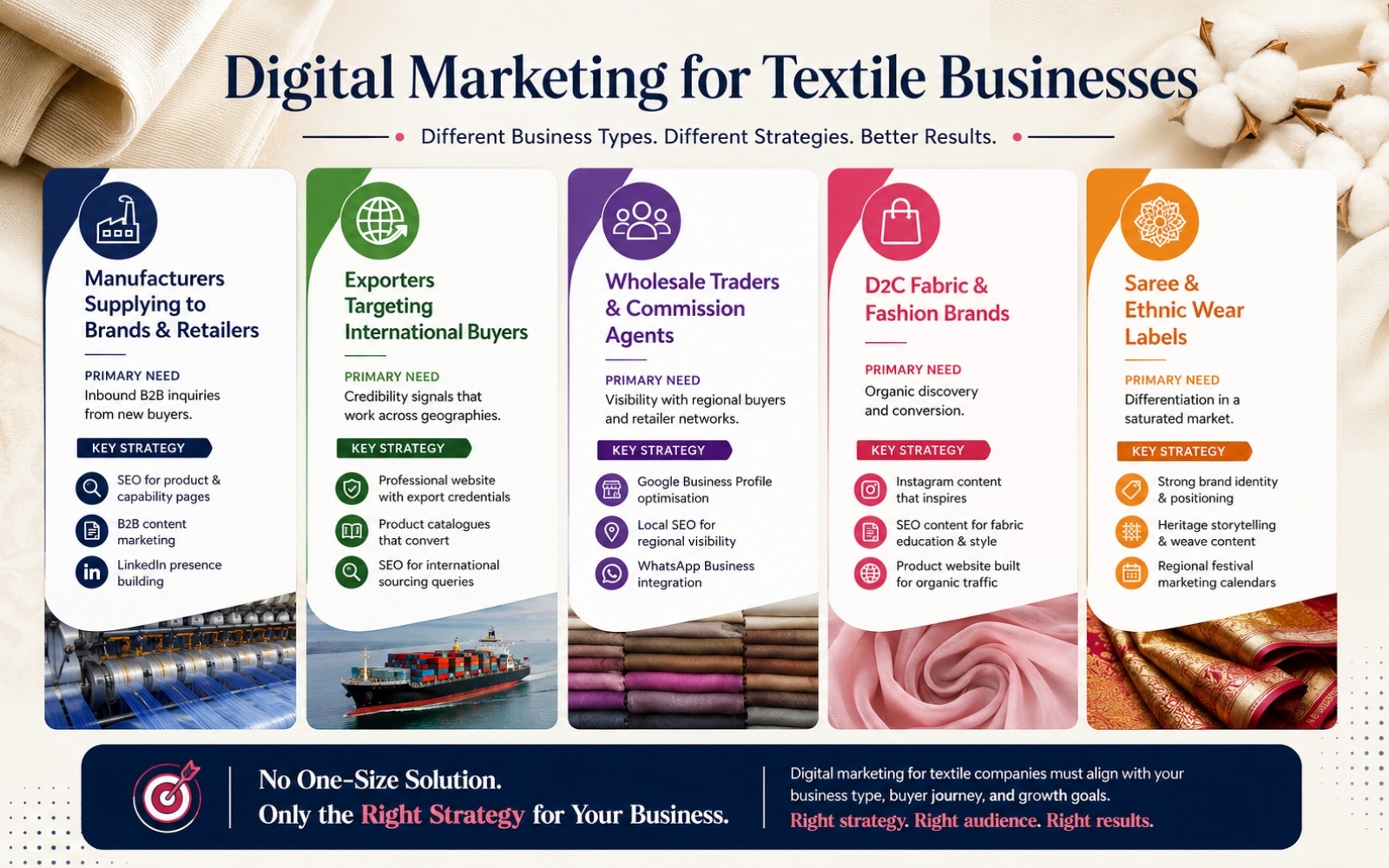
Textile Digital Marketing for Specific Business Types: A Quick Map
Manufacturers Supplying to Brands and Retailers
Primary need: Inbound B2B inquiries from new buyers. Strategy centres on SEO for product and capability pages, B2B content marketing, and LinkedIn presence building.
Our B2B SEO company services specifically address this buyer type, procurement managers and sourcing consultants who use search engines to build vendor shortlists.
Exporters Targeting International Buyers
Primary need: Credibility signals that work across geographies. Strategy centres on a professional website with export credentials, product catalogues, and SEO targeting international sourcing queries.
Wholesale Traders and Commission Agents
Primary need: Visibility with regional buyers and retailer networks. Strategy centres on Google Business profile optimisation, local SEO, and WhatsApp Business integration.
D2C Fabric and Fashion Brands
Primary need: Organic discovery and conversion. Strategy centres on Instagram content, SEO content for fabric education and style guidance, and a product website built for organic traffic.
Saree and Ethnic Wear Labels
Primary need: Differentiation in a saturated market. Strategy centres on brand identity, heritage storytelling, weave-specific content, and regional festival marketing calendars.
The approach to digital marketing for textile companies is fundamentally different for each of these profiles. A single-size solution does not exist in this industry. The businesses that have found digital marketing disappointing have usually encountered agencies applying the wrong framework to their specific business type.
The Practical First Steps for a Textile Business Starting Digital Marketing
The question most textile business owners arrive at is: where do we start?
The answer depends on where the most immediate revenue opportunity lies. For most textile manufacturers and exporters, the sequence is:
- A website audit to understand what your current site communicates and what it fails to communicate to a professional buyer
- Keyword research to identify which specific searches your target buyers run and where your business currently has zero visibility
- SEO foundation work on your primary product and capability pages before any content production begins
- Google Business profile setup and optimisation for local and regional B2B visibility
- Content strategy that maps to your actual buyer journey rather than generic industry topics
- Social presence built on the platform where your buyers actually spend time. LinkedIn for B2B, Instagram for D2C
Our brand logo and identity framework is a useful starting point for businesses that have no clear visual identity, because SEO and social media built on a weak brand foundation produce inconsistent results.
For textile businesses specifically, the SEO and content investment has a longer payoff curve than paid advertising. The returns are durable. A manufacturer that ranks on Page 1 for their core product categories receives buyer inquiries every month without ongoing spend. That asset compounds.
Technical Textiles, Home Textiles, and Industrial Fabrics: Segments with Almost Zero Digital Presence
The conversation around digital marketing for textile companies tends to cluster around apparel and fashion. The segments that are almost entirely absent from digital visibility are technical textiles, home textiles, and industrial fabric manufacturing.
These are high-value B2B segments where buyers are actively searching and finding very little. A manufacturer of coated fabrics for automotive interiors, a producer of medical-grade nonwovens, a supplier of geo-textiles for infrastructure projects, or a manufacturer of blackout fabrics for the hospitality industry is serving buyers who run very specific technical searches. The search competition in these segments is thin because very few suppliers have any digital presence at all.
Home textiles specifically represent a large missed opportunity for Surat-based manufacturers. Suppliers of bedding fabrics, curtain materials, and upholstery textiles to brands and retailers across India and internationally are discoverable online today through almost no structured digital presence. A manufacturer with a properly built product website and basic SEO can rank for category searches within months because the competitive bar is so low.
What the Digital Stack Looks Like for These Segments
- Technical specification pages built around the exact terminology buyers use in procurement searches
- Certification and compliance content that demonstrates quality standards without requiring a buyer to request documentation manually
- Application-specific landing pages covering end uses such as medical, automotive, agricultural, or hospitality
- A credible LinkedIn company page that reaches procurement professionals in these verticals
Textile industry marketing in these segments requires a manufacturer who is willing to build the digital infrastructure before their competitors realise the opportunity exists. The businesses that move first in technical textiles digital marketing will hold positions that are very difficult to displace once the category becomes competitive.
If your business operates in any of these segments, our B2B SEO services approach covers the full specification-led content and keyword architecture that procurement buyers in these verticals actually respond to.
Questions Textile Businesses Ask Us Before Starting
We already get orders through referrals. Why do we need digital marketing?
Referrals work until they stop. Buyers retire, shift suppliers, or reduce order volumes. A business with no digital presence has no mechanism to replace that pipeline. Digital marketing builds a second acquisition channel that runs independently of your existing relationships. The businesses that build it while referrals are strong are in a far better position than those who start after the pipeline has already shrunk.
How long does SEO take to show results for a textile business?
For a textile manufacturer with a properly structured website and consistent SEO work, initial ranking movement typically appears within three to four months. Consistent first-page visibility for competitive product searches takes six to nine months. The timeline depends on how established your domain is, how competitive the specific keywords are, and whether the foundational technical work on the site is in order before content work begins.
We tried running Google Ads before and got no results. What was wrong?
Google Ads without a landing page built for conversion is money spent on clicks that exit immediately. Most failed ad campaigns in the textile space have the same structure: a correctly targeted ad that sends traffic to a generic homepage with no product-specific content and no clear call to action. The ad is fine. The destination fails the buyer. Fixing this requires a purpose-built landing page before any ad spend resumes.
Is digital marketing relevant for B2B textile businesses or only for consumer brands?
B2B textile businesses arguably have more to gain from digital marketing than consumer brands. A procurement manager searching for a specific fabric supplier is a high-intent buyer with real volume behind the search. Ranking for those searches puts you in front of buyers at exactly the moment they are ready to shortlist vendors. Consumer marketing works on volume and emotion. B2B digital marketing works on precision and credibility.
What is the difference between SEO and running paid ads for a textile business?
Paid ads generate traffic immediately and stop the moment you stop paying. SEO builds rankings that generate traffic continuously without ongoing spend per click. For textile manufacturers with long buyer relationships and recurring orders, SEO is the higher-value investment because the cost per inquiry reduces over time. Paid ads are useful for specific campaigns, new product launches, or situations where immediate visibility is the priority.
We are based in Surat. Can digital marketing help us reach buyers outside Gujarat?
Surat-based manufacturers are already supplying buyers in Mumbai, Delhi, Tirupur, Jaipur, and Kolkata through referral and trade fair networks. Digital marketing extends that reach to buyers in cities and countries who would never reach you through existing channels. A grey fabric manufacturer in Surat ranking for product searches run by buyers in Bangladesh or Vietnam is entering markets that personal networks alone cannot open. Our B2B SEO company work for manufacturers in Surat is specifically built around this geographic expansion objective.
How much should a textile business budget for digital marketing?
The right budget depends on the specific objective. SEO and content work for a manufacturer looking to build inbound inquiry pipeline starts at a level appropriate for the competitive intensity of their product category. Businesses with no existing digital infrastructure need to factor in website restructuring before SEO begins. The clearest way to assess the right budget is to start with the value of a single new buyer relationship and work backwards from there.
The Textile Industry Is Moving Online. The Question Is Whether You Move With It.
The textile industry operates on relationships, quality, and reliability. None of those things change with digital marketing. What changes is who gets to be in the room when new relationships begin.
Buyers search. Buyers research. Buyers shortlist based on what they find digitally before they make a single phone call. Textile businesses that have built a credible online presence are already in that shortlist. Businesses that have not built that presence are invisible at the most important stage of the buyer journey.
Digital marketing for textile companies is about earning the chance to have those conversations by being found, by appearing credible, and by communicating capability clearly before any direct contact happens.
The textile industry Surat is sitting on one of the largest untapped digital opportunities in Indian B2B commerce. The commercial volume is enormous. The digital competition is thin. The window to establish a strong position is open right now.
The Subtext works with textile manufacturers, exporters, and D2C fabric brands to build the digital infrastructure that generates real commercial outcomes. If you want to understand what a focused digital strategy would look like for your specific business in this industry, reach out at hello@thesubtext.in or call +91 95125 35512.